
ESA mulls seriously over development of space-based solar power plant; seeks funding
ESA is planning to develop its space-based solar power plant, Solaris which would convert sunlight into microwaves and beam them to Earth for electricity needs.
- Science News
- 3 min read


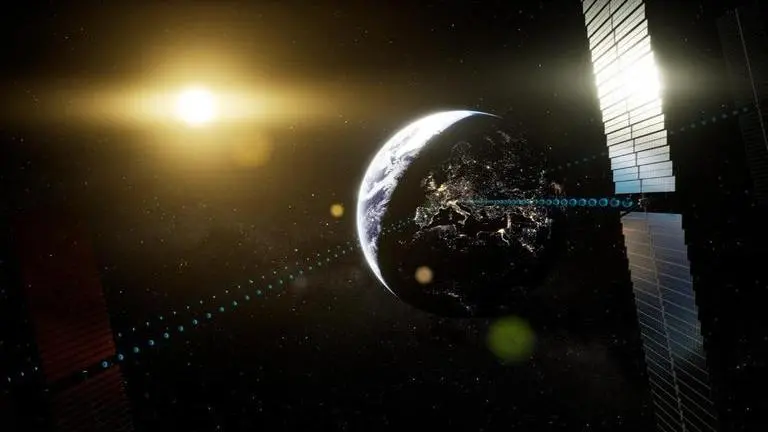
The European Space Agency (ESA) is planning to meet its energy needs through a space-based solar power (SBSP) plant and is making significant efforts for its installation. Recently, ESA’s Director General, Josef Aschbacher revealed that he would seek funding from its member states for an SBSP preparatory program to test the feasibility and potential of the facility.
“We have the main building blocks already, but let me be clear: for the project to succeed, much technology development and funding is still needed”, Aschbacher wrote in a tweet last week.
At #CM22, I will propose a SBSP preparatory programme to Member States called #SOLARIS. We have the main building blocks already, but let me be clear: for the project to succeed, much technology development and funding is still needed. https://t.co/iBbByzJDLB pic.twitter.com/raqf9ZcRht
— Josef Aschbacher (@AschbacherJosef) August 16, 2022
Aschbacher’s proposal would actually seek funding for a few studies that would provide ESA and its Member States with the necessary technical and programmatic information regarding the SBSP. He, however, did not clarify the amount needed to fund those studies.
Named Solaris, the SBSP development program has been conceptualised to provide Europe with environmentally sustainable, affordable and clean energy for its growing energy needs and achieve its net-zero carbon emission goal by 2050. Under this program, ESA will install satellites equipped with huge solar arrays at an altitude of 36,000 kilometers and the sunlight hitting these arrays would be directed to Earth for their conversion to electricity.
Advertisement
The concept of SBSP
The idea of developing a space-based solar plant is inspired by the fact that the intensity of sunlight is much higher in the low-Earth orbit than on the surface. According to ESA, the sunlight received by the solar arrays of the satellites will first be converted into current via photovoltaic cells in a geostationary orbit. In the next step, this current would be converted into microwaves at 2.45 GHz and beamed to ‘rectennas’, dedicated receivers on Earth. These receivers will further convert the microwaves into electricity and feed it into the local grid.
Space-based Solar Power would be an important step towards carbon neutrality and energy independence for Europe. Two recent independent studies strongly recommend investments to advance the SBSP technologies needed to address our growing energy crisis: https://t.co/aQImYF3fyN pic.twitter.com/VJ8z5lCLnp
— Josef Aschbacher (@AschbacherJosef) August 16, 2022
The agency says that since the power can be transferred wirelessly, the satellites can even beam the microwaves to receivers installed on the Moon or other planets and advance our exploration. If successfully developed, the solar power plant would generate around 2 gigawatts of electricity powering over ten lakh houses. The same amount of power would require over sixty lakh solar panels on Earth, says ESA.
Advertisement
Challenges around launching the SBSP
ESA says that a decision over the development of the solar power plant would be made by 2025, however, it also listed a few challenges. The first is the scale of the plant which would include massive satellites entailing a mammoth task of their launch. "A single solar power satellite at geostationary orbit might extend more than a kilometre across, with the receiver station on the ground needing a footprint more than ten times larger", the agency said in a statement.
Since the plant would weigh a thousand more tonnes than the International Space Station (ISS), the developers are also concerned about the order of magnitude of launches. However, ESA underscored that the worldwide launch costs are on a decline which might make the plant's construction feasible.