
Jupiter-like protoplanet found embedded in cosmic womb in new NASA picture; See
NASA's Hubble space telescope has produced a direct photograph of a Jupiter-like protoplanet embedded in a protoplanetary dusty disk around 2 million years old.
- Science News
- 3 min read

;'%3e%3cpath%20d='m8,15.99c4.41,0,7.99-3.58,7.99-7.99S12.41,0,8,0,0,3.59,0,8s3.58,7.99,7.99,7.99Z'%20style='stroke:%23fff;%20stroke-miterlimit:10;%20stroke-width:.02px;'/%3e%3cpath%20d='m3.08,3.37l3.82,5.11-3.84,4.15h.87l3.37-3.64,2.72,3.64h2.94l-4.04-5.39,3.58-3.87h-.86l-3.1,3.35-2.5-3.35h-2.94Zm1.27.64h1.35l5.97,7.99h-1.35l-5.97-7.99Z'%20style='fill:%23fff;'/%3e%3c/g%3e%3c/svg%3e)


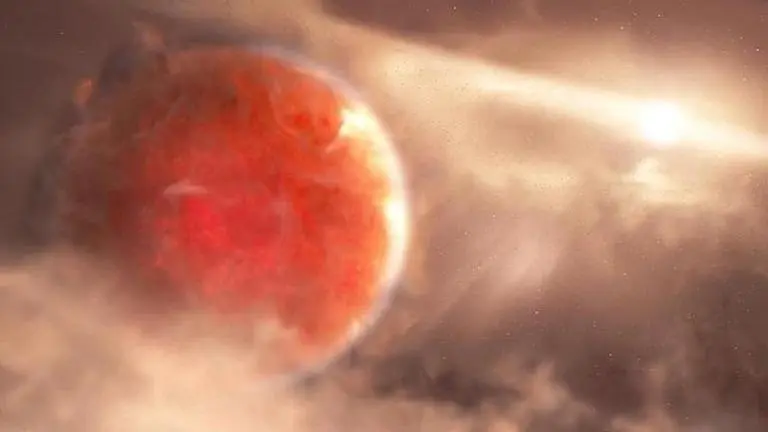
In a major advancement towards uncovering secrets regarding planet formation, NASA's Hubble space telescope has produced a direct photograph of a Jupiter-like protoplanet taking its form. NASA states that the protoplanet named AB Aurigae b is undergoing an "intense and violent process" and that this discovery would settle the long-debated theory on how planets like Jupiter form- the "disc instability" process.
Embedded in the womb of a protoplanetary disk abundant in dust and gas, the protoplanet is already about nine times more massive than Jupiter. Initially sceptical of the cosmic entity being a planet, scientists confirmed its existence as the vast disk of dust and gas swirling around the star AB Aurigae was found tilted nearly face-on to the Earth's view.
.@NASAHubble has photographed evidence of a Jupiter-like protoplanet – a planet in the making. Estimated to be nine times more massive than Jupiter, its discovery supports a long-debated theory of how planets form: https://t.co/4Y55T1Szv1 pic.twitter.com/e38gPIr34l
— NASA (@NASA) April 4, 2022

(Image: NASA)
More about the 'under-construction' world
This remarkably young planet came to light after scientists combined data from the Hubble telescope with the Subaru Telescope located at the summit of Mauna Kea, Hawaii. This protoplanet, which is the term for a developing planet, is gaining size through a process called "disk instability". NASA explains that this is the process wherein a massive disk around a star cools, and gravity causes it to rapidly break up into one or more planet-mass fragments. Interestingly, the dusty disk with a distinct spiral structure swirling around surrounding a young star is estimated to be around 2 million years old, which is the same age as our solar system when planet formation started.
Advertisement
What's more, is that this Jupiter-like world orbits its star from a distance of 8.6 billion miles, which is over two times farther than Pluto is from the Sun. Scientists believe that owing to such a massive distance, even a Jupiter-sized planet cannot form through core accretion. The core accretion is a process that occurs when planets embedded in the disk grow from small objects, having sizes ranging from dust grains to boulders, collide and stick together as they orbit a star. This made the scientists conclude that this new protoplanet formed through "disk instability".
Lead researcher of the study, Thayne Currie said as per NASA's statement, "Nature is clever; it can produce planets in a range of different ways". Further reflecting on planet formation, Alan Boss of the Carnegie Institution of Science added, "This new discovery is strong evidence that some gas giant planets can form by the disk instability mechanism. In the end, gravity is all that counts, as the leftovers of the star-formation process will end up being pulled together by gravity to form planets, one way or the other".