
Updated 15 August 2022 at 20:58 IST
NASA moves roll out of SLS rocket 3 days ahead of schedule; Artemis I launch on for Aug 29
NASA announced that its SLS rocket will now be rolled out to the launch pad on 9 p.m. EDT on Tuesday, August 16 (6:30 am IST, Aug 17) instead of August 19.
- Science News
- 3 min read

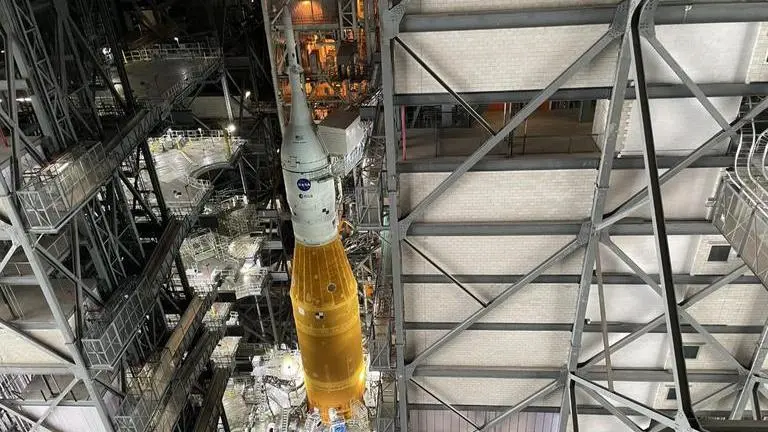
NASA, on Monday, announced that it has moved the scheduled rollout of the Space Launch System (SLS) rocket to the launch pad three days before the targeted date. The new rocket will now be hauled from the Vehicle Assembly Building (VAB) to the Launch Complex 39B at the Kennedy Space Center on August 16.
.@NASA is targeting as soon as 9 pm EDT of Tuesday, Aug. 16 for rollout of @NASA_SLS ahead of a targeted Aug. 29 #Artemis I launch.
— NASA's Kennedy Space Center (@NASAKennedy) August 15, 2022
Learn more: https://t.co/LYm5uWKDoJ pic.twitter.com/HjFeH1h4RF
“Engineers and technicians at NASA’s Kennedy Space Center in Florida have completed the final testing and checkouts of the Artemis I Moon rocket ahead of rolling to Launch Pad 39B”, the agency said in its update. “NASA is targeting as soon as 9 p.m. EDT of Tuesday, Aug. 16 (6:30 am IST, Aug 17) for rollout ahead of a targeted Aug. 29 launch”.
This news comes as a confirmation that the mission teams are on course for launching the SLS rocket under the Artemis I mission on the targeted date of August 29. As per the existing plans, the launch window on the said date opens at 6:03 pm IST and backup dates are available on September 2 and September 6.
"Over the weekend the team completed testing of the flight termination system, which marked the final major activity prior to closing out the rocket and retracting the final access platforms in the VAB", the agency further said in its statement. The Flight Termination System (FTS) is something all rockets are required to have in case the flight of the launch vehicle needs to be terminated.
Advertisement
Earlier on August 13, NASA’s Associate Administrator for Exploration Systems Development, Jim Free revealed that all work platforms surrounding the integrated SLS rocket and the Orion spacecraft have been removed, clearing the launch vehicle's path to the launch pad.
Nearly all the work platforms have been retracted that surround @NASA_SLS and @NASA_Orion as @NASAGroundSys makes the final preparations to the integrated #Artemis I stack ahead of a targeted roll-out on August 18. More of the progress on the blog: https://t.co/7BPfRUvcfH pic.twitter.com/1Z9XL5SNH1
— Jim Free (@JimFree) August 12, 2022
Artemis I launch
If the launch is carried out on August 29, the SLS rocket will send the Orion spacecraft on a test flight to the Moon. Following the launch, the Orion spacecraft, which has been developed at a cost of $20.4 billion, as per Gizmodo, will travel a total distance of 2.1 million kilometers during the mission which would last a few weeks. Once the mission is completed, Orion will re-enter the Earth's atmosphere and splash down in the Pacific Ocean on October 10.
Advertisement
During this test run, NASA teams would monitor Orion's overall performance right from the launch to reentry and splashdown. The monitoring will be carried out to confirm Orion's durability as the same spacecraft will be used when astronauts launch to the Moon later this decade.
This is why NASA has strapped three mannequins inside the spacecraft to gather data on the effects of outer space during lunar launch and Orion's capabilities to protect the astronauts from harmful radiation. A special CubeSat named BioSentinel is also hitching a ride aboard Orion and it will be used by scientists to measure the effects of outer space on microbial life. Read more about it here. Notably, as many as eight CubeSats are being launched aboard Orion and each of them has a different objective.
Published By : Harsh Vardhan
Published On: 15 August 2022 at 20:58 IST