
NASA planning to send scientists to work alongside astronauts in space: Report
NASA is planning to send “hyper-specialised” scientists to the International Space Station to carry out experiments alongside the astronauts.
- Science News
- 3 min read

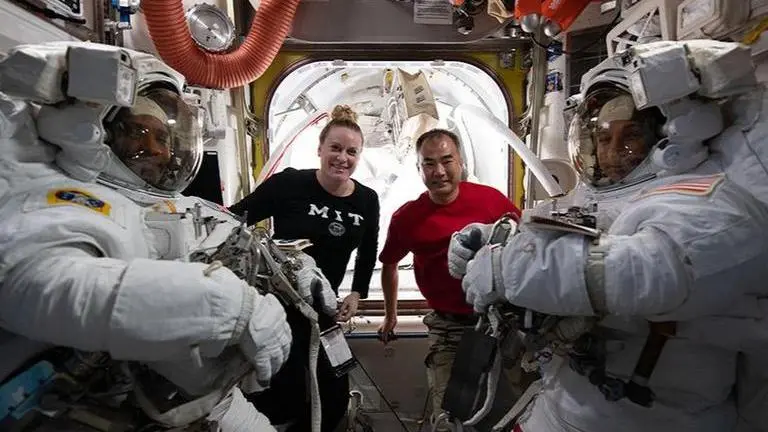
NASA is seeking funding to send scientists to the International Space Station (ISS) who could work alongside astronauts in micro-gravity. According to a report by Space News, the agency has plans to secure funds in the fiscal year 2023 for a programme that would allow “hyper-specialized” scientists to carry out research in space and hand them out to the astronauts later.
This idea was pitched during a meeting of a National Academies Committee, working on the decadal survey for biological and physical sciences research in space, last week. This division received funding of $82.5 million in the last fiscal year and is seeking $100.4 million for 2023.
NASA proposes CERISS initiative
The scientists will be sent to outer space under the initiative which has been named Commercially Enabled Rapid Space Science, or CERISS. "We seek to bring scientists back into space", Craig Kundrot, director of NASA’s biological and physical sciences division, said as per Space News. Notably, this initiative is similar to the space shuttle missions wherein non-career astronauts flew to the low-Earth orbit (LEO) for research missions in the 1980s.
Kundrot, however, emphasised that NASA is envisioning a different version than the shuttle missions as the space industry has gone private. “We seek to use that to fly hyper-specialised scientists to do research in LEO that is really very hard for even the most closely trained astronaut in that field to do," he added.
Advertisement
In the early stages of this initiative, the private companies will be asked what research they are developing for use in the LEO through requests for information (RFIs). NASA would also seek answers on the areas the said research would benefit if the scientists themselves flew to the space station. Currently, NASA's commercialisation policy allows two private astronaut missions (PAM) in a year for up to 30 days.
Kundrot said that the agency might send scientists to work with the astronauts under a "buddy system", wherein the latter would continue the experiment after the former leaves. It is no secret, that the LEO is gradually turning commercial thanks to the private space missions and the private space stations targeted for launch later this decade. Earlier this year, we saw non-career astronauts visit the International Space Station during the Axiom-1 mission, wherein four astronauts spent around two weeks conducting experiments in micro-gravity.
Advertisement
Besides, Axiom Space, along with companies such as Blue Origin, is developing private space habitats that would replace the ISS and act as a stand-alone research centre and habitat in space.