
NASA records intense 1-in-10,000 year Gamma ray burst, the brightest of all time
NASA scientists have revealed that the intense gamma ray burst was 70 times brighter than any such event ever documented and is 1-in-10,000 year event.
- Science News
- 3 min read

;'%3e%3cpath%20d='m8,15.99c4.41,0,7.99-3.58,7.99-7.99S12.41,0,8,0,0,3.59,0,8s3.58,7.99,7.99,7.99Z'%20style='stroke:%23fff;%20stroke-miterlimit:10;%20stroke-width:.02px;'/%3e%3cpath%20d='m3.08,3.37l3.82,5.11-3.84,4.15h.87l3.37-3.64,2.72,3.64h2.94l-4.04-5.39,3.58-3.87h-.86l-3.1,3.35-2.5-3.35h-2.94Zm1.27.64h1.35l5.97,7.99h-1.35l-5.97-7.99Z'%20style='fill:%23fff;'/%3e%3c/g%3e%3c/svg%3e)


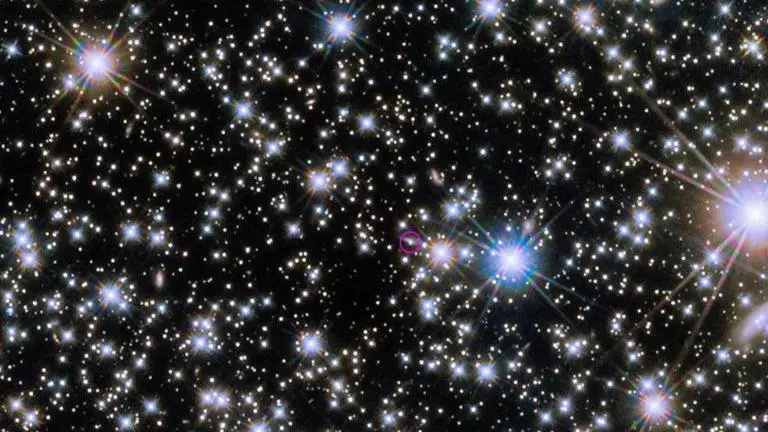
NASA scientists are currently studying the intense pulse of radiation that swept through our solar system late last year. This radiation that was recorded on October 9, 2022, resulted from a Gamma-ray burst (GRB) which is the most powerful class of explosion in the universe. It was so intense that detectors of several probes in space and observatories on Earth became active and collectively proved that this was the brightest of all time.
Most intense explosion shocks astronomers
A pulse of intense radiation swept through our solar system that astronomers called the BOAT: the brightest of all time.
— Hubble (@NASAHubble) March 28, 2023
Several @NASA missions, including Hubble, have followed up to study this gamma-ray burst, likely caused by the birth of a black hole: https://t.co/zCPiiamLL8 pic.twitter.com/xSRRLzD0dy
NASA says that the intensity of the GRB initially blinded most of the gamma-ray instruments in space which is why they could not directly observe the emission. Scientists from Russia, China and the US then pooled their data and it was revealed that the explosion was 70 times brighter than any such thing documented before. The explosion was so strong that the radiation reached the Voyager 1 spacecraft, which has crossed the solar system and is currently in interstellar space.
Scientists have concluded that the signal from the GRB 221009A had been travelling for about 1.9 billion years before it reached Earth making it one of the closest-known “long” GRBs. Investigating the causes of this radiation, the experts said that they might have emerged after a star collapsed under its weight and transformed into a black hole. However, they are currently looking for a supernova and are using the Hubble telescope and the Webb telescope for the purpose. “If it’s there, it’s very faint. We plan to keep looking,” said Andrew Levan, a professor of astrophysics at Radboud University in an official statement. “But it’s possible the entire star collapsed straight into the black hole instead of exploding (that means no supernova).”

(Radiation emission from a black hole; Image: NASA)
Advertisement
NASA explains that the radiation emanating from a black hole later expands into an afterglow constituting lights of different wavelengths. “Twenty-five years of afterglow models that have worked very well cannot completely explain this jet (of radiation),” Kate Alexander, University of Arizona professor said. What's more, is that the GRB 221009A is only the seventh gamma-ray burst to display X-ray rings (in the afterglow), 21 to be exact. This is triple the number seen earlier and the dust were carried from 700 and 61,000 light-years away. The study has not stopped yet as astronomers will continue to sift through the data and the radiation itself which will be detectable for a few more years.