
Updated 11 December 2022 at 15:21 IST
NASA says 'game changing' deep cosmic explosion in space rattled the scientists; Know more
On Sunday, the US space agency, NASA claimed that it witnessed a cosmic explosion that can be considered “game-changing”. The study of GRBs due to the event.
- Science News
- 3 min read

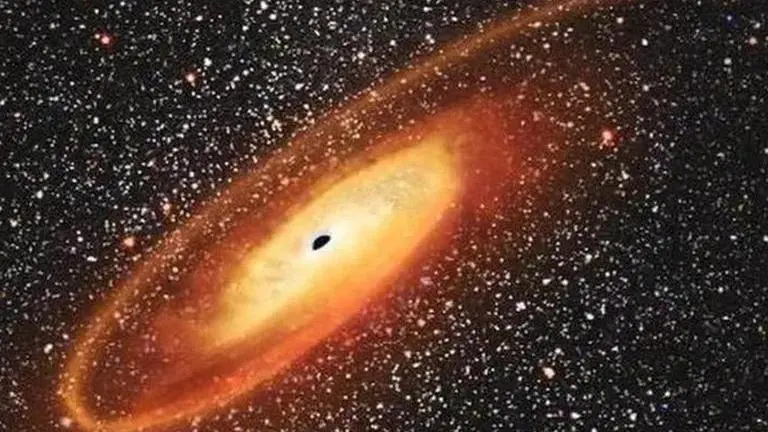
There are many marvels of the universe that are yet to be unfolded, however, the endeavors of numerous space scientists around the world, never fail to disappoint. On Sunday, the US space agency, NASA said that it witnessed a cosmic explosion that can be considered “game-changing”. On December 11, NASA in a statement stated that NASA’s Neil Gehrels Swift Observatory and Fermi Gamma-ray Space Telescope have detected “high-energy light,” one Billion light-years away. It further informed that “high-energy light” emerged from a massive explosion caused by the collision of two neutron stars and has the potential to change the game for the scientists who are working to understand gamma-ray bursts (GRBs).
According to NASA, earlier scientist divided the GRBs, which is doubted to be the most powerful events in the universe into two categories. The first category called the “Long Bursts” used to emit gamma rays after the emergence of “dense objects like” black holes at the center of the coalition between two massive stars. The emission of gamma rays in this case lasts for more than two seconds. The second category belongs to the “Short Bursts” which emits gamma rays for two second or less. The short bursts occur after two dense objects like neutron stars merge.
The explosion make scientists rethink how black holes are formed
What makes the recent explosion extraordinary is the fact that NASA believes that the long-duration burst happened after the coalition of neutron stars. Speaking more on the rarest of the rare event, a graduate student from Northwestern University in Evanston Illinois, Jillian Rastinejad said, “This burst, named GRB 211211A, was paradigm-shifting as it is the first long-duration gamma-ray burst traced to a neutron star merger origin.” Rastinejad then went on to explain how this event has implications for how scientists understand the emergence of heavy elements in the Universe, adding that “The high-energy burst lasted about a minute, and our follow-up observations led to the identification of a kilonova. This discovery has deep implications for how the universe’s heavy elements came to be."
According to NASA, Femi and Swift detected bursts simultaneously. The US space agency also claimed that it was the Swift that manage to rapidly identify the location of the event in the constellation Boots. The rapidness of the Swift enabled the scientist to conduct the follow-up observations quickly. Speaking more on the matter, Eleonora Troja, an astrophysicist at the University of Rome claimed, “Many years ago, Neil Gehrels, an astrophysicist, and Swift’s namesake, suggested that neutron star mergers could produce some long bursts,” and added that “the kilonova we observed is the proof that connects mergers to these long-duration events, forcing us to rethink how black holes are formed.”
Advertisement
Published By : Bhagyasree Sengupta
Published On: 11 December 2022 at 15:21 IST