
NASA taps Rocket Lab to launch remaining weather satellites after Astra's failed mission
NASA has announced the selection of US firm Rocket Lab to launch four of its weather satellites after it lost two satellites in a failed launch by Astra.
- Science News
- 2 min read

;'%3e%3cpath%20d='m8,15.99c4.41,0,7.99-3.58,7.99-7.99S12.41,0,8,0,0,3.59,0,8s3.58,7.99,7.99,7.99Z'%20style='stroke:%23fff;%20stroke-miterlimit:10;%20stroke-width:.02px;'/%3e%3cpath%20d='m3.08,3.37l3.82,5.11-3.84,4.15h.87l3.37-3.64,2.72,3.64h2.94l-4.04-5.39,3.58-3.87h-.86l-3.1,3.35-2.5-3.35h-2.94Zm1.27.64h1.35l5.97,7.99h-1.35l-5.97-7.99Z'%20style='fill:%23fff;'/%3e%3c/g%3e%3c/svg%3e)


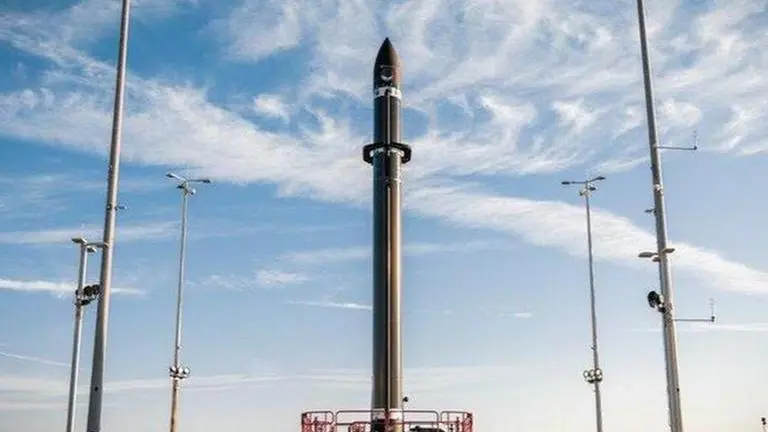
NASA has announced the selection of US firm Rocket Lab to launch four of its weather satellites as part of the agency's Venture-class Acquisition of Dedicated and Rideshare (VADR) launch services contract. This contract involves launching the Time-Resolved Observations of Precipitation Structure and Storm Intensity with a Constellation of Smallsats (TROPICS) satellites that will be installed in two low-Earth orbital planes.
🛰🚀#TROPICS UPDATE: @NASA picks @RocketLab to launch four #CubeSats to study tropical cyclones. Launch is targeted NET May 2023 on the #Electron rocket.https://t.co/ip0zT1CvaH
— NASA's Launch Services Program (@NASA_LSP) November 23, 2022
Originally there were six TROPICS satellites, however, two were lost after another launch providing company Astra’s mission failed in June. Investigations into the failure revealed that the second stage engine of Astra’s Rocket 3.3 vehicle, designated LV0010, shut down prematurely, about four minutes into five minutes and 15 seconds planned burn to reach orbit. After the mission failure, the satellites fell into the ocean.
Looks like they lost it late into the upper stage burn. pic.twitter.com/81xhMyTzfZ
— Chris Bergin - NSF (@NASASpaceflight) June 12, 2022
According to SpaceNews’ report, NASA revised its contract with Astra after the company decided to retire the Rocket 3.3 and move on to develop the Rocket 4 that will be used to launch “comparable scientific payloads” no earlier than 2023. As for Rocket Lab, it has been chosen to launch the satellites in two dedicated missions on its Electron rocket and the two missions are scheduled to launch no earlier than May 1, 2023, as the Atlantic Hurricane season starts from June 1. While NASA did not reveal the launch locations, Rocket Lab said it would use Launch Complex (LC) 2 at Wallops Island in Virginia, per SpaceNews.
"The TROPICS constellation targets the formation and evolution of tropical cyclones, including hurricanes and will provide rapidly updating observations of storm intensity, as well as the horizontal and vertical structures of temperature and humidity within the storms and in their surrounding environment," NASA explained in its statement. "These data will help scientists better understand the processes that affect these high-impact storms, ultimately leading to improved modeling and prediction." The agency said that Rocket Lab is one of the 13 companies that have been selected under the VADR contract which has a maximum total value of $300 million.