
NASA's new Webb telescope image shows 'lonely' dwarf galaxy; Here's what it means
In one of a kind discovery, NASA’s James Webb Space Telescope has snapped a remarkable image of a ‘lonely’ dwarf galaxy in striking detail.
- Science News
- 2 min read

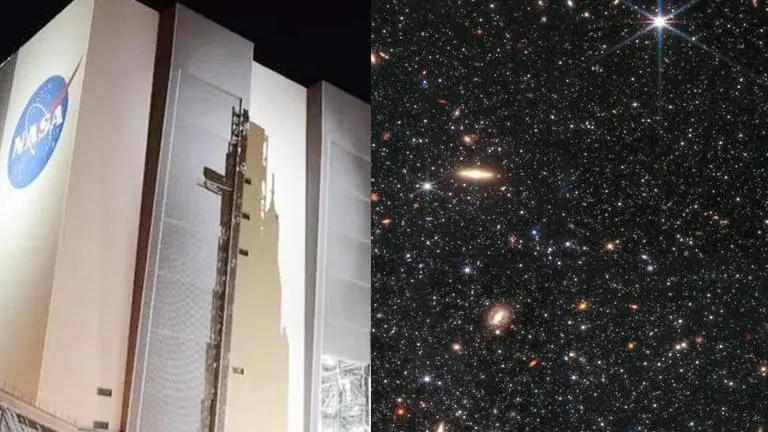
In a one-of-a-kind discovery, NASA’s James Webb Space Telescope has snapped a remarkable image of a ‘lonely’ dwarf galaxy in striking detail. The galaxy called WLM is a dwarf galaxy in the galactic neighbourhood of the Milky Way. In a Blog released by NASA on 9th November, Kristen McQuinn of Rutgers University asserted that the galaxy is about “3 million light-years away from Earth”.
Speaking on the clarity of the image the new Webb Telescope provided, the official Twitter account of the NASA Webb Telescope, tweeted: “In this comparison of Spitzer, Hubble and Webb views, respectively, check out how Webb’s NIRCam instrument “makes the whole place shimmer” — with an assortment of stars, clouds of gas, and background galaxies.”
This galaxy polishes up real nice. 💎
— NASA Webb Telescope (@NASAWebb) November 9, 2022
In this comparison of Spitzer, Hubble and Webb views, respectively, check out how Webb’s NIRCam instrument “makes the whole place shimmer” — with an assortment of stars, clouds of gas, and background galaxies. pic.twitter.com/sHrdonO7ZN
Proving their point, they shared a side-by-side comparison of the image of the dwarf galaxy captured by the Webb Telescope and the one captured by the Splitzer. Commenting on the remarkable clarity of the Webb telescope, the team wrote, “How it started - How it’s going These images demonstrate Webb’s remarkable ability to resolve faint stars in nearby dwarf galaxy Wolf-Lundmark-Melotte (WLM). On the right is Webb’s brand new image, and on the left is Spitzer’s view”
How it started ➡️ How it’s going
— NASA Webb Telescope (@NASAWebb) November 9, 2022
These images demonstrate Webb’s remarkable ability to resolve faint stars in nearby dwarf galaxy Wolf-Lundmark-Melotte (WLM). On the right is Webb’s brand new image, and on the left is Spitzer’s view: https://t.co/ha4Wv7cBJK pic.twitter.com/9V6ppr4hoe
What is the Dwarf galaxy WLM?
The galaxy which is in the galactic neighbourhood of the Milky Way Galaxy is relatively ‘isolated’. McQuinn asserted in the NASA blog that the isolated nature of the galaxy will make it “really nice” for testing theories of galaxy formation and evolution. Given the fact that the WLM galaxy has similar chemical makeup to early universe galaxies, it will help in the study of how stars “form and evolve in small galaxies like those in the ancient universe.”
Advertisement
According to McQuinn the main focus is to “reconstruct the star formation history of the galaxy.” Speaking further on the matter, McQuinn said, “low-mass stars (like their ages), we can gain insight into what was happening in the very distant past.” On the question of how McQuinn felt while showcasing the image captured by the Webb Telescope on the dome at a planetarium. McQuinn explained how enamoured she was looking at the clarity of the image. She said, “I could imagine that we were standing on a planet in the WLM galaxy and looking up at its night sky.”