
Updated 18 October 2020 at 18:28 IST
Russian spacecraft Venera 4 made first landing on surface of Venus on this day in 1967
A Russian unmanned spacecraft, Venera 4, for the first time ever, entered the atmosphere of Venus on this day, i.e., October 18, in 1967
- Science News
- 2 min read

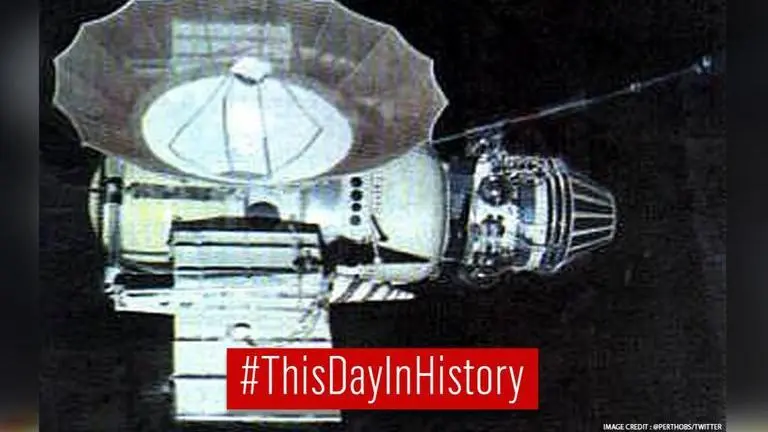
A Russian unmanned spacecraft, Venera 4, for the first time ever, entered the atmosphere of Venus on this day, i.e., October 18, in 1967. The space probe was the first to transmit data from the atmosphere of another planet. Venera 4 was launched from a Tyazheliy Sputnik on June 12, 1967, and after a mid-course correction, the probe was released from the bus and entered the nightside Venusian atmosphere on October 18, 1967.

(Image: @barefootHippieT/Twitter)
Venera 4 was the first successful probe to perform in-place analysis of the environment of another planet. It provided the first chemical analysis of the Venusian atmospheres, showing it to be primarily carbon dioxide with a few per cents of nitrogen and below one per cent of oxygen and water vapours. It became the first spacecraft to survive entry into another planet’s atmosphere and it was the first to send direct measurements proving that Venus was extremely hot. Venera 4 noted that Venus’ atmosphere was far denser than expected and that it also had lost most of its water long ago.
Mission Venera 4
The Russian space probe consisted of a 3.5-meter high main bus carrying a 383-kilogram lander probe with vital instruments encased in a pressure vessel. The spacecraft was designed to withstand high temperatures, pressures, and accelerations. The bus of Venera 4 was powered by 2.5 square meters of solar panel "wings" with a span of 4 meters.
Advertisement
Communications from the spaceship were achieved by two 922 MHz, 1 bit/sec transmitters in the DM waveband. The probe was protected by a heat-shield and carried a radar device and parachutes for the descent. It carried two thermometers, a barometer, a radio altimeter, an atmospheric density gauge, 11 gas analysers, and two radio transmitters operating in the DM waveband.
Advertisement

(Image: @perthobs/Twitter)
During the entry into the Venusian atmosphere, the probe initially braked from the bus using a thick ablative heat-shield. The capsule deployed its parachute and started sending data on pressure, temperatures and gas composition back to Earth. At the end of the descent, as the temperature and pressure increased, the signal transmission, unfortunately, terminated. Venera 4 was over the Eisila region when it succumbed to the atmospheric pressure and temperature.
Published By : Bhavya Sukheja
Published On: 18 October 2020 at 18:15 IST