
Solar wing jammed on NASA's newly-launched Lucy spacecraft en route to chase asteroids
NASA stated that the possibility of reopening the Solar wing to its extent, which is nearly 24 feet, would not happen until the mid of November.
- Science News
- 2 min read

;'%3e%3cpath%20d='m8,15.99c4.41,0,7.99-3.58,7.99-7.99S12.41,0,8,0,0,3.59,0,8s3.58,7.99,7.99,7.99Z'%20style='stroke:%23fff;%20stroke-miterlimit:10;%20stroke-width:.02px;'/%3e%3cpath%20d='m3.08,3.37l3.82,5.11-3.84,4.15h.87l3.37-3.64,2.72,3.64h2.94l-4.04-5.39,3.58-3.87h-.86l-3.1,3.35-2.5-3.35h-2.94Zm1.27.64h1.35l5.97,7.99h-1.35l-5.97-7.99Z'%20style='fill:%23fff;'/%3e%3c/g%3e%3c/svg%3e)


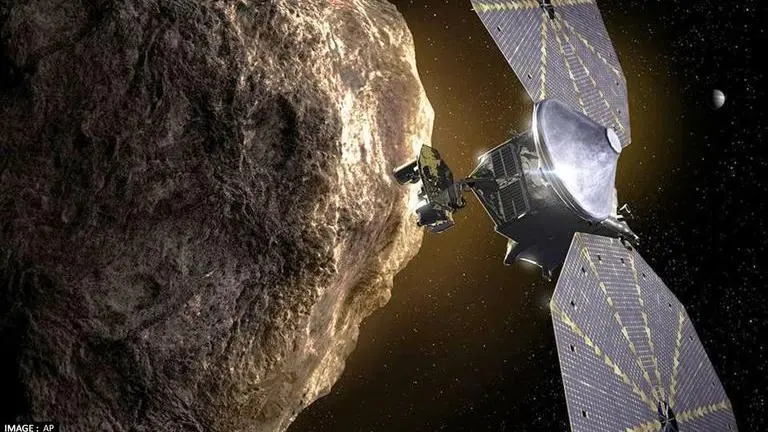
National Aeronautics and Space Administration (NASA) is currently discussing the dilemma of whether or not they should attempt to repair a clogged solar wing or panel of the newly launched Lucy spacecraft, which is on the way to examining an unprecedented number of asteroids.
NASA revealed, on Wednesday, that one of Lucy's two massive, circular solar panels is stretched between the range of 75% to 95%. This issue was witnessed just after monitoring the electric current this week.
As per the Associated Press, NASA stated that the possibility of reopening the wing to its extent, which is nearly 24 feet or 7 metres in diameter, would not happen until November.
#LucyMission Update:
— NASA Solar System (@NASASolarSystem) October 27, 2021
✅The spacecraft has successfully executed several small maneuvers
✅Analysis of electric currents show that the unfurled solar array is between 75% and 95% deployed
➡️Next: The team will decide whether and how to re-deploy the arrayhttps://t.co/s6C6uIyu7V pic.twitter.com/fsHA7zvPrM
NASA clarified the clogged solar wing issue
The officials further clarified that there is no urgency to decide on what to do next because the issue has not disrupted Lucy's outgoing travel yet. Further, they stated that all the other parts in the spaceship are appearing to be working well.
Advertisement
Lucy which launched on October 16, is already 3.7 million miles away from the earth's surface.
According to the mission's chief scientist, Hal Levison of Southwest Research Institute, the crew is optimistic about the fact that the collective power which Lucy is obtaining from both solar panels is sustaining the spaceship healthy and running.
Advertisement
Quoting Levison's statement from the main he wrote on Thursday, as reported by AP, “It's too early to determine longer range implications to the entire mission, our team is working this very diligently and carefully to find a workable solution.”
Furthermore, the Lucy project of NASA which is worth around $1 billion, aims to investigate seven Trojan asteroids that revolve around the sun in the same orbit as Jupiter. Lucy will also examine another space rock closer to Earth. Lucy is the very first mission of NASA to Jupiter's Trojan asteroids, which launched into orbit on a United Launch Alliance (ULA) Atlas V rocket from the Space Launch Complex at Cape Canaveral.
According to a NASA news release, Lucy will travel by one of the primary asteroids' belts as well as seven Trojan asteroids during the next 12 years, making it NASA's first single spacecraft trip to examine so many different asteroids. It is anticipated that Lucy would travel for encountering its first Trojan asteroid in the year 2027 before meeting Jupiter.
(Image: AP)