
Stargazers Alert! The Moon Meets Jupiter In A Stunning Sky Display Tonight
Tonight, the Moon and Jupiter will have a close celestial encounter. Through a telescope, observers can spot Jupiter's cloud bands, the Great Red Spot, and its four largest moons, with three lining up on one side.
- Science News
- 3 min read

;'%3e%3cpath%20d='m8,15.99c4.41,0,7.99-3.58,7.99-7.99S12.41,0,8,0,0,3.59,0,8s3.58,7.99,7.99,7.99Z'%20style='stroke:%23fff;%20stroke-miterlimit:10;%20stroke-width:.02px;'/%3e%3cpath%20d='m3.08,3.37l3.82,5.11-3.84,4.15h.87l3.37-3.64,2.72,3.64h2.94l-4.04-5.39,3.58-3.87h-.86l-3.1,3.35-2.5-3.35h-2.94Zm1.27.64h1.35l5.97,7.99h-1.35l-5.97-7.99Z'%20style='fill:%23fff;'/%3e%3c/g%3e%3c/svg%3e)


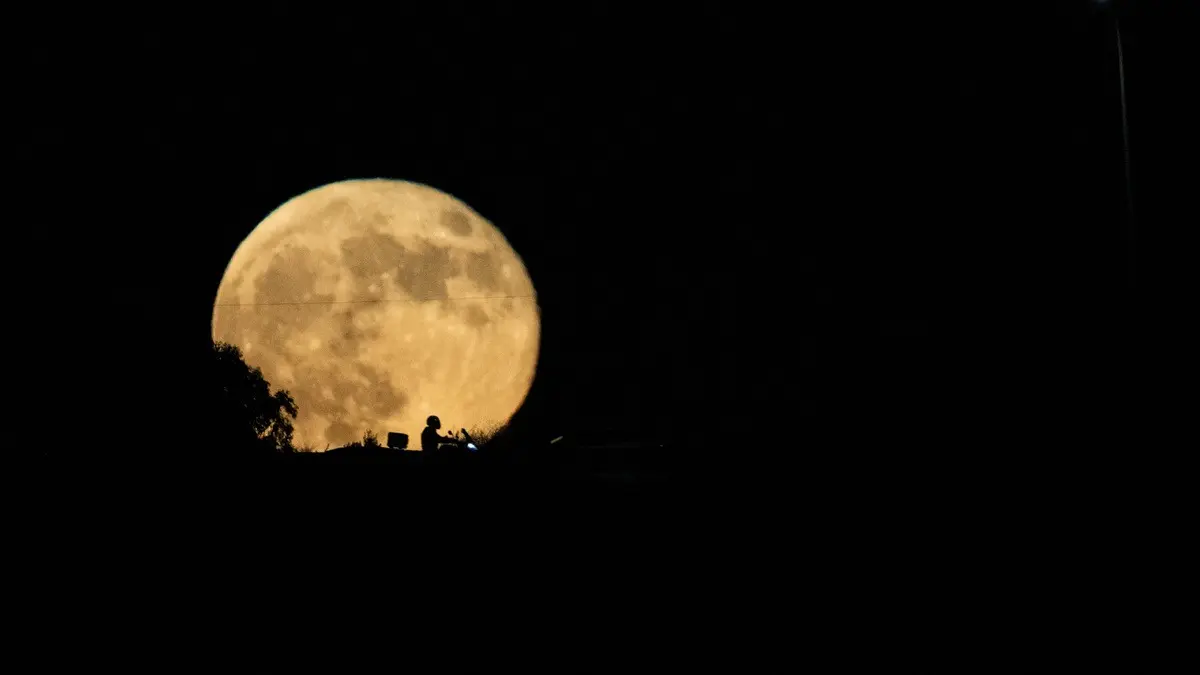
Mark your calendars, moon lovers! Tonight, the night sky tells a story of two cosmic neighbours, the Moon and Jupiter, coming together for a breathtaking display.
On October 13, the Moon and Jupiter will share the night sky in a striking celestial meetup. Just hours past its last quarter phase, the Moon will rise above the east-northeastern horizon shortly before midnight, with Jupiter glowing about six degrees to its right.
To visualise the distance between them, extend your arm and hold out a clenched fist, it measures about 10 degrees across. The Moon and Jupiter will appear separated by just over half that width. Of course, this closeness is only an illusion. The Moon lies about 235,000 miles (378,000 km) from Earth, while Jupiter sits a staggering 477 million miles (768 million km) away — more than 2,000 times farther out in space.
Best Time to Watch
For those planning to catch this celestial duo, the Moon and Jupiter will rise together in the east-northeastern sky around 11:30 to 11:40 p.m. local time on October 13. The Moon, just hours past its last quarter phase, will appear to glow softly, while Jupiter, the largest planet in our solar system, will shine brilliantly about six degrees to its right.
Advertisement
In the early stages of the night, Jupiter will hover low near the horizon, but patience will be rewarded. By around 2:30 a.m., it will have climbed roughly 30 degrees above the horizon, about one-third of the way up the sky. This is considered the ideal time for viewing, as atmospheric turbulence decreases and the planet’s features come into sharper focus through telescopes or binoculars.
This rare pairing can be enjoyed with the naked eye without a telescope. Both the Moon and Jupiter will be clearly visible, appearing as two bright celestial neighbours glowing side by side in the night sky. For an even closer look, binoculars will reveal Jupiter’s cloud bands and its four largest moons.
Advertisement
Currently, Venus remains a dazzling morning object visible only around dawn, which leaves Jupiter as the dominant planet in the late-night and predawn sky. As it rises higher, stargazers will be treated to a striking sight — the Moon glowing serenely beside the bright, steady light of Jupiter, creating a perfect moment for night photography or quiet sky watching.
Grab your telescope to see what happens because moments like these remind us just how magical our universe really is.
Through binoculars or a small telescope, Jupiter reveals a mesmerising scene — bands of clouds streaking across its atmosphere and the famous Great Red Spot, now shrinking and wobbling as it changes shape. You’ll also spot its four largest moons — Io, Europa, Ganymede, and Callisto. Late Monday into Tuesday morning, three of them (Callisto, Europa, and Io) will line up on one side of Jupiter, while Ganymede will stand alone on the other.