
Swirling, Vortex-like Patterns Observed on the Sun's Surface
Astronomers captured unprecedented high-resolution images of the sun's photosphere, revealing swirling vortex-like patterns in superheated gases similar to Vincent van Gogh's "The Starry Night." Using the Daniel K. Inouye Solar Telescope, they observed hot plasma whirls, ranging from 12 to 100 miles in diameter, providing insights into solar dynamics.
- Science News
- 4 min read

;'%3e%3cpath%20d='m8,15.99c4.41,0,7.99-3.58,7.99-7.99S12.41,0,8,0,0,3.59,0,8s3.58,7.99,7.99,7.99Z'%20style='stroke:%23fff;%20stroke-miterlimit:10;%20stroke-width:.02px;'/%3e%3cpath%20d='m3.08,3.37l3.82,5.11-3.84,4.15h.87l3.37-3.64,2.72,3.64h2.94l-4.04-5.39,3.58-3.87h-.86l-3.1,3.35-2.5-3.35h-2.94Zm1.27.64h1.35l5.97,7.99h-1.35l-5.97-7.99Z'%20style='fill:%23fff;'/%3e%3c/g%3e%3c/svg%3e)


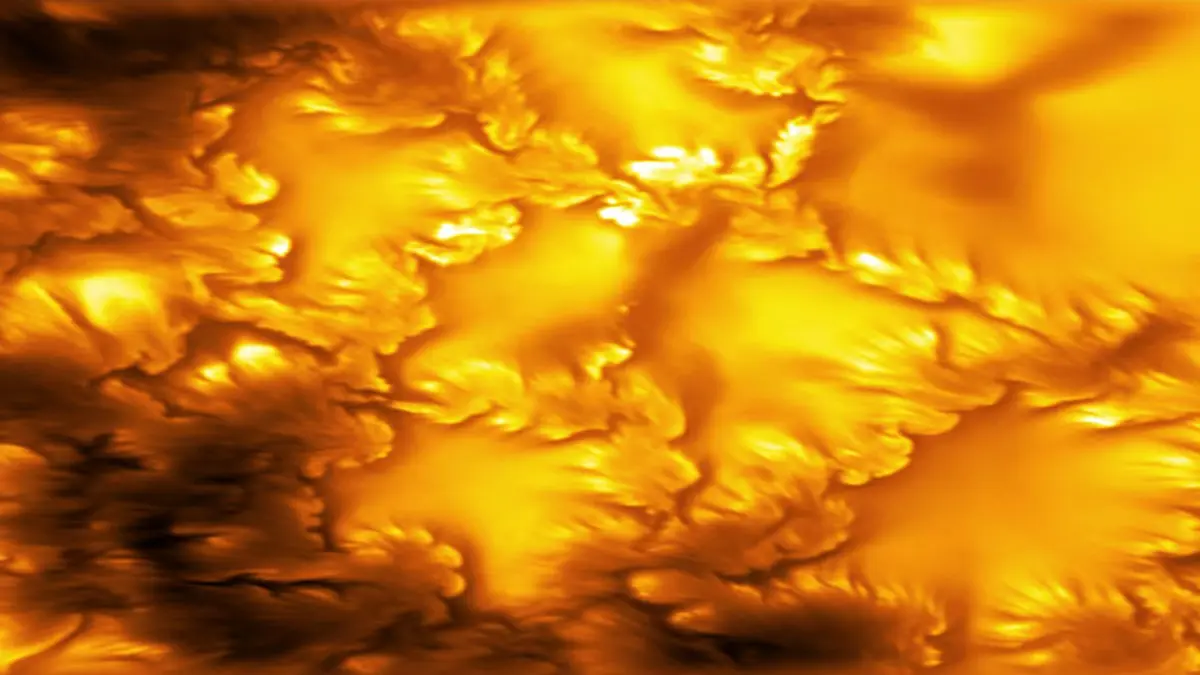
Washington: Astronomers have obtained the highest-resolution images to date of our sun's visible surface, observing swirling, vortex-like patterns in superheated solar gases reminiscent of the shapes depicted in the nocturnal sky in Vincent van Gogh's 1889 painting "The Starry Night, opens new tab."
The researchers made the observations of a portion of the sun's photosphere, a relatively thin layer - about 60 miles (100 km) in depth compared to the overall solar diameter of roughly 865,000 miles (1.4 million km) - using the U.S. National Science Foundation's Hawaii-based Daniel K. Inouye Solar Telescope.
The still images and time-lapse video reveal continuously growing whirls of hot plasma, gas heated to temperatures so high that subatomic particles called electrons break free from atoms and form a broth of charged particles. The observed whirls are large on a human scale but small on the scale of a stellar surface, with diameters ranging from about 12 miles (19 km) - the minimum scale detectable by the world's most powerful solar telescope - up to roughly 100 miles (170 km).
The researchers said the observations may provide insight into underlying physical processes that impact the dynamics of the sun and other stars, including eruptions from the solar surface that can interfere with the operation of satellites, GPS navigation, power grids and global communications on Earth.
Advertisement
The curly, circular patterns do not represent random shapes, but rather are the first detection of a phenomenon called Kelvin-Helmholtz instability, or KHI, on the surface of a star. KHI, first described in the 19th century, refers to a dynamic process that happens when two parallel streams of fluids or gases interact while moving at different velocities.
"The interface can become unstable and develop wave-like vortices that grow in size until they break apart, not unlike waves out on a lake or out on the ocean in windy conditions," said astronomer Friedrich Wöger, a senior scientist at the National Science Foundation's National Solar Observatory in Colorado, the Inouye telescope's instrument program scientist, and co-lead author of the study published on Wednesday in the journal Nature, opens new tab.
Advertisement
Swirling clouds caused by KHI are a well-known, albeit rare, meteorological occurrence on Earth, and also have been observed in the atmospheres of the giant gas planets Jupiter and Saturn, Wöger said.
"The difference from the waves and clouds we know here on Earth is that the two interacting fluids are hot plasma - about 6,000 degrees Kelvin and 10,000 degrees Fahrenheit (5,540 degrees Celsius) - moving within a magnetic field that helps create the conditions for the instability to develop," Wöger said.
By twisting the solar magnetic field, KHI creates energy that can suddenly unleash an explosion.
‘A True Game-Changer’
Wöger called the discovery of solar KHI "a true game-changer," saying it opens up a new framework for understanding how the sun energizes its atmosphere.
"The sun and sun-like stars are extremely dynamic systems, characterized by a whole spectrum of rapid, explosive events within their magnetic elements. How these explosions are triggered is one of the main frontiers in modern solar physics," National Solar Observatory astronomer and study co-lead author David Kuridze said.
The KHI manifestation might help explain why the sun's outer atmosphere becomes as hot as it does and why magnetic energy accumulates and moves around on the solar surface.
The constant twisting motions generated by KHI can gradually build the energy required to trigger coronal mass ejections and solar flares, Kuridze said. Coronal mass ejections are huge bubbles of gas threaded with magnetic field lines that are expelled from the sun's surface. Solar flares are gigantic explosions on the sun that propel light, energy and high-speed particles into space.
Aside from the science, the researchers admired the beauty of the new close-up views of the sun.
"Maybe 'magnificent' comes closest to describing the aesthetics in the images for us," Wöger said.
"Interestingly, artists have long captured this fluid dynamic intuition in their work. A famous example is Van Gogh's 'The Starry Night,' where the sky's vortex structures closely resemble turbulent KHI structures," Kuridze said. "A similar parallel appears in Hokusai's famous woodblock print, 'The Great Wave off Kanagawa,' where the curling crests of the wave echo the iconic shape of KHI billows. It shows how the fundamental geometry of nature deeply resonates with human art."