
Targeting 6 More Launches This Financial Year: ISRO Chief V Narayanan
Narayanan also spoke about the Gaganyaan human spaceflight programme, describing it as a technology-intensive mission. He said the launch vehicle being prepared for the mission is human-rated and that ISRO is continuing work to get the programme ready.
- Science News
- 5 min read

;'%3e%3cpath%20d='m8,15.99c4.41,0,7.99-3.58,7.99-7.99S12.41,0,8,0,0,3.59,0,8s3.58,7.99,7.99,7.99Z'%20style='stroke:%23fff;%20stroke-miterlimit:10;%20stroke-width:.02px;'/%3e%3cpath%20d='m3.08,3.37l3.82,5.11-3.84,4.15h.87l3.37-3.64,2.72,3.64h2.94l-4.04-5.39,3.58-3.87h-.86l-3.1,3.35-2.5-3.35h-2.94Zm1.27.64h1.35l5.97,7.99h-1.35l-5.97-7.99Z'%20style='fill:%23fff;'/%3e%3c/g%3e%3c/svg%3e)


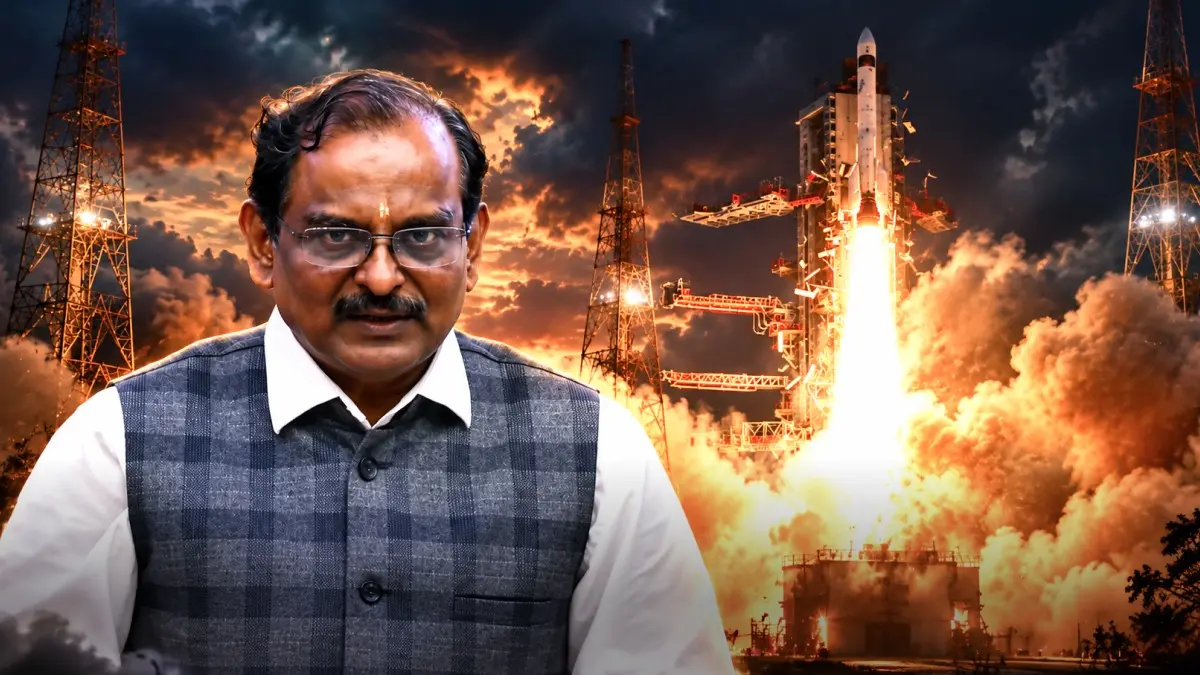
Sriharikota: ISRO is targeting six more launches this financial year, said ISRO Chief V Narayanan after the successful launch of the GSLV-F17/EOS-05 mission on Friday. "This financial year, in the direction of the Prime Minister, we are targeting six more launches,” Narayanan told ANI.
He said the successful mission was significant for the country as the EOS satellite would be placed in geosynchronous orbit. The satellite is intended to support continuous monitoring of India and nearby areas for Earth observation. “This mission is a very important mission for our country because, for the first time, we are going to place an Earth observation satellite in the geosynchronous orbit, which is essentially required for continuously monitoring India and its nearby places for Earth observation," he added.
Narayanan also spoke about the Gaganyaan human spaceflight programme, describing it as a technology-intensive mission. He said the launch vehicle being prepared for the mission is human-rated and that ISRO is continuing work to get the programme ready. “Gaganyaan is a technology-intensive mission. The vehicle is human-rated. We are getting ready for this mission. A lot of development work we have completed, including safety system development,” he said.
The ISRO chief said a substantial amount of development work for Gaganyaan had already been completed, including the development of safety systems. He added that preparations for the human spaceflight mission were progressing. Narayanan also provided an update on the upcoming launch infrastructure at Kulasekarapattinam in Tamil Nadu. He said the launch pad there is expected to be ready by March next year and that work is progressing according to the targeted plan.
Advertisement
“The launch pad at Kulasekarapattinam will be ready by March next year. Everything is going as per the targeted plan,” he said. Highlighting the broader growth of India’s space sector, Narayanan said the focus should not be limited to the growth of ISRO but should also include the expansion of the country’s overall space ecosystem.
“What is required is not just ISRO’s growth but the growth of the space ecosystem in our country,” he said. He noted that around 440 startup companies are currently working in the space sector, contributing to the expansion of the industry and providing employment opportunities.
Advertisement
His remarks came after ISRO successfully deployed the EOS-05 Earth observation satellite into orbit from the Satish Dhawan Space Centre in Sriharikota on Friday, marking another major milestone in India’s space programme. The launch took place from the Second Launch Pad at the Satish Dhawan Space Centre, SHAR. The launch was carried out on a GSLV-F17 rocket, which is the 19th flight of India’s Geosynchronous Satellite Launch Vehicle (GSLV), as it carried EOS-05 towards a Sub-Geosynchronous Transfer Orbit (Sub-GTO).
ISRO chief V Narayanan on Friday announced that the GSLV-F17 vehicle has successfully and precisely injected the Advanced Earth Observation Satellite-05 (EOS-05), the geo-imaging star satellite, into its intended and required orbit.
Narayanan said the successful mission was a significant achievement for India’s space programme and that the satellite’s health was perfectly alright after its injection into orbit.
“I am very happy to announce that the GSLV-F17 vehicle has successfully and precisely injected the Advanced Earth Observation Satellite 05, the geo-imaging satellite, in the intended and required orbit,” Narayanan said right after the mission success was announced at the space centre.
He added that once EOS-05 is operationalised in orbit, it will become India’s first dedicated imaging satellite from the geo orbit and provide important strategic data for the country. “Today, we have injected the heaviest satellite, 2367 kgs, using this launch vehicle. The health of the satellite is perfectly alright,” the ISRO chief said.
Narayanan credited the successful mission to the collective efforts of the entire ISRO team, along with its industrial partners and the academic community. “This success is the culmination of the hard work of the entire ISRO team along with our industrial partners and academia. On this occasion, I congratulate each one of you. This is a great achievement in our country’s space programme,” he said.
Later, while addressing a press conference, the ISRO chief also mentioned that the space agency is targeting another six launches in the current financial year. Praising ISRO and the scientists involved in the mission, Minister of State in the Department of Space, Jitendra Singh, wrote on X, "Another giant leap for India in Space! Kudos to Team @isro on the successful launch of GSLV-F17/EOS-05. EOS-05 is a state-of-the-art Earth Observation satellite and India’s first imaging satellite from Geosynchronous Orbit, enabling advanced imaging across visible, infrared, multi-spectral and hyperspectral bands. With the visionary leadership of PM Shri @narendramodi Ji, India’s space capabilities continue to scale new heights, strengthening our position as a global space power."
ISRO successfully deployed the EOS-05 Earth observation satellite into orbit from the Satish Dhawan Space Centre in Sriharikota on Friday, marking another major milestone in India’s space programme. The launch took place from the Second Launch Pad at the Satish Dhawan Space Centre, SHAR. The launch was carried out on a GSLV-F17 rocket, which is the 19th flight of India’s Geosynchronous Satellite Launch Vehicle (GSLV), as it carried EOS-05 towards a Sub-Geosynchronous Transfer Orbit (Sub-GTO).