
Will NASA's Robotic Rescue Mission Save A Sinking $250 Million Space Telescope?
In a historic final flight for Northrop Grumman’s air-launched Pegasus XL rocket, dropped from the belly of the L-1011 Stargazer carrier aircraft, the booster safely delivered the private LINK servicing satellite into low Earth orbit.
- Science News
- 2 min read

;'%3e%3cpath%20d='m8,15.99c4.41,0,7.99-3.58,7.99-7.99S12.41,0,8,0,0,3.59,0,8s3.58,7.99,7.99,7.99Z'%20style='stroke:%23fff;%20stroke-miterlimit:10;%20stroke-width:.02px;'/%3e%3cpath%20d='m3.08,3.37l3.82,5.11-3.84,4.15h.87l3.37-3.64,2.72,3.64h2.94l-4.04-5.39,3.58-3.87h-.86l-3.1,3.35-2.5-3.35h-2.94Zm1.27.64h1.35l5.97,7.99h-1.35l-5.97-7.99Z'%20style='fill:%23fff;'/%3e%3c/g%3e%3c/svg%3e)


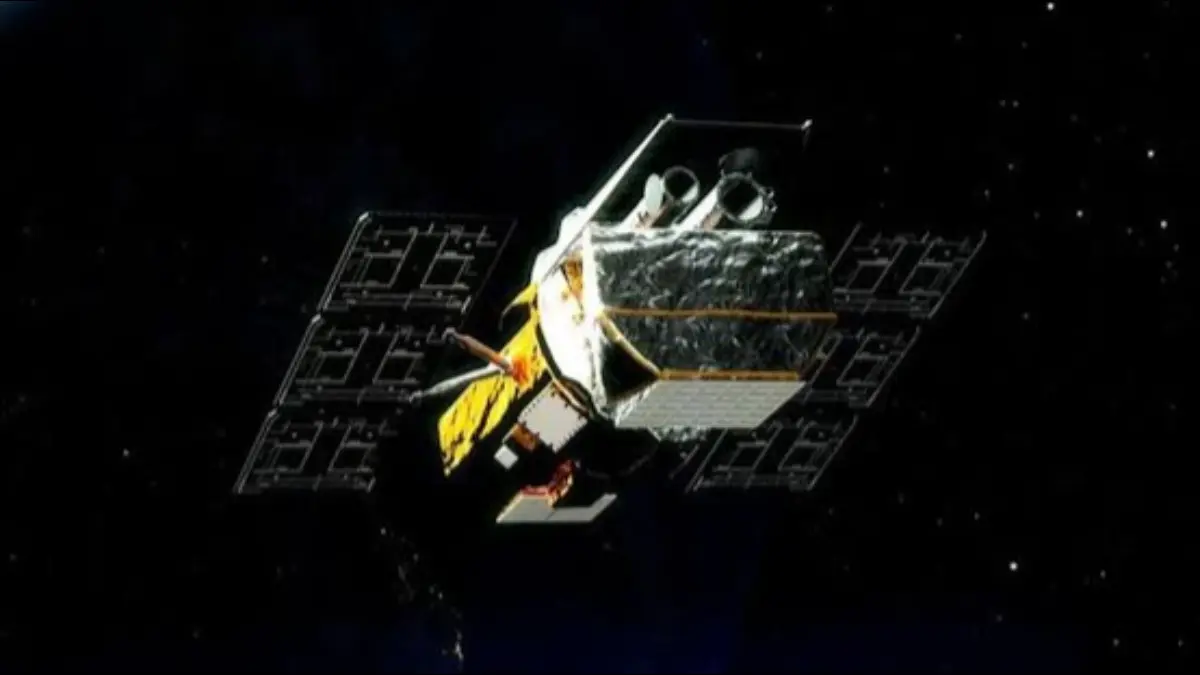
In a high-stakes, first-of-its-kind cosmic salvage operation, NASA and Northrop Grumman have successfully launched an experimental robotic space tug designed to intercept and rescue the falling Neil Gehrels Swift Observatory before it plunges into Earth's atmosphere and burns up.
The $30 million mission, dubbed Swift Boost, successfully lifted off on Friday morning from the Reagan Missile Test Site on Kwajalein Atoll in the Marshall Islands.
In a historic final flight for Northrop Grumman’s air-launched Pegasus XL rocket, dropped from the belly of the L-1011 Stargazer carrier aircraft, the booster safely delivered the private LINK servicing satellite into low Earth orbit.
Built by Arizona-based startup Katalyst Space Technologies, the small, three-armed LINK spacecraft is now officially on a race against the clock.
Advertisement
The $250 million Swift space telescope, launched in 2004 to monitor gamma-ray bursts, the most explosive explosions in the universe, has no onboard propulsion system.
Intense solar storms peaking during the 2024 solar maximum heated and expanded Earth's upper atmosphere, generating unprecedented drag that began dragging the telescope down far faster than projected.
Advertisement
Without intervention, scientists warned the observatory would undergo an uncontrolled, fiery reentry by the end of 2026. The rescue mission represents a massive paradigm shift in aerospace logistics and commercial partnerships.
NASA selected Katalyst in late 2025, giving the company a razor-thin, nine-month window to design, build, and integrate a custom vehicle capable of executing one of the most mechanically complex rendezvous manoeuvres ever attempted.
LINK will spend the next several weeks executing system checks and adjusting its trajectory to catch up with the decaying telescope.
Once it reaches Swift, the 4.9-foot-tall robot will spend roughly a month capturing imagery to locate a secure, non-operational structural flange to grapple onto.
Using its three robotic arms, LINK will lock onto the 12.7-foot telescope. From there, LINK's highly efficient, low-power ion thrusters will begin a slow, meticulous towing operation spanning 10 to 12 weeks, aiming to push the iconic observatory nearly 190 miles (300 km) higher into a stable, long-term orbit.
If successful, the mission will not only extend Swift's legendary scientific lifespan by another decade but also prove the viability of commercial, on-orbit satellite servicing, transforming how humanity maintains, refuels, and recycles ageing orbital infrastructure, letting it burn.