
Updated 16 December 2023 at 19:38 IST
Decoding the Duckworth-Lewis Rule in Cricket: Learn what is DLS Method and its impact on the game
Unveiling the mysteries of Duckworth-Lewis Rule in cricket—a math marvel adjusting targets during rain disruptions for equitable and riveting outcomes.
- SportFit
- 2 min read

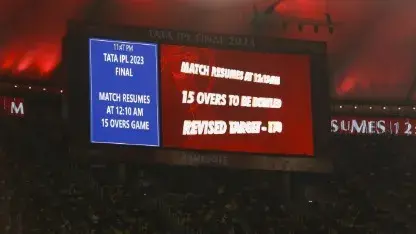
Cricket, known for its unpredictability, ushered in the Duckworth-Lewis (D/L) method to grapple with a major uncertainty—weather disturbances. Coined after statisticians Frank Duckworth and Tony Lewis, this method brought a sea change by offering an impartial means to determine revised targets in rain-hit matches.
Understanding the Necessity
In cricket, rain delays can significantly sway the course of a game. The conventional approach of reducing overs often fell short, resulting in unfair conclusions. The Duckworth-Lewis method, initiated in the 1996 World Cup, aimed to redress this by employing a mathematical formula that considers various factors.
The Duckworth-Lewis Formula
The D/L method revolves around a straightforward principle: the team batting second is assigned a revised target based on the resources at its disposal during the interruption. The key factors include the number of overs bowled and the number of wickets lost by each team.
The formula involves computing a par score, indicating the hypothetical number of runs a team should score given the existing state of the match. This par score is then modified based on the actual overs faced and wickets lost by the batting team.
Advertisement
Variables and Complexities
Several variables contribute to the complexity of the Duckworth-Lewis method. These involve initial scoring rates, the number of wickets in hand, and the stage of the innings. The formula takes these variables into account to ensure a just adjustment of the target, considering the strategic advantage a team might have gained before the rain interruption.
Application in T20 and ODI Formats
The Duckworth-Lewis method is applicable in both One Day Internationals (ODIs) and Twenty20 (T20) matches. However, the shorter format necessitates a modification known as the D/L par score, accommodating the faster pace and higher scoring rates typically observed in T20 cricket.
Advertisement
Criticisms and Evolutions
While the Duckworth-Lewis method has garnered widespread acceptance, it has not been without its share of criticisms. Critics argue that it can sometimes yield results that seem counterintuitive. In response, the International Cricket Council (ICC) introduced the Duckworth-Lewis-Stern (DLS) method in 2014, incorporating additional refinements to address these concerns.
Conclusion
The Duckworth-Lewis rule stands as evidence of the amalgamation of sports and mathematics. It ensures that rain interruptions do not unjustly favor one team over another, preserving the integrity of the game. As cricket undergoes continuous evolution, so too will the methods devised to keep matches competitive and true to the spirit of fair play.
Published By : Garvit Parashar
Published On: 16 December 2023 at 18:31 IST