
In a Patagonia Town With An 85-Foot Messi Statue, Argentines Celebrate Reaching World Cup Final
In Patagonia, Argentines celebrated their team's advancement to the World Cup final with joy after a 2-1 victory against England, highlighted by a new 85-foot Messi statue. The atmosphere mirrored celebrations in Buenos Aires, fueled by historical rivalries, including the Falklands War.
- SportFit
- 3 min read

;'%3e%3cpath%20d='m8,15.99c4.41,0,7.99-3.58,7.99-7.99S12.41,0,8,0,0,3.59,0,8s3.58,7.99,7.99,7.99Z'%20style='stroke:%23fff;%20stroke-miterlimit:10;%20stroke-width:.02px;'/%3e%3cpath%20d='m3.08,3.37l3.82,5.11-3.84,4.15h.87l3.37-3.64,2.72,3.64h2.94l-4.04-5.39,3.58-3.87h-.86l-3.1,3.35-2.5-3.35h-2.94Zm1.27.64h1.35l5.97,7.99h-1.35l-5.97-7.99Z'%20style='fill:%23fff;'/%3e%3c/g%3e%3c/svg%3e)


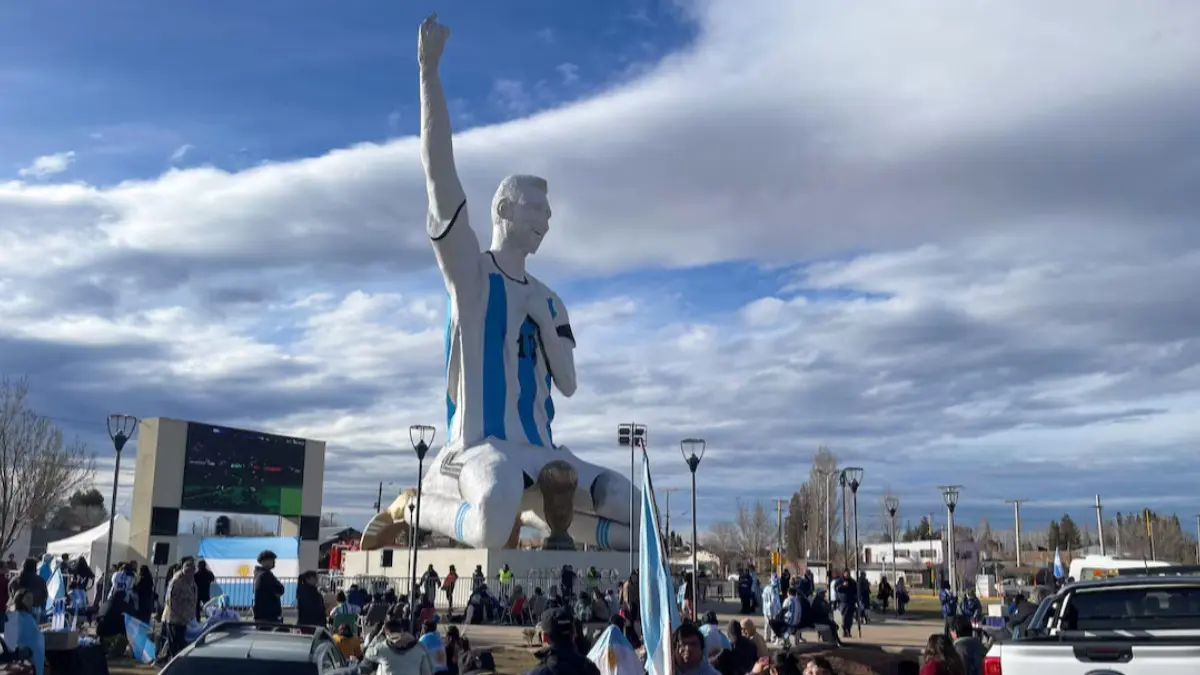
Argentina: In a town in Patagonia boasting a new 85-foot (26-metre) statue of soccer great Lionel Messi, joyful Argentines celebrated their country's advance to the World Cup final after they beat long-time rivals Englandwith two late goals in Atlanta.
It was a scene repeated in Buenos Aires and across the country. Now only Spainstand between Argentina and their attempt in Sunday's final to become the first country to win back-to-back World Cup titles since 1962.
In Cutral Co in the southern province of Neuquen, a crowd of about 300 locals watched the game on a screen set up next to Messi's towering knees. They burst into screams as the referee blew his whistle at the end of the semi-final against England. Argentina came back from 1-0 down to win 2-1.
"It was a victory of suffering," said Lucas Romero, a 32-year-old local, standing next to his beaming wife.
Advertisement
He motioned to the statue in front of him: "It's a good recognition of all that Messi has done."
The showdown between the two countries on Wednesday was framed by history and rivalry, including England's victory at the 1966 World Cup, the memory of the 1982 war over the Falkland Islands, known in Argentina as the Islas Malvinas, and Diego Maradona's "Hand of God" goal in 1986.
Advertisement
"This isn't just another match," wrote Argentina's Vice President Victoria Villarruel on X before the game.
"I'm not going to be politically correct or cold-hearted; against the English, it's always something more. It's the Malvinas, it's Diego, it's Leo's last one, and it's putting the brakes on the invaders."
Cutral Co is a town of about 40,000, with many families who work in the nearby oil fields of Vaca Muerta, a formation that holds among the world’s largest shale gas and oil reserves.
It made headlines in June when it inaugurated a statue by local artist Aldo Beroisa - a smiling Messi kneeling while pointing a finger up at the sky - declaring it in a statement to be the tallest monument to Messi in the world.
The crowd by the monument quickly swelled to several thousand on Wednesday. Orange and red fireworks exploded around Messi's head.
From a Tempered Atmosphere to Anxiety
There was a noticeably more tempered atmosphere in Argentina at the start of the 2026 tournament compared to the 2022 World Cup, with many saying they felt that the stakes were lower because they already had the Qatar triumph.
But that quickly changed.
As Argentina advanced through the stages, crowds filled downtown Buenos Aires after each victory, in games where the team more than once had a close call or came back from behind.
Public anxiety around the games spurred local newspapers to interview cardiologists warning about signs of heart attacks.
In Buenos Aires, which had been mostly empty during Wednesday's match, fans waved flags and chanted as drivers honked to celebrate the victory.
"I’m overcome with emotion," said Mariano Gecik, a 49-year-old university professor who watched the game at the home of friends. "Once again, it’s about resurrection, resilience, and sheer grit; we truly deserve our place in the World Cup final."
At a watch party of Falklands War veterans in Quilmes, a city in Buenos Aires province, Juan Carlos Salinas, a 74-year-old veteran, struggled to speak through tears.
"This for us is ... something big," he said.