
Pooja Krishnamoorthy Narrates The Romance in Endurance After Historic Run At Brazil 135
Pooja Krishnamoorthy made history at Brazil 135 Ultra, becoming the first Indian woman in 21 years to represent the country. Her grit, resilience and focus carried her through 217 km of brutal terrain.
- SportFit
- 8 min read

;'%3e%3cpath%20d='m8,15.99c4.41,0,7.99-3.58,7.99-7.99S12.41,0,8,0,0,3.59,0,8s3.58,7.99,7.99,7.99Z'%20style='stroke:%23fff;%20stroke-miterlimit:10;%20stroke-width:.02px;'/%3e%3cpath%20d='m3.08,3.37l3.82,5.11-3.84,4.15h.87l3.37-3.64,2.72,3.64h2.94l-4.04-5.39,3.58-3.87h-.86l-3.1,3.35-2.5-3.35h-2.94Zm1.27.64h1.35l5.97,7.99h-1.35l-5.97-7.99Z'%20style='fill:%23fff;'/%3e%3c/g%3e%3c/svg%3e)


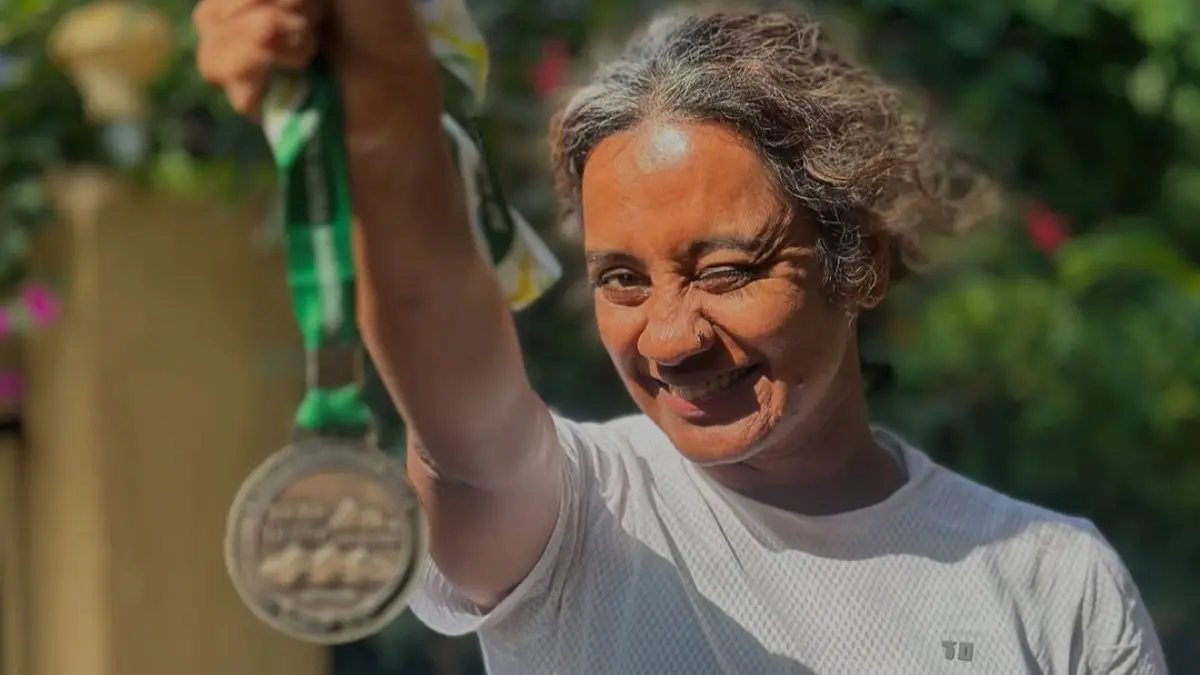
Pooja Krishnamoorthy rewrote history after crossing the finish line at Brazil 135 Ultra. She became the first Indian woman in 21 years to represent the country at the race, which is known for its brutality. The accomplishment blends resilience, grit and quiet determination.
The Brazil 135 is known to have gruelling conditions: extreme heat, steep climbs, and long stretches of isolation, something which takes a stern physical and mental challenge. But Pooja's determination and focus helped her carry through the challenge and push herself past breaking points.
Republic World sat down with famed Indian Ultra Runner Pooja Krishnamoorthy to dive deep into her experience at Brazil 135. In a candid conversation, she shared the journey, emotions, and lessons behind this milestone.
The following are the excerpts from the interview:
Q1: What was the defining moment when you decided to take on the Brazil 135 Ultra, knowing it’s one of the toughest endurance races in the world?
Advertisement
I wouldn't say there was one single defining moment. It was more of a quiet buildup over time. That said, growing my coach Adil Mirza for Badwater, which is again, one of the toughest endurance races in the world, in 2023. I think that was the turning point for me. Because when I did that, and I paced him for a good 80 kilometres, I was barely a half-marathoner. And out there, meeting ultra runners like Sonia Ahuja, who had podiumed at both Brazil and Badwater, was a silent inspiration as well.
So it was then that I somewhat decided in my head and told my coach that, you know, I'll do these races someday. Then, after that experience, when I actually started taking up ultras myself, it slowly kind of showed me what I was capable of. And along the way, of course, my coach's belief in me also played a huge role. So eventually, by the time the Brazil 135 opportunity came up, I mean, while I felt the jitters, you know, but it still felt possible. And yeah, I guess that was it. So yeah, as I said, it was a build-up. It wasn't like one thing that made it happen.
Advertisement
Q2: You’re the first Indian woman in 21 years to represent the country at Brazil 135. How does carrying that legacy feel on your shoulders?
I definitely didn't think about the legacy while running, or even while signing up. If I had, I'd probably have overthought everything. So, but yeah, during the race, I was just trying to stay calm, patient, and you know, keep moving forward without doing anything stupid or silly.
But the whole first Indian woman part, actually, I mean, it actually hit me when I finished the run. So what it means to me now is possibility, but I think it's more about, you know, it's possibility. And if my presence there makes the path feel a little more possible, visible, reachable for another Indian woman, then I think that is a good start.
Q3: Could you walk us through the most unconventional or surprising aspect of your training that prepared you for Brazil 135?
Especially for Brazil, it is definitely the training that I have been doing over time, played a role where I have been consistent for the past three years, I would say since 2023. That definitely helped me reach here. But for Brazil, especially, I just increased my training a bit more by a couple of hours. As in earlier, I used to probably train once a day. Now I started doing it twice a day, a bit in the morning, a bit in the evening, you know, so those definitely, I had to increase my mileage, all those things were done. That definitely played a huge role.
I think the surprising thing as such, I mean, the training was the basic runners' training that every runner does. But I think the surprising thing for me was every morning, you know, there were these new aches and pains that I would wake up with, not every morning, but you know, there were mornings that I would pick up and wake up with these aches and pains, and I would just not know where it would pop out from some random muscle tightness or a niggle here and there would appear one morning, and it would kind of force me then to discover things that could actually go wrong with me. But yeah, oddly enough, that became a huge part of being race-ready as well, because it taught me how to handle the unexpected.
Q4: Many athletes talk about why they are doing what they are doing. What was your personal “why” that kept you moving through 217 km?
I have always loved the outdoors. So, since childhood, we were introduced to the outdoors by the family. And since then, I have always loved the outdoors. So as to and which I so once when and this was it started with mountaineering. So the outdoors and long distances, endurance is because I was a mountaineer earlier. So when that took a backseat, when work started taking over, I found running, that's how the journey started with running.
In terms of endurance runs, why do you keep doing this? There is some pleasure in this kind of pain and discomfort for me, since you're asking about me. So, you know, and the whole idea of keep going, keep going, and keep moving forward. It just, I mean, these things give me, you know, it's a different high that you get. So I think that is my personal why, so to speak, as in, it's just the silence, it's just the pleasure and the pain, so to say, or the comfort and the discomfort in a very nice way. If there is, you know, there is. Yeah, it just makes you feel great. The adrenaline rush is great. So I would rather have this kind of rush than have a night out with friends at a pub. So yeah, this is why I keep going.
Q5: If you could describe the Brazil 135 Ultra in one word that captures both its brutality and beauty, what would it be?
It was empowering, for sure. But there's, if I could give it another word. In a very unconventional way, actually, but it was it's actually quite romantic, too, in a very poetic way, not in a sweet way, like not in the romantic sweet way, so to say, but in a poetic, grand heroic way where it's just you and the mountains and there's something romantic about and where you keep going as well. And there's something romantic about that kind of suffering, I would say. So there are two words, empowering and romantic, for me.
Q6: What message do you hope your participation sends to young women in India who aspire to break barriers in sports where female representation is limited?
One thing from my learning itself, it's, you know, you do not have to have everything figured out before you begin. So sometimes it's you realise that every journey starts imperfectly and it grows with time. If you enjoy the process, stay patient and keep showing up. The doors will open, you know, it will open. So take that first step. Take that first step. And most importantly, you are, you know, also to feel that you are allowed to take up space in these places. You know, I think that is a very important part for generally women. You know, we constantly a lot of us do go through, you know, imposter syndrome. So, you know, constantly feeling. So I just want to also say that, you know, you need to feel that you are allowed to take up space in these places, even if you're the first or the only one for a while, but just take that first step.
Q7: You've been associated with Well-being Nutrition for a while. How has it helped you in going the extra mile, as it is something that normal humans cannot even dare to do?
After starting endurance runs and once I got into these long-distance endurance runs, associating with well-being nutrition has actually given me insights about how supplements could help you push forward on your journey, you know, and then the whole thing about protein for strength, creatine and magnesium for muscle recovery, high results for hydration. So when I started doing ultras, I think their support meant I could focus now on the miles instead of second-guessing what I could eat or drink. So, especially on long ultras like Brazil 135, this reliability makes a huge difference. So, yeah, well-being definitely has made a huge difference.
For Pooja Krishnamoorthy, Brazil 135 wasn’t just a race, but was a statement. It was a statement of endurance, possibility, and breaking barriers. And in her words, it was both empowering and romantic, a journey that will inspire countless others to take their first step into the unknown.