
Apple’s M5 Chip vs M4: What’s New, What Stays the Same - Explained
Apple’s new M5 chip brings faster performance, better AI processing, and improved efficiency over the M4. Here's a quick breakdown of what’s upgraded, what’s unchanged, and whether it’s worth the switch.
- Tech News
- 3 min read

;'%3e%3cpath%20d='m8,15.99c4.41,0,7.99-3.58,7.99-7.99S12.41,0,8,0,0,3.59,0,8s3.58,7.99,7.99,7.99Z'%20style='stroke:%23fff;%20stroke-miterlimit:10;%20stroke-width:.02px;'/%3e%3cpath%20d='m3.08,3.37l3.82,5.11-3.84,4.15h.87l3.37-3.64,2.72,3.64h2.94l-4.04-5.39,3.58-3.87h-.86l-3.1,3.35-2.5-3.35h-2.94Zm1.27.64h1.35l5.97,7.99h-1.35l-5.97-7.99Z'%20style='fill:%23fff;'/%3e%3c/g%3e%3c/svg%3e)


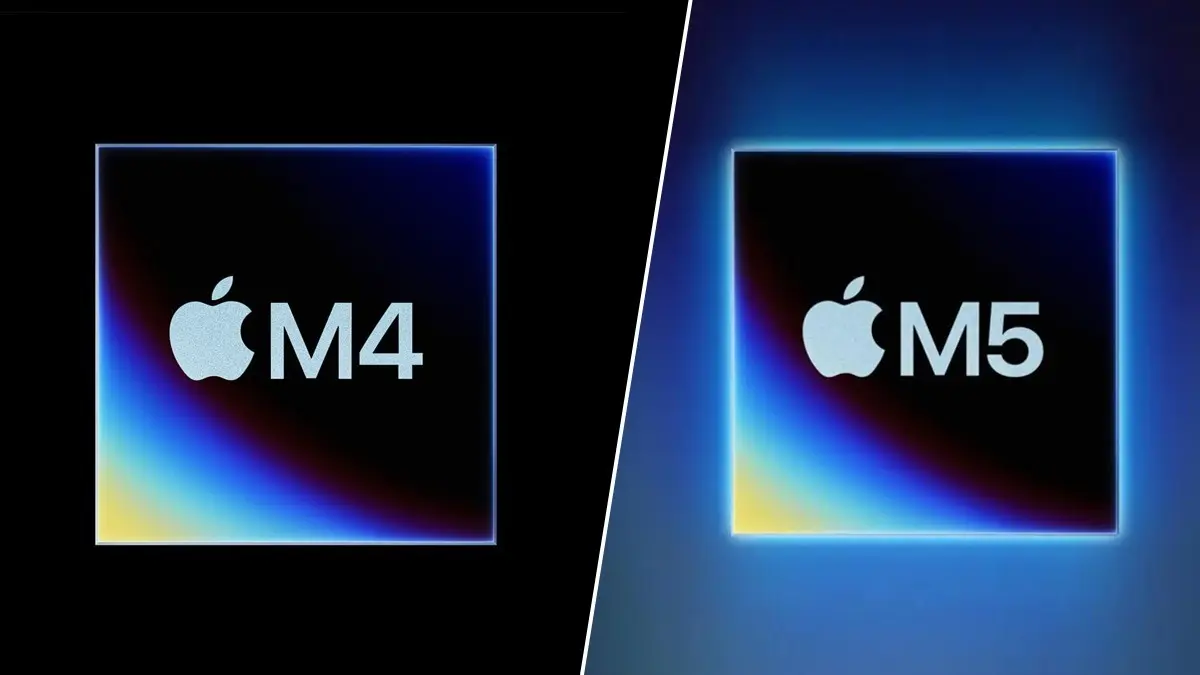
Apple quietly launched its M5 chip on Wednesday, the powerhouse behind its latest 14-inch MacBook Pro, iPad Pro, and Vision Pro. It marks another major milestone in Apple’s silicon journey - one that began in 2020 with the game-changing M1. But while the M1 started Apple’s breakaway from Intel, the new M5 looks set to redefine how much artificial intelligence a chip can handle on your desk or in your hands.
From M1 to M5: A Quick Evolution
M1 proved Apple could make its own chips that rivalled Intel. M2 brought incremental boosts. M3 introduced ray tracing and hardware-level AI optimisation. Then came the M4 that focused mainly on graphics improvements and energy efficiency.
Now, the M5 takes that foundation and supercharges it for the AI era. This is a redesigned engine built to run artificial intelligence models directly on your device.
4x Faster GPU Compute, and Neural Accelerators in Every Core
The M5 chip comes with a new 10-core GPU, with each GPU core having its own Neural Accelerator. This basically means the GPU can now handle AI-heavy tasks like image generation, video rendering, or running language models far faster and more efficiently.
Advertisement
Compared to the M4, Apple says the M5 delivers over 4x peak GPU compute performance and up to 45% better graphics performance. In short: games look smoother, creative apps render faster, and AI tools can finally flex without cloud support.
World’s Fastest CPU Core and a Stronger Neural Engine
Apple also calls the M5’s CPU the “world’s fastest performance core.” It combines four performance cores with six efficiency cores, boosting multithreaded performance by 15% over M4. Then there’s the upgraded 16-core Neural Engine, built to handle tasks like photo transformations, real-time language translation, and the new Apple Intelligence features. It works alongside those GPU Neural Accelerators to make everything - from image generation to app recommendations - faster and more responsive.
Advertisement
Memory Bandwidth and Multitasking
The M5 gets a serious memory boost - 153GB/s unified memory bandwidth, almost 30 per cent higher than M4. This helps when working on large creative projects or AI workloads locally, without offloading to the cloud.
Built for On-Device AI
This is where Apple’s M5 sounds like a leap. Unlike traditional chips that depend on cloud AI processing, M5 is designed to handle large AI models entirely on-device - faster, more privately, and more energy-efficiently.
The Key Difference
The main difference between the Apple M5 and M4 chips centres on a huge boost to Artificial Intelligence (AI) and graphics. While the core structure remains similar, the M5 dramatically upgrades the GPU by embedding a dedicated Neural Accelerator in every core, making AI tasks like image generation or smart video effects up to 4x faster. Additionally, the M5 includes a 3rd-generation ray tracing engine for a significant 45 per cent graphics boost in 3D apps and games, and it features 30 per cent faster memory bandwidth, ensuring data moves more quickly across the chip to handle demanding professional and AI workloads with greater efficiency.