
Artemis II Astronauts Took an iPhone 17 Pro Max to Space: How Apple's Flagship Got NASA's Clearance
NASA has officially cleared the iPhone 17 Pro Max for use aboard the Artemis II mission, marking the first time a modern smartphone has been fully approved for a crewed deep-space flight.

;'%3e%3cpath%20d='m8,15.99c4.41,0,7.99-3.58,7.99-7.99S12.41,0,8,0,0,3.59,0,8s3.58,7.99,7.99,7.99Z'%20style='stroke:%23fff;%20stroke-miterlimit:10;%20stroke-width:.02px;'/%3e%3cpath%20d='m3.08,3.37l3.82,5.11-3.84,4.15h.87l3.37-3.64,2.72,3.64h2.94l-4.04-5.39,3.58-3.87h-.86l-3.1,3.35-2.5-3.35h-2.94Zm1.27.64h1.35l5.97,7.99h-1.35l-5.97-7.99Z'%20style='fill:%23fff;'/%3e%3c/g%3e%3c/svg%3e)


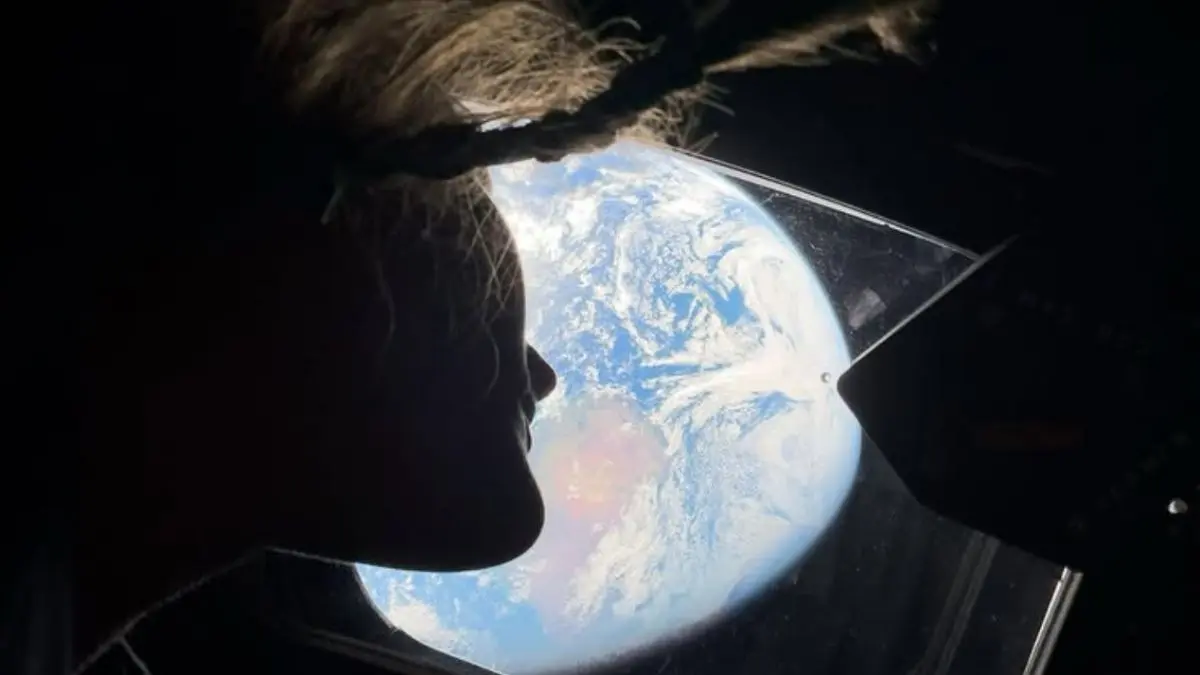
In what sounds like a marketing headline but is very much real, NASA’s Artemis II astronauts are carrying the iPhone 17 Pro Max on a mission to the Moon. Yes, an actual consumer smartphone is now floating inside a deep-space spacecraft. And no, it didn’t get there just because someone slipped it into a pocket.
This is the first time NASA has approved an iPhone for deep space
NASA has officially cleared the iPhone 17 Pro Max for use aboard the Artemis II mission, marking the first time a modern smartphone has been fully approved for a crewed deep-space flight. Each of the four astronauts on board the Orion spacecraft is carrying one device, primarily to capture photos and videos during the mission.
While smartphones have appeared in space before in limited or experimental roles, this is the first time NASA has allowed them as standard equipment for every crew member on a mission beyond Earth orbit.
Why NASA allowed iPhones this time
The decision is part of a broader effort to modernise how missions are documented. Traditionally, astronauts relied on professional cameras like Nikon DSLRs and GoPros.
Advertisement
Those are still onboard. But smartphones offer something different. They are compact, easy to use, and capable of capturing high-quality images and videos quickly.
NASA’s goal here is not operational. The iPhones are not being used to control the spacecraft or run any mission-critical systems. They are simply tools for documentation and communication of the human experience in space.
Advertisement
In short, they are there to capture moments, not run the mission.
The approval process is anything but simple
Before any device goes to space, NASA subjects it to a rigorous evaluation process. And a glass-and-metal smartphone is not exactly built for zero gravity. According to reports, NASA follows a multi-phase approval system:
- The device is first reviewed by a safety panel
- All potential hazards are identified
- Mitigation plans are created
- The solution is tested and validated
The risks are not theoretical. If the iPhone’s glass were to shatter, fragments would not fall to the ground. They would float inside the cabin, posing a serious risk to astronauts’ eyes, skin, or even breathing.
Even basic things like battery safety, heat generation, and material behaviour in microgravity need to be evaluated.
What changes in space
Despite being a consumer device, the iPhone 17 Pro Max is not being used like one.
- No cellular connectivity
- No internet access
- No Bluetooth usage
The devices are essentially operating as standalone cameras. They have also been physically managed differently. In some cases, units were secured inside astronaut suits or mounted using Velcro to prevent them from floating away inside the spacecraft.
Because in microgravity, even your phone can become a projectile.
Apple didn’t push this
Interestingly, Apple was not directly involved in getting the iPhone approved for the mission. The company confirmed that NASA handled the entire certification process independently. This makes the approval less about branding and more about capability.
NASA essentially decided that a modern smartphone is now reliable enough to coexist with mission-grade equipment in deep space.
What this means going forward
The presence of the iPhone 17 Pro Max on Artemis II signals a subtle but important shift. Space missions are no longer relying only on specialised, purpose-built hardware. Consumer technology is starting to earn a place, at least in non-critical roles.
That has implications. As smartphones become more powerful and durable, they could play a bigger role in future missions, especially for documentation, communication, and even certain operational tasks.