
Creepy! Robo Dog With Realistic Elon Musk Head Roams On Streets, Waving At People In San Francisco
Pedestrians walking on the streets of San Francisco were surprised to see a realistic silicon head of world's richest man Elon Musk roaming around waving at people. The spectacle came across as creepy since the head was attached to the body of a robot dog!
- Tech News
- 2 min read

;'%3e%3cpath%20d='m8,15.99c4.41,0,7.99-3.58,7.99-7.99S12.41,0,8,0,0,3.59,0,8s3.58,7.99,7.99,7.99Z'%20style='stroke:%23fff;%20stroke-miterlimit:10;%20stroke-width:.02px;'/%3e%3cpath%20d='m3.08,3.37l3.82,5.11-3.84,4.15h.87l3.37-3.64,2.72,3.64h2.94l-4.04-5.39,3.58-3.87h-.86l-3.1,3.35-2.5-3.35h-2.94Zm1.27.64h1.35l5.97,7.99h-1.35l-5.97-7.99Z'%20style='fill:%23fff;'/%3e%3c/g%3e%3c/svg%3e)


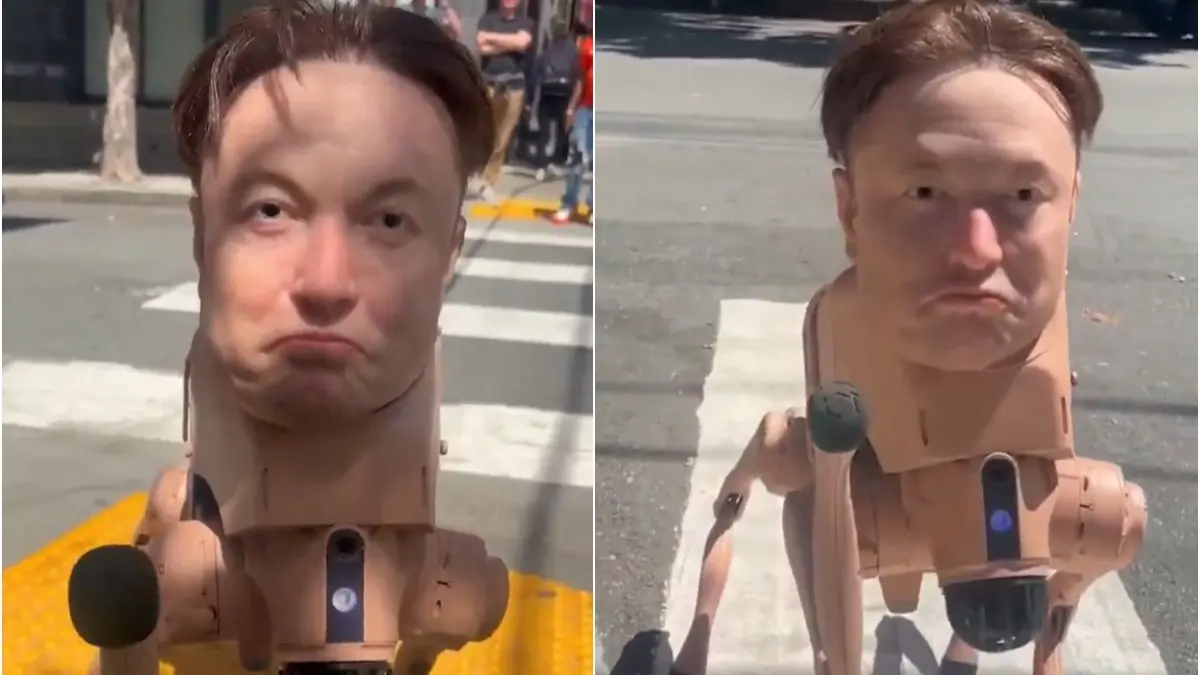
San Francisco: Pedestrians walking on the streets of SoMa in San Francisco, California, were surprised to see a realistic silicon head of world's richest man Elon Musk roaming around, waving at people. The spectacle came across as creepy since the flesh-coloured head was attached to the body of a robot dog!
A video showed the four-legged autonomous robot dog wandering around, leaving people amazed. It was also seen raising one of its leg to say hello to people.
What Was The Robo Doing On Streets?
The bizarre sight even came with a ‘Lost Dog’ poster plastered nearby, complete with a phone number to call, all part of an elaborate stunt ahead of an upcoming art exhibition. The ‘Lost Dog’ poster featured a robot dog with ahead imitating Meta CEO Mark Zuckerberg's face.

The robot dog was out on the streets to promote an art show in Palo Alto. The robot is part of digital artist Mike Winklemann's art installation titled 'Regular Animals'.
Advertisement
Musk Is Not Alone!
Tesla CEO and X owner Elon Musk is not the only personality whose face has been an inspiration for the robot. Silicon heads inspired by Meta CEO Mark Zuckerberg and Amazon Founder Jeff Bezos have been used by Winkelmann (also known as Beeple) on other robot dogs in his art collection.
The robot dogs capture images, map its surroundings and convert those experiences into prints and NFTs that document its life.
Advertisement
According to Beeple Studios, “Their silicone faces, robotics, and onboard computer vision merge the digital and physical, blurring where portraiture ends and machine agency begins. Unlike static depictions, these humanoid animals continuously reinterpret the world through their sensors, generating an ever-expanding dataset that will outlive the machines themselves.”