
Ghost Murmur: What Is This US Tech That Let CIA Track Heartbeats 40 Miles Away to Find Pilot in Iran
Discover how the CIA's Ghost Murmur technology used quantum magnetometry to track a wounded airman's heartbeat 40 miles away in Iran. Learn how this breakthrough tech works and why it marks a new era in military search and rescue.

;'%3e%3cpath%20d='m8,15.99c4.41,0,7.99-3.58,7.99-7.99S12.41,0,8,0,0,3.59,0,8s3.58,7.99,7.99,7.99Z'%20style='stroke:%23fff;%20stroke-miterlimit:10;%20stroke-width:.02px;'/%3e%3cpath%20d='m3.08,3.37l3.82,5.11-3.84,4.15h.87l3.37-3.64,2.72,3.64h2.94l-4.04-5.39,3.58-3.87h-.86l-3.1,3.35-2.5-3.35h-2.94Zm1.27.64h1.35l5.97,7.99h-1.35l-5.97-7.99Z'%20style='fill:%23fff;'/%3e%3c/g%3e%3c/svg%3e)


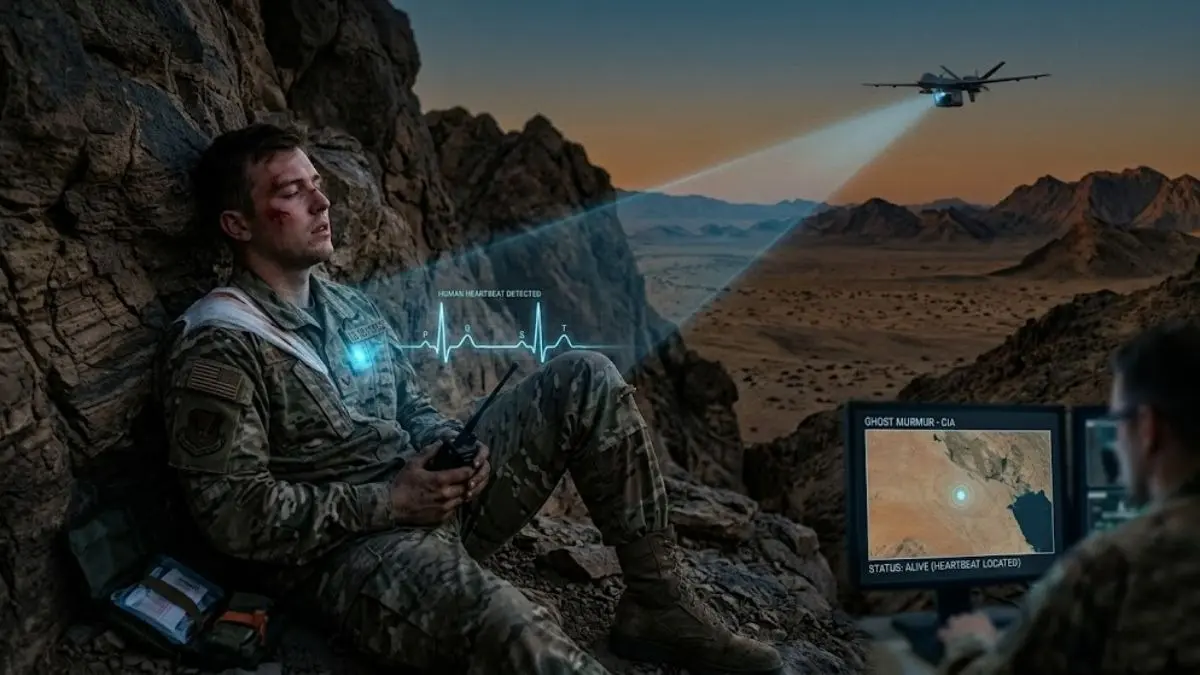
In the middle of a vast, silent desert in southern Iran, a wounded American airman lay hidden inside a mountain crevice, trying not to be seen, not to be heard, barely moving as enemy forces searched for him. There were no clear signals, no obvious movement, nothing that would normally give away his position. And yet, miles away, US intelligence had already found him.
Not by sight. Not by sound. But by his heartbeat.
The First Ever Use of ‘Ghost Murmur’
According to a report by the New York Post, the CIA used a highly classified system known as “Ghost Murmur” to locate the missing airman, marking what sources describe as its first real-world operational use. The rescue that followed was complex and risky, but what stands out is the technology that made it possible - a system that sounds like science fiction, yet may now be very real.
How the Technology Actually Works
At its core, Ghost Murmur works on a surprisingly simple idea. Every human heart produces a tiny electromagnetic signal when it beats. Under normal conditions, that signal is so faint it can only be detected in a hospital, with sensors placed directly on the chest. But this system changes the rules.
Advertisement
Using advances in quantum magnetometry, it can detect that same signal from far away. The technology relies on extremely sensitive sensors, reportedly built using specially engineered diamonds, that can pick up even the weakest magnetic fields. Once those signals are captured, artificial intelligence software filters out everything else - environmental noise, terrain interference, random electromagnetic activity - and isolates the unique rhythm of a human heartbeat.
Why the Desert Made It Easier
The conditions in southern Iran made this an ideal testing ground. The landscape is sparse, with very little electronic interference and almost no competing human presence. At night, the contrast between a living body and the cooler desert surroundings becomes sharper, offering an additional layer of confirmation. All of this combined to give operators a rare advantage: a clean environment where even the faintest signal could stand out.
Advertisement
The Moment That Changed the Search
The airman had activated a survival beacon at one point, but that alone wasn’t enough to pinpoint his exact location. What mattered more, according to sources quoted in the report, was that he had to briefly expose himself to send that signal. That moment may have helped Ghost Murmur lock onto him, turning a vague search into a precise detection.
Not a Magic Tool, Yet
Even with its breakthrough capability, the system is far from all-powerful. It reportedly works best in remote, low-noise environments and requires significant processing time to confirm a signal. In crowded or electronically dense areas, isolating a single heartbeat would be far more difficult. This is not a tool that sees everything everywhere, at least, not yet.
Much of Ghost Murmur remains classified, and the full extent of its capabilities is still unclear. But if the New York Post report is even partly accurate, this mission may mark a turning point - a moment where intelligence agencies proved they can track not just where someone is, but whether they are alive, by listening to the quiet, steady rhythm inside the human body.
In a place where a man had almost vanished without a trace, it was that rhythm - steady, invisible, unmistakably human - that led rescuers straight to him.