
Honeywell Trueno U8000 Review: Loud, Bass-Heavy, and Surprisingly Practical for Indian Homes
The Honeywell Trueno U8000 succeeds because it understands what most people actually want from a soundbar. Is this good enough for you?
- Tech News
- 6 min read

;'%3e%3cpath%20d='m8,15.99c4.41,0,7.99-3.58,7.99-7.99S12.41,0,8,0,0,3.59,0,8s3.58,7.99,7.99,7.99Z'%20style='stroke:%23fff;%20stroke-miterlimit:10;%20stroke-width:.02px;'/%3e%3cpath%20d='m3.08,3.37l3.82,5.11-3.84,4.15h.87l3.37-3.64,2.72,3.64h2.94l-4.04-5.39,3.58-3.87h-.86l-3.1,3.35-2.5-3.35h-2.94Zm1.27.64h1.35l5.97,7.99h-1.35l-5.97-7.99Z'%20style='fill:%23fff;'/%3e%3c/g%3e%3c/svg%3e)


Most TVs today look fantastic and sound disappointing. That’s especially true once you move to larger Mini LED or OLED panels. The visual experience becomes increasingly cinematic, while the built-in speakers continue sounding like they were designed primarily for YouTube reaction videos and weather updates. The Honeywell Trueno U8000 exists to solve exactly that problem.
After using it extensively with my TV setup, I came away fairly impressed, though not without reservations. At ₹19,999, the Trueno U8000 delivers the kind of loud, room-filling sound most people actually want in Indian households, while also offering enough flexibility to satisfy slightly more demanding users.
And thankfully, it doesn’t require an engineering degree to set up. Consumer audio companies still occasionally behave as if buyers enjoy decoding input formats for entertainment.
What’s Good
Setup is straightforward despite the large footprint
Unboxing the Trueno U8000 is technically a one-person job, but realistically, it’s better to have another pair of hands nearby, especially if you’re mounting or positioning the tweeters and subwoofer around a larger room.
Advertisement
Honeywell sending a technician after purchase genuinely helps here.-1779986146237.webp)
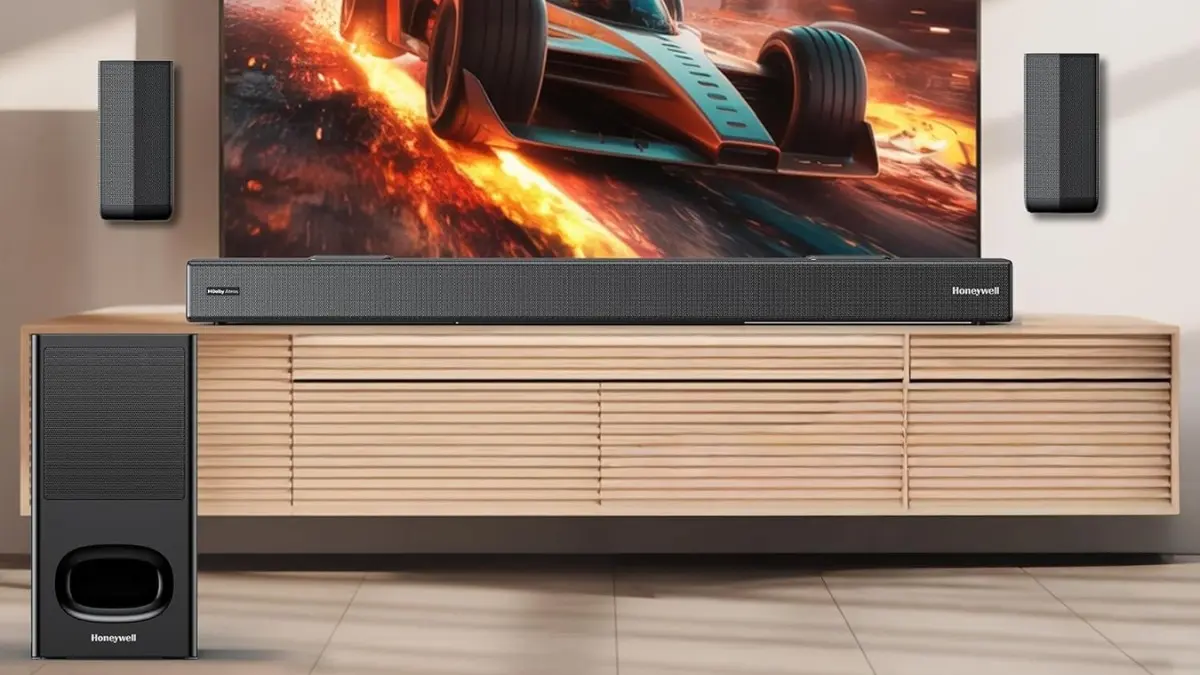
The system itself includes the main soundbar, a wireless-looking but wired-connected subwoofer setup, surround tweeters, remote control, HDMI cable, and power accessories. Depending on your room layout, speaker placement can dramatically affect the final soundstage, so professional installation makes sense.
Advertisement
Once everything is connected, the soundbar becomes very easy to live with.
For most users, the bundled HDMI cable through the eARC port is the best option. That setup gave me the lowest latency and the smoothest integration with my TV. The soundbar automatically powered on when the TV turned on and switched itself off when the TV shut down.
More importantly, volume controls synced properly between both remotes. That level of convenience matters because the best home theatre systems are the ones you stop thinking about after setup.
If you are more serious about audio equipment, the soundbar also supports SPDIF and optical connections. DJs or users with professional audio gear may appreciate that flexibility, although HDMI eARC will be sufficient for almost everyone.
The sound signature is unapologetically bass-heavy
The Trueno U8000 is a 5.1-channel system with a total 700W output, and it sounds exactly like a soundbar built for living rooms where people actually want to feel explosions, background scores, and dramatic soundtrack drops.
The bass response is aggressive in a good way.
Watching action movies, cricket broadcasts, concerts, or even loud Indian news debates immediately revealed how much fuller the room sounded compared to regular TV speakers. Even at lower volume levels, the soundbar easily filled my room without sounding weak or strained.
Interestingly, I kept returning to the Movie preset for nearly everything.
The soundbar offers dedicated presets for music, movies, news, and standard playback, but Movie mode consistently delivered the most balanced and immersive experience for me. It produced the crispest dialogue while maintaining enough bass and treble to keep movies, OTT shows, songs, and even YouTube content engaging.
The Music preset was oddly disappointing. Instead of enhancing musical depth, it toned down the thump and low-end energy significantly, which felt counterintuitive for a music-focused mode.
Thankfully, Honeywell gives users direct control over bass, treble, and mid frequencies through dedicated remote buttons. That turned out to be one of the most useful features during daily usage.
Streaming platforms like Netflix, Amazon Prime Video, and JioHotstar often mix dialogue poorly, where background music overwhelms softer voices. I frequently used the remote to reduce bass slightly and increase mid-level output to improve dialogue clarity during movies and web series.
That level of quick tuning makes a bigger difference than most people realise.-1779986154913.webp)
Dolby Atmos support genuinely improves OTT viewing
The Trueno U8000 supports Dolby Audio and Dolby Atmos, with Atmos being the more important feature here.
Watching supported content through OTT apps immediately adds a greater sense of space and immersion. Action sequences sound larger, environmental effects feel more directional, and background ambience becomes more convincing. Shows and movies on Netflix and Apple TV+ particularly benefited from Atmos playback.
The soundbar obviously cannot replicate the precision of a dedicated ceiling-speaker Atmos setup costing several times more, but for ₹19,999, the simulated spatial separation is respectable.
Honeywell also deserves credit for including proper eARC passthrough support. Atmos content transmitted correctly from my TV without requiring complicated setup adjustments.
Loudness is excellent for large rooms
This soundbar gets loud. And importantly, it maintains composure even at higher volumes.
Cheaper soundbars often start distorting or losing detail once volume crosses a certain threshold. The Trueno U8000 remained relatively controlled even when I pushed it aggressively during movie sessions or music playback.
The subwoofer also adds enough physical depth to make cinematic content feel more engaging without becoming excessively muddy.
What’s Bad
Dolby Atmos support for music is limited
This is not entirely Honeywell’s fault, but it affects the experience nonetheless. Most music streaming apps available through Google TV still do not support Dolby Atmos music playback properly. So while Atmos movies and OTT content sound impressive, music largely falls back to standard stereo processing.
The limitation becomes more noticeable if you use Apple Music or spatial audio playlists regularly on other devices.
I also noticed that Dolby Atmos did not work while streaming music from my iPhone over Bluetooth. Wireless playback sounded perfectly fine for casual listening, but it lacked the dimensionality available through wired or eARC-based Atmos playback.-1779986191199.webp)
The remote is practical, but not elegant
The bundled remote works reliably, but it feels slightly oversized and plasticky compared to the otherwise premium presentation of the soundbar. The button layout is functional, though, and I appreciated the dedicated audio tuning controls enough to tolerate the design.
Some presets feel unnecessary
The inclusion of multiple sound presets sounds useful on paper, but realistically, I found myself ignoring most of them after the first few days. Movie mode consistently outperformed the others, making the remaining presets feel more like checkbox additions than carefully tuned listening profiles.
Verdict
Rating: 4/5
The Honeywell Trueno U8000 succeeds because it understands what most people actually want from a soundbar. It is loud, bass-heavy, immersive, easy to set up, and flexible enough to improve almost every type of entertainment content significantly. Dolby Atmos support, strong room-filling sound, useful tuning controls, and seamless eARC integration make daily usage genuinely enjoyable.
At the same time, it is not an audiophile product. Some sound presets feel poorly tuned, Bluetooth Atmos support is absent, and finer sound details occasionally take a back seat to aggressive surround processing.
Still, at ₹19,999, the Trueno U8000 offers a surprisingly complete home theatre experience for people upgrading from standard TV audio.