
How Microsoft's Majorana 1 Chip Could Be Key to Solving Quantum Computing's Biggest Problem
Microsoft’s Majorana 1’s successful implementation could unlock a new era of quantum computing, which could leapfrog other architectures.
- Tech News
- 3 min read

;'%3e%3cpath%20d='m8,15.99c4.41,0,7.99-3.58,7.99-7.99S12.41,0,8,0,0,3.59,0,8s3.58,7.99,7.99,7.99Z'%20style='stroke:%23fff;%20stroke-miterlimit:10;%20stroke-width:.02px;'/%3e%3cpath%20d='m3.08,3.37l3.82,5.11-3.84,4.15h.87l3.37-3.64,2.72,3.64h2.94l-4.04-5.39,3.58-3.87h-.86l-3.1,3.35-2.5-3.35h-2.94Zm1.27.64h1.35l5.97,7.99h-1.35l-5.97-7.99Z'%20style='fill:%23fff;'/%3e%3c/g%3e%3c/svg%3e)


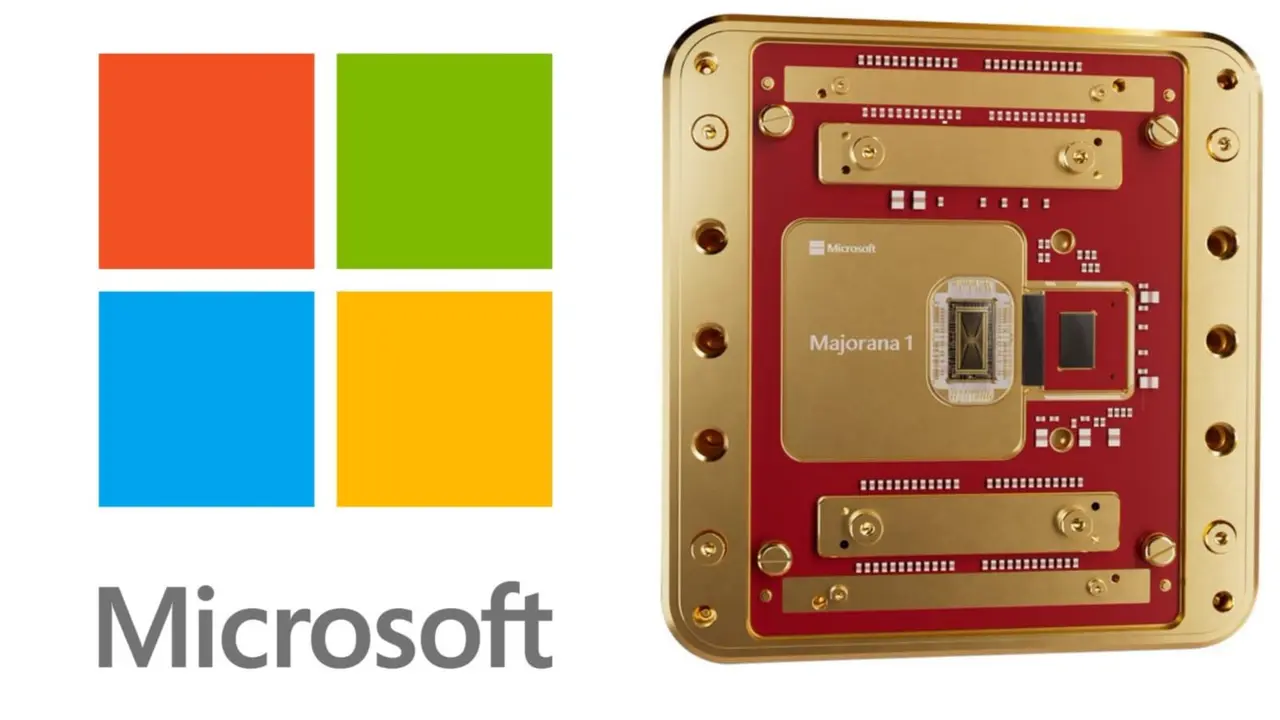
Majorana 1, deemed Microsoft’s groundbreaking quantum processing unit (QPU), marks the beginning of the next era of quantum computing. Built using a new class of materials called topoconductors, the Majorana 1 chip is claimed to achieve the scale that has mostly appeared elusive but it will play a significant role in solving the biggest challenge in quantum computing: error correction and decoherence.
What are quantum error correction and decoherence?
Quantum computing uses quantum bits, or qubits, — made from electrons, photons, and trapped ions — to store information, but unlike binary bits in classic computing, qubits are fragile, so much so that a large number of physical qubits are needed to create a single reliable logical qubit. This process is called quantum error correction aimed at preserving quantum information, while the system fostering it is known as quantum error-correcting codes (QECCs).
Qubits are also prone to external influences, such as sound waves, vibrations, and temperature changes, causing them to lose their behaviour and information. This phenomenon is known as decoherence, where scaling up a qubit’s coherence time is a challenge.
Both quantum error correction and decoherence collectively pose what the industry has realised as the biggest problem in quantum computers. The existing state of even the best of the best quantum processors has only hundreds of qubits, but practical quantum advantage can be achieved only when thousands or even millions of qubits are used. Enter Majorana 1, which, as Microsoft CEO Satya Nadella explained, is made of a “new state of matter,” which allows qubits to be faster, smaller, and more stable than their current counterparts.
Advertisement
Microsoft has used its innovation in the design of years and “fabrication of gate-defined devices that combine iridium arsenide (a semiconductor) and aluminium (a superconductor).” The new type of material resulted from a process wherein these devices were cooled to near absolute zero and tuned with magnetic fields to “form topological superconducting nanowires with Majorana Zero Modes (MZMs) at the wires’ ends.”
How will Majorana 1 help?
The topological qubits in Majorana 1 are inherently resistant to decoherence, causing better preservation of information when an external factor is introduced. They are also naturally resistant to environmental noise and disturbances since they store quantum information in a non-local way, so decoherence is minimal (microseconds to milliseconds). This results in lower error rates while needing comparatively smaller quantum error correction.
Advertisement
Microsoft says it takes a measurement-based approach to simplify QEC “dramatically,” adding that it performs “error correction entirely through measurements activated by simple digital pulses that connect and disconnect quantum dots from nanowires.” Quantum information encoded in MZMs, which uses topological nanowires, can move from physics breakthrough to practical information, solving a major hurdle in quantum computing.
If what Microsoft hopes works out in its favour, its topological qubits could drastically lower the number of qubits required for fault-tolerant quantum computing. That could allow Microsoft to turn large-scale quantum computers into reality.
Why is Majorana 1 a big deal?
Microsoft’s Majorana 1’s successful implementation could unlock a new era of quantum computing, which could leapfrog other architectures by significantly reducing hardware complexity and error correction overhead. Scaling up fault-tolerant quantum computing systems will be achievable in years, not decades. It could be applied in several industries, including cryptography, materials science, and Artificial General Intelligence (AGI). It could also be Microsoft’s answer to IBM’s superconducting qubits and Google’s Sycamore chip.