
No, Google Didn't Predict Venezuela's Earthquake, Here's What Actually Happened
Two massive earthquakes struck northern Venezuela within seconds, but Google’s Android-based earthquake detection system alerted some residents before the shaking began. Learn how smartphones act as seismometers, why Google’s alerts work, and what this means for countries without traditional seismic warning networks.
- Tech News
- 4 min read

;'%3e%3cpath%20d='m8,15.99c4.41,0,7.99-3.58,7.99-7.99S12.41,0,8,0,0,3.59,0,8s3.58,7.99,7.99,7.99Z'%20style='stroke:%23fff;%20stroke-miterlimit:10;%20stroke-width:.02px;'/%3e%3cpath%20d='m3.08,3.37l3.82,5.11-3.84,4.15h.87l3.37-3.64,2.72,3.64h2.94l-4.04-5.39,3.58-3.87h-.86l-3.1,3.35-2.5-3.35h-2.94Zm1.27.64h1.35l5.97,7.99h-1.35l-5.97-7.99Z'%20style='fill:%23fff;'/%3e%3c/g%3e%3c/svg%3e)


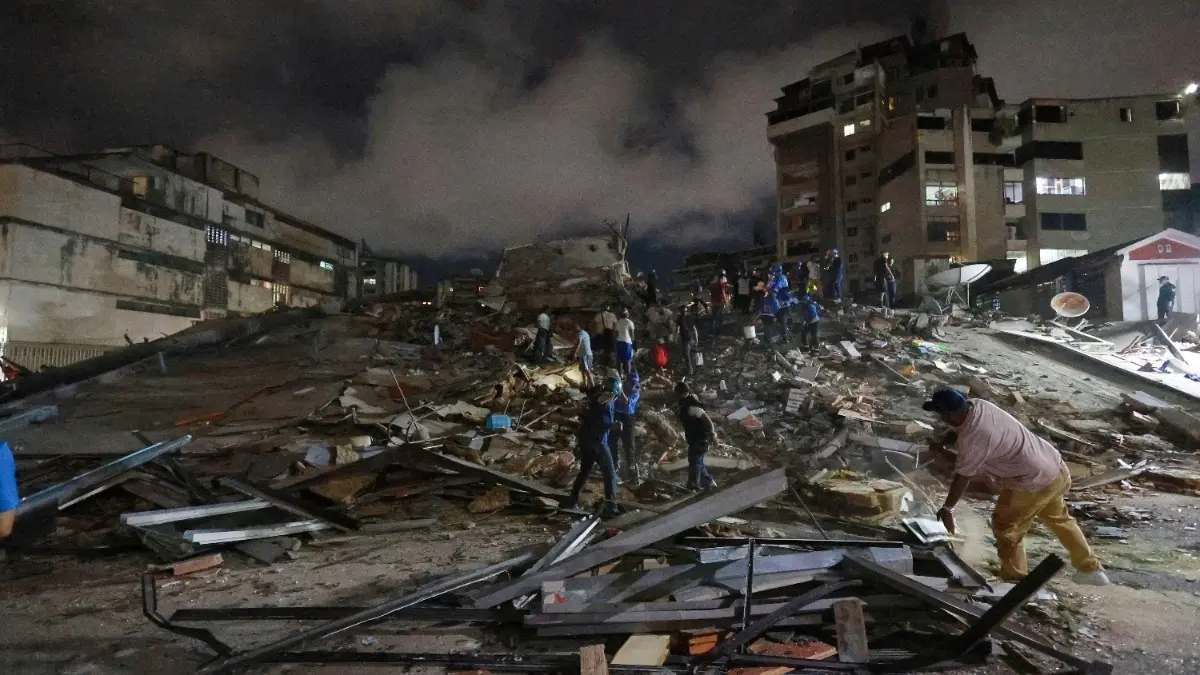
When two massive earthquake, a magnitude 7.2 followed just 39 seconds later by a 7.5, tore through northern Venezuela on Wednesday, some residents say their phones buzzed with a warning before they felt anything. The first quake struck at 6:04 p.m. ET, with the larger 7.5 mainshock following roughly 39 seconds later. On X, screenshots circulated showing Google alerts flagging a quake roughly 212 miles away, seconds ahead of the shaking. Naturally, people are asking: how did Google know an earthquake was coming?
The honest answer is a little less magical than "Google predicted it" and a lot more interesting.
It's not prediction. It's a head start.
Google didn't see the future. What it did was win a race against the ground itself.
When an earthquake starts, it releases two kinds of waves. The fast, less destructive P-waves arrive first. The slower S-waves and surface waves, the ones that actually shake buildings and snap power lines, arrive seconds to tens of seconds later depending on how far you are from the epicenter. Internet and cellular signals, traveling near the speed of light, can outrun those slow seismic waves easily over a distance of even a hundred miles.
Advertisement
So the moment Google's system detects the start of a quake near the epicenter, it has a brief window, sometimes just a few seconds, sometimes closer to a minute for people farther away, to fire off a warning before the worst of the shaking reaches them. That's the entire trick. It's detection plus a head start, not foresight.
How Google actually detected it using your phone as a seismometer
Here's the part of the story that's specific to Venezuela: the country has no traditional government earthquake warning network, no underground seismometers feeding a system like California's ShakeAlert. Outside the U.S. states that use ShakeAlert, Google relies on a crowdsourced approach, since all smartphones contain tiny accelerometers that can sense vibrations indicating a possible earthquake.
Advertisement
In practice, that means every Android phone with the feature enabled is quietly doubling as a low-grade seismometer. When a phone detects something that looks like shaking, it sends a signal to Google's earthquake detection server along with a rough location, and the server combines data from many phones to determine whether an earthquake is actually happening. This turns the more than two billion Android phones in use worldwide into what Google calls the largest earthquake detection network on the planet.
Once enough phones agree something is shaking, the system estimates the magnitude and pushes out one of two alerts- a milder "Be Aware" notice for light shaking, or an urgent "Take Action" alert for moderate-to-severe shaking that prompts immediate protective action. That's almost certainly the alert Venezuelan users saw- built not from government sensors, but from the phones of strangers around them.
Why this matters
The real story here isn't that Google has some clever notification feature. It's that a private company has quietly become the de facto national earthquake warning system for dozens of countries that never built one of their own. The same crowdsourced technology is already delivering alerts in 97 countries, many of which, like Venezuela, sit on dangerous fault lines but lack the budget or infrastructure for a dedicated seismic network.
That's a genuine public good. It's also a genuine governance question: emergency warning systems have historically been the job of national governments and agencies like the USGS, not ad-tech companies. When the system that decides whether to wake up a city in the middle of the night runs on a private algorithm, the usual questions about transparency and accountability, who audits it, what happens if it's wrong, what data it collects don't go away just because it works.
For Venezuela, in the middle of a humanitarian crisis already, those extra few seconds may have mattered. The bigger question of whether the world should be this reliant on one company's phones to do a government's job is the one worth sitting with.