
Quantum AI Can Solve Major Business Problems In 3-5 Years: Utpal Chakraborty, Souvik Chakraborty In AI Summit 2026
Both Dr. Utpal Chakraborty and Souvik Chakraborty stressed on India actively developing AI, with a focus on domain-specific models, and applying it on concepts like Smart Cities and Smart Infrastructure. They pointed out the nation’s focus on quantum AI and neuromorphic (brain-inspired) AI research.

;'%3e%3cpath%20d='m8,15.99c4.41,0,7.99-3.58,7.99-7.99S12.41,0,8,0,0,3.59,0,8s3.58,7.99,7.99,7.99Z'%20style='stroke:%23fff;%20stroke-miterlimit:10;%20stroke-width:.02px;'/%3e%3cpath%20d='m3.08,3.37l3.82,5.11-3.84,4.15h.87l3.37-3.64,2.72,3.64h2.94l-4.04-5.39,3.58-3.87h-.86l-3.1,3.35-2.5-3.35h-2.94Zm1.27.64h1.35l5.97,7.99h-1.35l-5.97-7.99Z'%20style='fill:%23fff;'/%3e%3c/g%3e%3c/svg%3e)


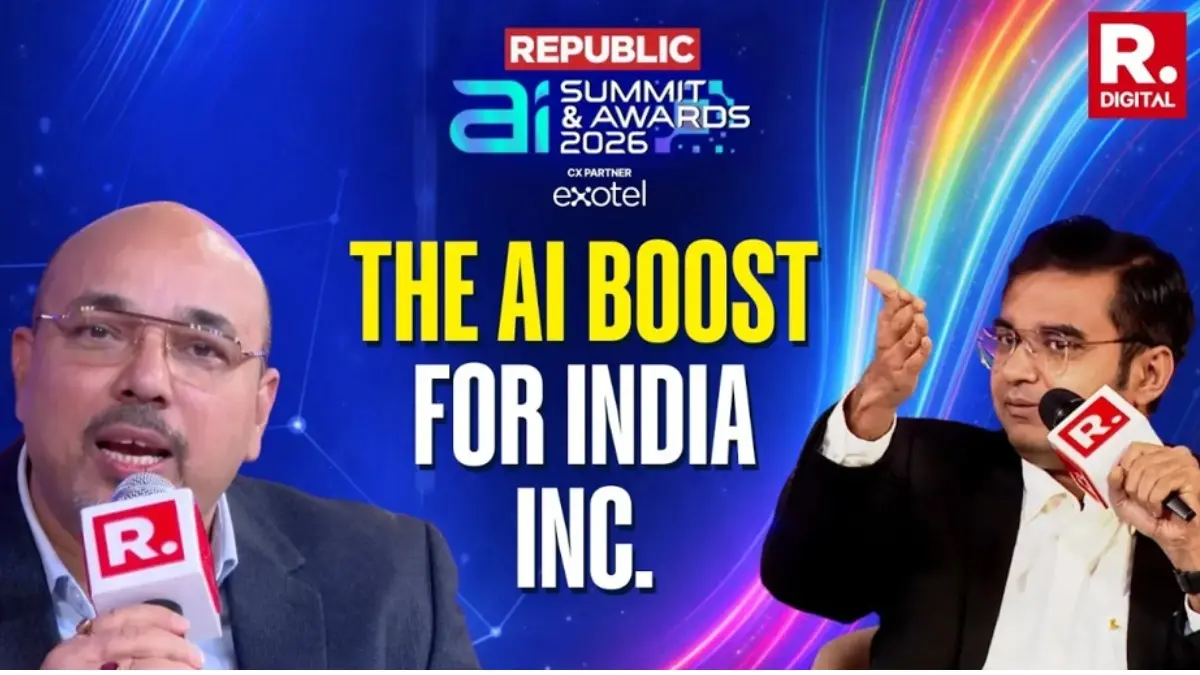
New Delhi: At the AI Summit and Awards 2026, (PhD) Dr. Utpal Chakraborty (Quantum Scientist, AI Researcher and Author) and Souvik Chakraborty (Associate Professor, IIT Delhi) took the stage to speak on ‘The AI Boost for India Inc’. Both gave a realistic look into the progress made by India in the field of AI, including the Smart Infrastructure, Quantum Computing and Semiconductor niches, along with a bright picture of what the future looks like for India in terms of AI Sovereignty.
Here’s a brief lay down of what they covered in their session.
Current AI Landscape in India
Both Dr. Utpal and Souvik stressed on India actively developing AI, with a focus on domain-specific models, and applying it on concepts like Smart Cities and Smart Infrastructure. Additionally, they proudly pointed out the nation’s focus on quantum AI and neuromorphic (brain-inspired) AI research, which has been termed as the "Third wave of AI" for its energy efficiency.
Quantum AI and the Semiconductor Industry
Though they accept the fact that Quantum computers are currently at a research level and not yet ready for widespread business applications, Dr. Utpal and Souvik also highlighted the rapid progress made by India in this regard. In fact, they claim that within 3-5 years, such applications are expected to solve major business problems.
Advertisement
Coming to Quantum computers, they both anticipate this technology to be millions of times faster than classical computers, providing a significant boost to AI.
Both also acknowledge India's dependence on Nvidia for AI chip development due to their GPU chips and the CUDA software ecosystem. They emphasize the Indian government's focus on building its semiconductor industry to reduce this reliance. A major highlight of this session was how they claimed Quantum Computing to be a potential answer to counter this dominance, as quantum processors consume very less energy.
Advertisement
Challenges and Opportunities
Dr. Utpal and Souvik highlight 2 main challenges that India faces in the field of AI.
The first one is the long standing Brain Drain issue. Till date, talented AI scientists and engineers often prefer to work abroad due to better financial opportunities and quality of living. The second challenge they point to, is the Lack of Industry and Startups, which can also be considered to be a causative factor for Brain Drain.
Dr. Utpal and Souvik highlight that India previously lacked the kind of risk-taking industry and startups like OpenAI, Google, or Facebook that drove LLM development globally. This is, however, changing with increased funding and initiatives like the India AI mission.
Furthermore on this positive note, both highlighted the scope for Human-AI collaboration in the future. They start out by shattering the myth of AI replacing humans as instead of that, AI is expected to rather enhance human capabilities. AI will not be fully autonomous as it lacks consciousness, which is an intrinsic human property. So when it comes to decision-making, human beings will always be in the loop.
Other domains where AI potential was highlighted, were AI being integrated into the physical world, influencing design, manufacturing, monitoring, and decision-making in areas like smart infrastructure (bridges that can self-repair). Additionally, the focus according to them should also be on developing smaller, energy-efficient models that can run on devices like mobile phones, moving away from large data centers.
Dr. Utpal and Souvik unanimously agreed on the notion that the future of AI in India will be characterized by AI sovereignty. Dependence on foreign AI models, especially for critical services, poses a national security threat due to unknown architectures, data sources, and compliance issues.
India's "sovereign model initiative" aims to build its own domain-specific AI models for critical services, such as the "Ghana initiative" for cybersecurity. India is already developing its own AI systems, albeit on a smaller scale and often within academic silos, with plans for more widespread public release.
Who are Dr. Utpal and Souvik Chakraborty?
Dr. Utpal Chakraborty is a globally recognised Quantum Scientist, AI researcher, strategist, and author, known for working at the intersection of advanced AI systems, quantum computing, and national-scale AI adoption. He has had experience in enterprise leadership, research, policy advisory, and education. It’s his experience on sovereign AI models, responsible AI frameworks, and future technologies that he brought to the AI Summit and Awards 2026.
An Associate Professor at IIT Delhi, Prof. Souvik Chakraborty, brings an academic perspective to the AI dialogue. His work in machine learning, scientific AI, and physics-informed models ensures that AI systems are not just powerful, but also robust, interpretable, and grounded in real-world science. It’s these insights which he brought to the AI Summit and Awards 2026.
We would like to thank our CX Partner - Exotel: Experience The New CX for making the AI Summit & Awards 2026 possible.