
Xiaomi Pad 8 Review: A Tablet That Finally Feels Like a Work Companion
The Xiaomi Pad 8 comes with a large display, multiple speakers, a capable camera, and a battery that simply refuses to die. But is it worth your money?
- Tech News
- 8 min read

;'%3e%3cpath%20d='m8,15.99c4.41,0,7.99-3.58,7.99-7.99S12.41,0,8,0,0,3.59,0,8s3.58,7.99,7.99,7.99Z'%20style='stroke:%23fff;%20stroke-miterlimit:10;%20stroke-width:.02px;'/%3e%3cpath%20d='m3.08,3.37l3.82,5.11-3.84,4.15h.87l3.37-3.64,2.72,3.64h2.94l-4.04-5.39,3.58-3.87h-.86l-3.1,3.35-2.5-3.35h-2.94Zm1.27.64h1.35l5.97,7.99h-1.35l-5.97-7.99Z'%20style='fill:%23fff;'/%3e%3c/g%3e%3c/svg%3e)


Xiaomi’s presence in the tablet market has been quietly growing, and at this point, it is hard to ignore. While the company is still better known for its smartphones, its tablets are now inching closer to what Samsung and Apple have been offering for years, sometimes even undercutting them where it matters.
The Xiaomi Pad 8 is another step in that direction. It may not immediately dethrone iPads or Galaxy Tabs, but it makes a strong case for why Xiaomi’s tablets deserve the same level of consideration.
At its core, the Pad 8 does not try to be something radically different. It still comes with a large display, multiple speakers, a capable camera, and a battery that simply refuses to die. But what stood out to me was how well it works as a companion device for work, especially if your workflow sits somewhere between productivity and creativity.

What’s Good
Design and Build: Looks simple, works everywhere
The aluminium back and frame give the Pad 8 a sturdy, premium feel without trying too hard. It has that clean, neutral design that fits almost anywhere. I could place it on my work desk or casually carry it to a café, and it never felt out of place.
Advertisement
At around 494g, it is not exactly light, but I never felt it was uncomfortably heavy. The weight distribution is done well, which makes a difference when you are holding it for long hours, whether for watching something or getting work done.
The form factor works both ways. I used it in portrait while reading and in landscape while working or watching videos, and it felt equally comfortable.
Advertisement
That said, the camera bump can get slightly annoying. It causes a wobble when placed on a flat surface, and I quickly learned to avoid keeping it camera-down.
The buttons are easy to reach, but since they are placed on different edges, it took me a couple of days to get used to their positions.
Display and Audio: Built for both binge and work
Xiaomi gives you two display options here, and I think that choice matters more than most people will realise.
The standard LCD panel is good enough. It is sharp, colours are decent, and for everyday use, it does not feel lacking. But if you spend a lot of time reading, writing, or editing, the nano-texture display is worth considering.
I noticed the difference almost immediately. The reduced glare makes it much easier to use in bright environments, whether I was sitting near a window or working in a café. It is one of those features that does not scream for attention but quietly improves the experience.
Watching content is where the tablet really settles in. I watched episodes of The Boys on Prime Video, and the HDR performance looked great. Dolby Vision support on Netflix makes things even more immersive.
The quad speakers get loud enough to fill a room, but I still found them lacking depth. There is volume, but not enough richness. An iPad still does a better job here.
The adaptive refresh rate works as expected. Scrolling through Instagram feels smooth, while reading articles or e-books helps save battery. I also liked the Reading Mode. It is genuinely soothing for long sessions and probably one of the best implementations I have seen in this segment.
The 11.2-inch display also works surprisingly well for productivity. I found myself comfortably working on Excel sheets, which is not something I say often about tablets.
Performance: Handles more than you expect
The Snapdragon 8s Gen 4 is not the fastest chip out there, but I never felt it was holding me back.
I used the tablet for multiple tasks, including keeping several Chrome tabs open, working on documents, and even trying out some high-graphics games. It handled everything without noticeable stutters.
My unit had 12GB RAM, and that clearly helped. Multitasking felt smooth, and apps stayed in memory longer. I suspect the 8GB variant might struggle a bit if you push it too hard.
Storage goes up to 256GB, but there is no expansion option. Personally, I would have preferred either higher storage variants or microSD support. For now, cloud storage is the only fallback.
Software and Productivity: Useful, but not perfect
HyperOS 3, based on Android 16, is where things get interesting.
The AI tools are not just there for show. I used transcription for interviews, and the results were mostly accurate. Summarisation also helped me quickly identify key points without going through everything again.
These are the kind of tools that actually save time, even if your work is not heavily creative.
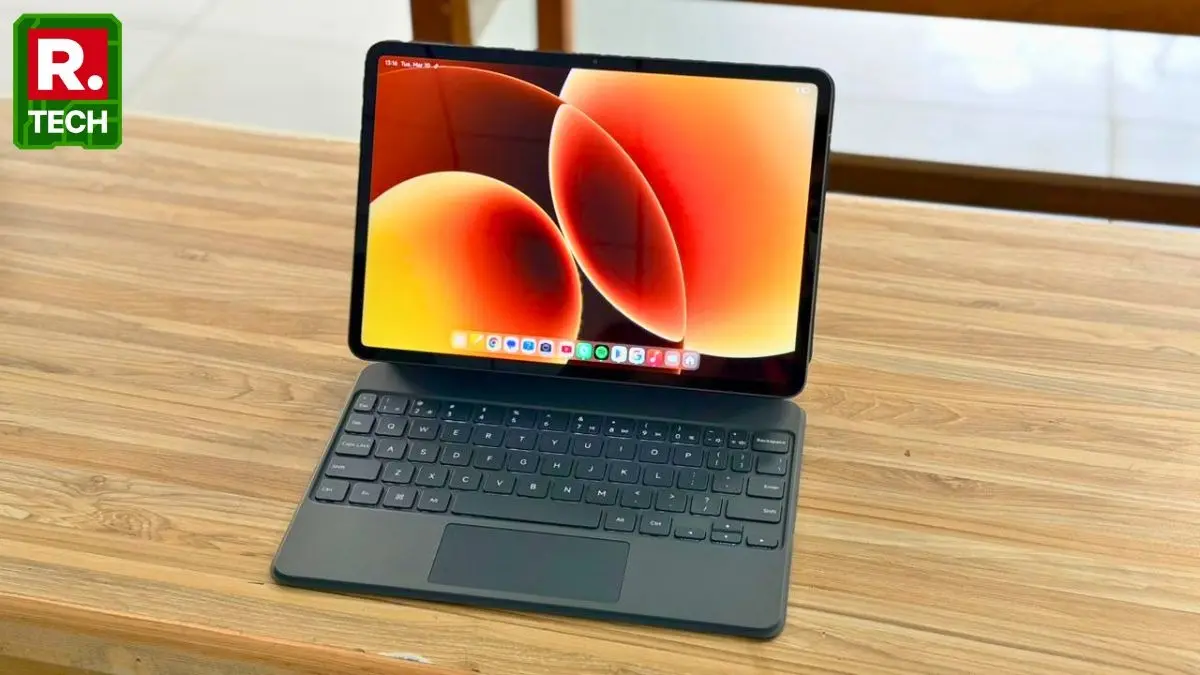
The Focus Keyboard is another highlight. The key travel feels good, and I could comfortably type for long periods. The backlit keys help in low-light conditions, and the built-in trackpad means I did not need to carry a separate mouse.
That said, the trackpad can be inconsistent depending on the app. It works well most of the time, but occasionally feels like it is not fully optimised. Apple’s Magic Keyboard still does this better.
I did have one major issue with the software. HyperOS switches between tablet mode and laptop mode, and that affects how apps behave.
In tablet mode, apps scale properly and can be resized freely. In laptop mode, forced scaling causes issues. Apps like Netflix would sometimes restart or appear in awkward sizes. It did not break the experience, but it was annoying enough to notice.
The good part is that I did not encounter any major bugs. Connectivity was also solid. File transfers with Xiaomi phones worked smoothly, and continuity features like taking calls on the tablet were genuinely useful. Wi-Fi performance remained stable across different networks.
Stylus and Accessories: Great utility, questionable magnet
The Xiaomi Smart Pen is a useful addition if you are into sketching or note-taking.
It attaches magnetically to the tablet and charges that way. But the magnetic hold is not very strong. I had to stop it from falling multiple times while moving around in the newsroom.
Carrying it in a bag solves the problem, but if you are someone who casually walks around with the tablet, you will need to be careful.
In terms of performance, the pen is precise. I did not notice any lag while sketching or writing.
Battery Life: Just refuses to die
This is easily one of the strongest aspects of the Pad 8. The 9200mAh battery comfortably lasted two days in my usage, which included watching videos, browsing, and working. I rarely felt the need to charge it frequently.
Xiaomi’s battery management in HyperOS deserves credit here. It does a good job of optimising power usage. You can binge-watch an entire season without worrying about plugging it in. For a tablet in this segment, this is easily among the best battery performances I have seen.
Cameras: Better than expected for a tablet
The 13MP rear camera is not something you will use often, but it gets the job done. I used it for scanning documents and occasional photos for work, and the results were clear with fairly accurate colours.
The 8MP front camera matters more. Video calls were clear, though I did feel exposure control could have been better.
What’s Bad
Display still falls short of iPads
As good as the display is, it still does not match what an iPad offers in terms of colour richness and overall visual depth.
Speaker quality lacks depth
The speakers are loud, but they do not have the depth you would expect at this level.
Software scaling issues in laptop mode
The switch between tablet and laptop modes feels inconsistent, especially with app scaling.
Stylus magnet could have been stronger
The pen attachment is not secure enough if you are moving around frequently.
No expandable storage
You are stuck with what you buy. Cloud storage becomes necessary for heavy users.
Verdict
Rating: 4/5
The Xiaomi Pad 8 feels like a tablet that understands what most people actually need. It is not trying to beat the iPad at everything, and it does not need to. Instead, it focuses on delivering a balanced experience across productivity, entertainment, and battery life. For working professionals, students, and creators, it hits a sweet spot. It is powerful enough for serious work, comfortable enough for long usage, and affordable enough to make sense.
It starts at ₹33,999 and goes up to ₹43,999 for the nano-texture display variant with accessories.
If you want the absolute best display and ecosystem, an iPad still holds the crown. But if you want a tablet that gets most things right without burning a hole in your pocket, the Pad 8 is very easy to recommend.