
Your Apple Watch Can Now Alert You to Sleep Apnoea in India. Here's How It Actually Works
This piece explains what sleep apnoea features on Apple Watch and AirPods do, how they work under the hood, and what the clinical evidence actually says about their reliability.
- Tech News
- 5 min read

;'%3e%3cpath%20d='m8,15.99c4.41,0,7.99-3.58,7.99-7.99S12.41,0,8,0,0,3.59,0,8s3.58,7.99,7.99,7.99Z'%20style='stroke:%23fff;%20stroke-miterlimit:10;%20stroke-width:.02px;'/%3e%3cpath%20d='m3.08,3.37l3.82,5.11-3.84,4.15h.87l3.37-3.64,2.72,3.64h2.94l-4.04-5.39,3.58-3.87h-.86l-3.1,3.35-2.5-3.35h-2.94Zm1.27.64h1.35l5.97,7.99h-1.35l-5.97-7.99Z'%20style='fill:%23fff;'/%3e%3c/g%3e%3c/svg%3e)


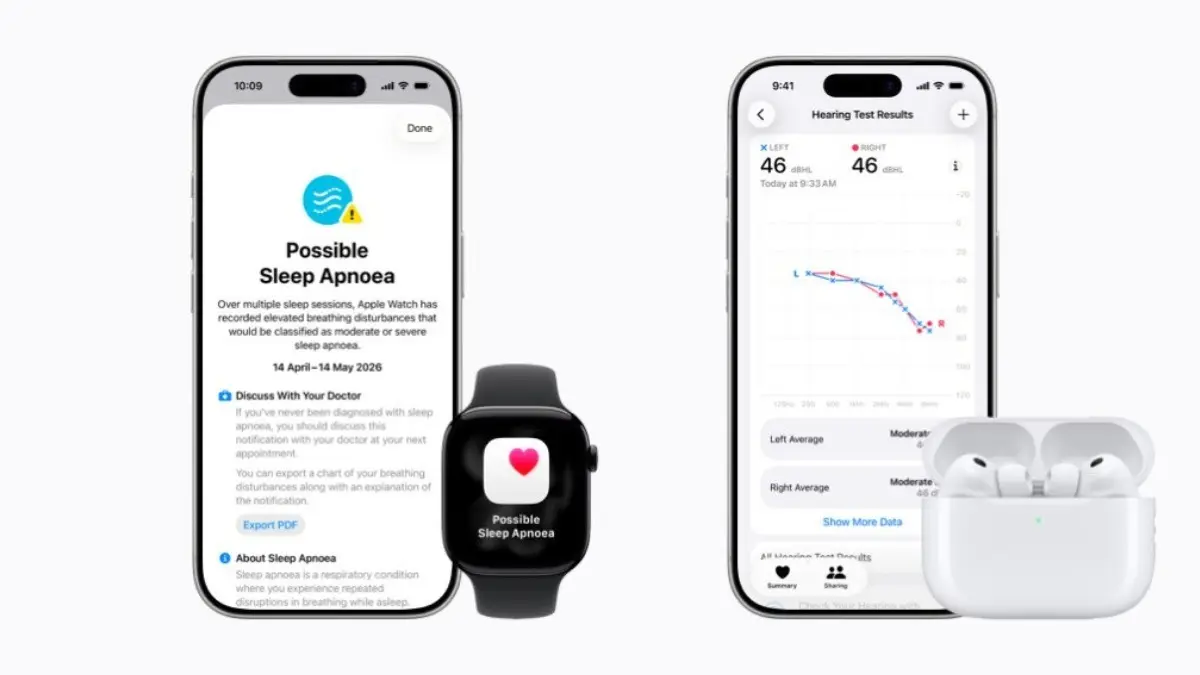
Apple has quietly enabled two of its most clinically significant health features for Indian users: sleep apnoea notifications on the Apple Watch and an at-home hearing test through AirPods Pro 2 and Pro 3. Neither feature is new globally, but their arrival in India matters given the country's enormous burden of undiagnosed sleep and hearing disorders. This piece explains what these features do, how they work under the hood, and what the clinical evidence actually says about their reliability.
What is Sleep Apnoea, and Why Does It Go Undetected?
Sleep apnoea is a condition in which breathing repeatedly stops and starts during sleep. The most common form, obstructive sleep apnoea (OSA), occurs when throat muscles intermittently relax and block the airway. Most people who have it do not know, because the episodes happen during sleep and rarely wake the person fully. If the watch detects repeated abnormal breathing patterns over time, it may send a notification suggesting you consult a doctor, though it cannot diagnose sleep apnoea on its own.
The condition is estimated to affect over 1 billion people globally, with a significant majority of cases remaining undiagnosed. Left untreated, chronic sleep apnoea is associated with long-term health risks including hypertension, type 2 diabetes, and cardiovascular disease. India's urban population, with its high rates of obesity, stress, and disrupted sleep schedules, carries a disproportionate share of this burden.
Advertisement
How the Apple Watch Detects It
Apple's approach introduces a new metric called Breathing Disturbances. The feature uses the Apple Watch's accelerometer to detect microscopic wrist movements that correlate with disruptions in normal respiratory patterns during sleep. The watch does not measure airflow directly, which is an important distinction. It is inferring respiratory events from motion data rather than measuring breathing itself.
Advertisement
The Apple Watch analyses this data over 30-day intervals. If the algorithm detects consistent signs of moderate to severe sleep apnoea, it triggers a notification advising the user to consult a medical professional. Users can also export a PDF from the Health app detailing three months of breathing disturbance data, specific instances of potential apnoea, and educational context to facilitate discussions with healthcare providers.
Beyond screening for apnoea, the Breathing Disturbances metric tracks general sleep restlessness. Because these disturbances can be influenced by external factors like alcohol consumption, medication, and sleep position, users can monitor nightly trends categorised as "elevated" or "not elevated" over one-month, six-month, or one-year periods.
What the Clinical Evidence Says
The most rigorous publicly available validation data comes from the FDA clearance study, which supports the feature's use in the US and informs its rollout elsewhere. The clinical trial analysed data from 1,448 participants with apnoea-hypopnoea index values ranging from normal to severe. The feature showed a weighted sensitivity of 66.3 per cent and a specificity of 98.5 per cent for identifying moderate-to-severe sleep apnoea.
Those numbers require some unpacking. A sensitivity of 66.3 per cent means the feature will miss roughly one in three cases of moderate to severe sleep apnoea. A specificity of 98.5 per cent means it generates very few false positives, so when it does send an alert, it is highly likely something is genuinely wrong. The Apple Watch is therefore more useful as a low-friction screening tool than as a diagnostic instrument. It is not FDA-cleared for diagnosis, and Apple does not position it as such.
Separately, a peer-reviewed study published in 2025 tested an algorithm using only Apple Watch accelerometer signals on 61 adults undergoing clinical polysomnography, the gold standard sleep study. The best-performing model achieved an AUC of 0.831 in the test group, with per-subject predictions strongly correlating with clinical apnoea-hypopnoea index scores. The study validated the underlying premise that wrist-based motion sensing can meaningfully correlate with clinical sleep apnoea data, even if the correlation is not perfect.
The practical value of the feature for India lies less in its clinical precision and more in its accessibility. A formal sleep study (polysomnography) in India costs anywhere between ₹8,000 and ₹25,000, requires a hospital visit, and involves sleeping overnight with electrodes attached to the body. The Apple Watch offers a continuous, passive, at-home alternative that, while less accurate, reaches a far larger population, including those who would never seek a formal diagnosis.
The AirPods Pro Hearing Test: How It Works
Because hearing loss typically progresses gradually, many individuals remain unaware of its onset. Apple's Hearing Test feature on AirPods Pro 2 and Pro 3, used with a compatible iPhone or iPad, is based on pure-tone audiometry, the standard clinical approach. The test takes approximately five minutes, is conducted entirely at home, and produces an audiogram, a numerical map of hearing sensitivity per ear, along with actionable recommendations.
Developed using large-scale, real-world data and insights from the Apple Hearing Study, the feature uses advanced acoustic science to deliver clinical-grade results. Once completed, the audiogram is stored in the Health app, where it can be shared with a physician for further evaluation.
Who These Features Are For
Both features are designed for people who would not otherwise seek professional evaluation. For sleep apnoea, that means the large cohort of middle-aged adults in India with undiagnosed OSA, particularly men over 40 with sedentary lifestyles, where prevalence is estimated to be highest. For hearing, the primary beneficiaries are those experiencing a gradual hearing decline, where the change is too slow to notice subjectively but measurable by an audiogram over time.
Neither feature replaces a doctor. Both features make the case for seeing one considerably easier to act on.