
Arctic Ocean began warming rapidly decades earlier than expected, study confirms
According to a recent study, the Arctic Ocean has been warming from the start of the 20th century, decades sooner than existing records show.
- Science News
- 3 min read

;'%3e%3cpath%20d='m8,15.99c4.41,0,7.99-3.58,7.99-7.99S12.41,0,8,0,0,3.59,0,8s3.58,7.99,7.99,7.99Z'%20style='stroke:%23fff;%20stroke-miterlimit:10;%20stroke-width:.02px;'/%3e%3cpath%20d='m3.08,3.37l3.82,5.11-3.84,4.15h.87l3.37-3.64,2.72,3.64h2.94l-4.04-5.39,3.58-3.87h-.86l-3.1,3.35-2.5-3.35h-2.94Zm1.27.64h1.35l5.97,7.99h-1.35l-5.97-7.99Z'%20style='fill:%23fff;'/%3e%3c/g%3e%3c/svg%3e)


According to a recent study, the Arctic Ocean has been warming from the start of the 20th century, decades sooner than existing records show. The study's findings were published in the journal 'Science Advances'. An international team of researchers rebuilt the recent history of ocean warming in the Fram Strait, which connects Greenland and Svalbard and serves as a gateway to the Arctic Ocean.
The researchers discovered that the Arctic Ocean began rapidly warming at the beginning of the last century as warmer and saltier waters flowed in from the Atlantic - a phenomenon known as Atlantification - and that this change likely occurred before the warming documented by modern instrumental measurements. The temperature of the water has risen by about 2 degrees Celsius since 1900, while sea ice has receded and salinity has risen. The results support the first historical perspective on the Arctic Ocean's Atlantification and demonstrate a far stronger relationship to the North Atlantic than previously imagined.
Arctic Ocean study reveals the ocean started getting warmer decades earlier than expected
As the polar ice sheets continue to melt, the relationship has the potential to shape Arctic climate variability, which might have significant implications for sea-ice retreat and global sea-level rise. Climate change is warming the world's oceans, but the Arctic Ocean, the world's smallest and shallowest ocean, is warming the quickest of all. Atlantification is one of the causes of warming in the Arctic.
"The rate of warming in the Arctic is more than double the global average, due to feedback mechanisms. Based on satellite measurements, we know that the Arctic Ocean has been steadily warming, in particular over the past 20 years, but we wanted to place the recent warming into a longer context.", said co-lead author Dr Francesco Muschitiello from Cambridge's Department of Geography.
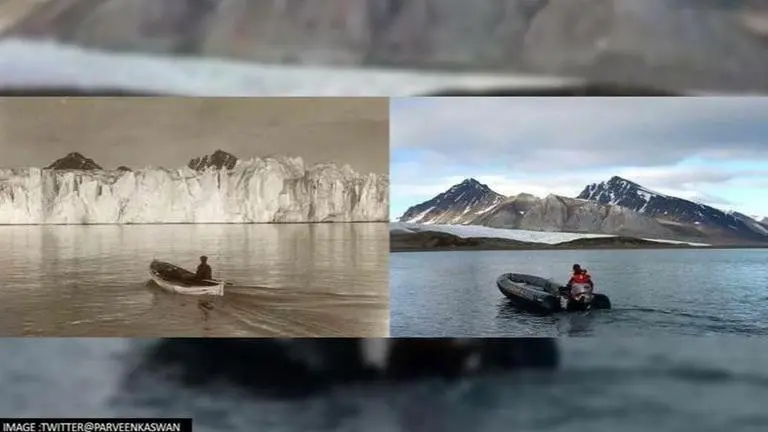
This is Arctic 105 years apart. Both picture taken in summer. Do you notice anything special. Courtesy Christian Åslund. pic.twitter.com/9AHtLDGKRb
— Parveen Kaswan, IFS (@ParveenKaswan) November 24, 2021
Reconstruction of climate change and global warming prediction models
As the Arctic Ocean warms, the ice in the arctic area melts, affecting global sea levels. As the ice melts, more of the ocean's surface is exposed to light, allowing heat to escape and rising air temperatures. As the Arctic warms, the permafrost melts, releasing massive amounts of methane, a significantly more destructive greenhouse gas than carbon dioxide. The researchers reconstructed the change in water column properties over the last 800 years using geochemical and ecological data from ocean sediments. They used a variety of ways to precisely date sediments and looked for definitive evidence of Atlantification, including temperature and salinity changes. According to the researchers, their findings reveal a potential fault in climate models because they do not replicate early Atlantification at the turn of the century. Francesco Muschitiello is a fellow of Cambridge's Sidney Sussex College.
Advertisement
"When we looked at the whole 800-year timescale, our temperature and salinity records look pretty constant. But all of a sudden at the start of the 20th century, you get this marked change in temperature and salinity - it really sticks out", said co-lead author Dr Tesi Tommaso from the Institute of Polar Sciences of the National Research Council in Bologna.
🌊 The Arctic Ocean is a difficult place to access and study. That’s why NASA, @NOAA, @ESA, and others turn to the vantage point of space to observe the region.
— NASA (@NASA) October 18, 2021
Here are five facts to help you understand Arctic sea ice and why it's important: https://t.co/Td26NY1unT pic.twitter.com/3lSDncJlkw