
NASA says 'squishy' outermost layer of Venus is possibly resurfacing the planet
A new study has answered year-old questions about the planet Venus' heat flow mechanism and how it loses its internal heat by evaluating its top layer.
- Science News
- 2 min read

;'%3e%3cpath%20d='m8,15.99c4.41,0,7.99-3.58,7.99-7.99S12.41,0,8,0,0,3.59,0,8s3.58,7.99,7.99,7.99Z'%20style='stroke:%23fff;%20stroke-miterlimit:10;%20stroke-width:.02px;'/%3e%3cpath%20d='m3.08,3.37l3.82,5.11-3.84,4.15h.87l3.37-3.64,2.72,3.64h2.94l-4.04-5.39,3.58-3.87h-.86l-3.1,3.35-2.5-3.35h-2.94Zm1.27.64h1.35l5.97,7.99h-1.35l-5.97-7.99Z'%20style='fill:%23fff;'/%3e%3c/g%3e%3c/svg%3e)


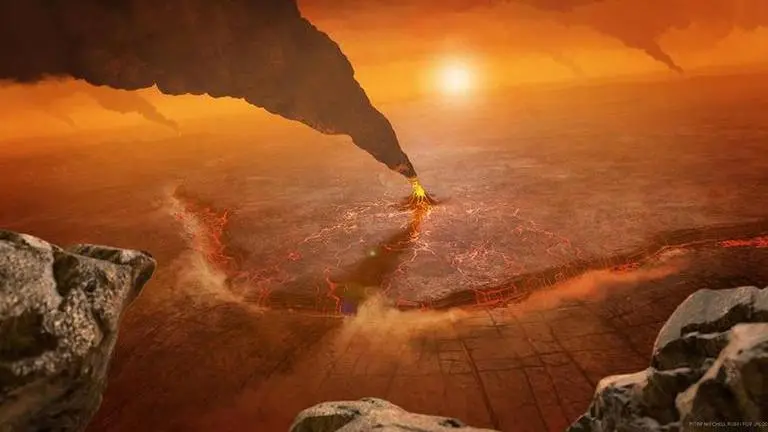
A new study has answered years-old questions about the planet Venus' heat flow mechanism and how it loses its internal heat by carefully evaluating its top layer. According to NASA, researchers used data from the Magellan mission from three decades ago and found that the rocky planet might possibly be losing its heat caused by geologic activity via thin regions known as coronae.
Unlike Earth, which has tectonic plates, Venus has coronae, which are quasi-circular geological features that have now been found to be located where the planet's lithosphere is the thinnest and extremely active. As per NASA, this ultra-thin lithosphere helps heat to escape from the inside through bouncy or "squishy" molten rock that rises to the outer layer.
“For so long we’ve been locked into this idea that Venus’ lithosphere is stagnant and thick, but our view is now evolving,” said Suzanne Smrekar, a senior research scientist at NASA’s Jet Propulsion Laboratory in California and the lead author of the study published in Nature Geoscience.
Scientists have found that Venus’ “squishy” surface shows signs of geothermal activity. This discovery provides a window into how planets like Earth may have had dynamic surfaces even before forming tectonic plates: https://t.co/frt0tpu9iD pic.twitter.com/WfE9kQhTvx
— NASA (@NASA) February 23, 2023
Venus is a 'window' to Earth's past: Researchers
“While Venus doesn’t have Earth-style tectonics, these regions of thin lithosphere appear to be allowing significant amounts of heat to escape, similar to areas where new tectonic plates form on Earth’s seafloor,” she said. Usually enhanced heat in a specific region is an indicator that there is high volcanic activity right under the surface. Therefore, coronae might be able to reveal areas where active geology is resurfacing the planet.
Advertisement
The new study is a gateway to understanding the Earth's past, specifically its lithosphere. “What’s interesting is that Venus provides a window into the past to help us better understand how Earth may have looked over 2.5 billion years ago. It’s in a state that is predicted to occur before a planet forms tectonic plates,” said Smrekar.