
NASA shares 3-D visualisation of 'bizarre structures' in Carine Nebula | WATCH
NASA shared the three-dimensional virtual tour of several dark pillars of cold gas in Carine Nebula that create “fantasy-like structures” on October 13.
- Science News
- 2 min read

;'%3e%3cpath%20d='m8,15.99c4.41,0,7.99-3.58,7.99-7.99S12.41,0,8,0,0,3.59,0,8s3.58,7.99,7.99,7.99Z'%20style='stroke:%23fff;%20stroke-miterlimit:10;%20stroke-width:.02px;'/%3e%3cpath%20d='m3.08,3.37l3.82,5.11-3.84,4.15h.87l3.37-3.64,2.72,3.64h2.94l-4.04-5.39,3.58-3.87h-.86l-3.1,3.35-2.5-3.35h-2.94Zm1.27.64h1.35l5.97,7.99h-1.35l-5.97-7.99Z'%20style='fill:%23fff;'/%3e%3c/g%3e%3c/svg%3e)


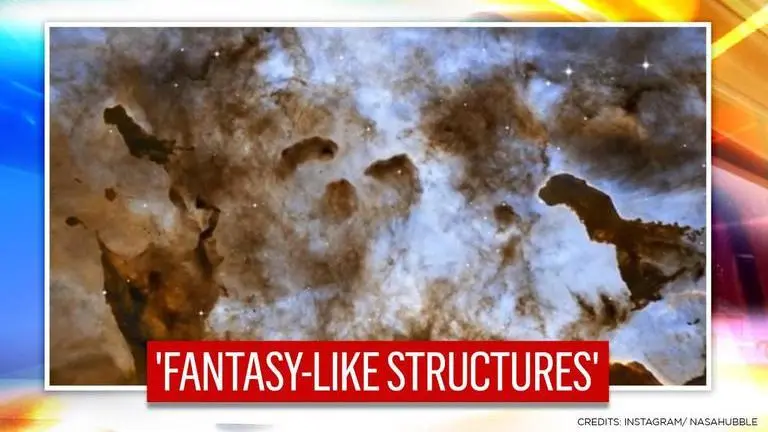
NASA shared the three-dimensional virtual tour of several dark pillars of cold gas in Carine Nebula that create “fantasy-like structures”. Taking to official social media accounts of NASA Hubble, the video was shared on October 13 which is derived from the two-dimensional images captured from Hubble Telescope. According to NASA, the stars and nebula were separated using both the scientific knowledge and artistic license to create the depth in the video.
These “bizarre” structures were formed as the relative distances between the stars and the nebula have been “greatly compressed” resulting in an “intriguing journey through a virtual cosmic landscape.” While sharing the engrossing video, NASA wrote on Instagram, “Winds and radiation from massive stars in the nebula carve away at these clouds, creating bizarre, fantasy-like structures.”
Advertisement
'Sounds of the universe'
Before the ‘fantasy-like structures’ in Carine Nebula were shared based on observations from the telescope, Hubble also contributed to bringing “stunning cosmic sights”. Even though there is no sound in space, NASA assigned pitches to several stars and galaxies and shared the data in a unique way called “data sonification”. This includes the translation of digital data into images which is further transformed into sound. NASA said in a statement that “the Chandra X-ray Observatory team combined their observations with those from the Hubble Space Telescope and the Spitzer Space Telescope to create these sonifications.”
Hubble brings us stunning cosmic sights, but images can be experienced with other senses as well! Though there’s no sound in space, assigning pitches to stars & galaxies in this image provides a new way to conceptualize its data.
— Hubble (@NASAHubble) October 9, 2020
More sonifications here: https://t.co/tO2RGwRGck pic.twitter.com/NTw9akuc10
Advertisement
Earlier this month, NASA had shared a spectacular photograph of NGC 5643, a galaxy which is a part of constellation Lupus. The image of the spiral galaxy was captured by the agency’s Hubble Space Telescope and it took a total of nine hours for scientists to click the image. “Looking this good isn’t easy; 30 different exposures, for a total of nine hours of observation time, together with the high resolution and clarity of Hubble, were needed to produce an image of such high level of detail and beauty,” the ESA which jointly owns Hubble with NASA wrote on its website.
#HubbleFriday Looking this good isn’t easy.
— Hubble (@NASAHubble) October 2, 2020
Capturing this Hubble image of the galaxy NGC 5643 took 30 different exposures and nine hours of observation time! This beautiful galaxy is about 60 million light-years away in the constellation Lupus: https://t.co/LaYGOTP6ZK pic.twitter.com/VBFVejyHrj