
Tardigrades can survive any condition; read interesting facts about these water bears
Tardigrades are microscopic animals who have often caught the interest of scientists and biology enthusiasts. Know more details about them here.
- Science News
- 3 min read

;'%3e%3cpath%20d='m8,15.99c4.41,0,7.99-3.58,7.99-7.99S12.41,0,8,0,0,3.59,0,8s3.58,7.99,7.99,7.99Z'%20style='stroke:%23fff;%20stroke-miterlimit:10;%20stroke-width:.02px;'/%3e%3cpath%20d='m3.08,3.37l3.82,5.11-3.84,4.15h.87l3.37-3.64,2.72,3.64h2.94l-4.04-5.39,3.58-3.87h-.86l-3.1,3.35-2.5-3.35h-2.94Zm1.27.64h1.35l5.97,7.99h-1.35l-5.97-7.99Z'%20style='fill:%23fff;'/%3e%3c/g%3e%3c/svg%3e)


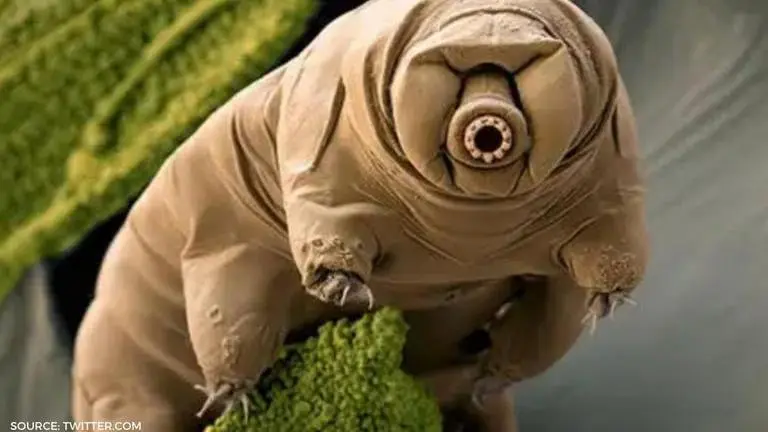
Tardigrades, also called water bears and moss piglets, have often fascinated scientists. Because this almost microscopic animal is able to survive in harsh conditions, even in outer space. In this article, you will learn some amazing facts about tardigrades.
Appearance and size of tardigrades
According to an article published in the American Scientist, tardigrades have eight legs and hands which contain four to eight classes. They are cute and bizarre at the same time. They are often called water bears and have striking similarities to the imaginary hookah-smoking caterpillar that you see in the famous story “Alice in the Wonderland”. In general, the tardigrades are 0.05 mm long but they do not grow longer than 1 mm in most cases.
Scientific classification of tardigrades
Tardigrades come from the Animalia kingdom, Bilateria subkingdom and Protostomiainfra kingdom. They belong to Superphylumecdysozoa and their phylum is Tardigrada. They have many species.
Advertisement
Habitat of Tardigrades
Tardigrades or water bears are the kings of survival battles because they can live in any place. Although their preferred habitat is wet environments like the sediments at the bottom of a lake, moss, they can live in any place and in any atmosphere, even in space.
Advertisement
Also read: Bangalore Issues Clarification Over 'fireworks' During Virat Kohli's Birthday Celebrations
According to research published in the Smithsonian Magazine, a tardigrade can live in extremely cold temperatures like -328 degree F and hot temperature up to 300 degrees F. The magazine also states that these small creatures are able to survive in extreme conditions like boiling water, radiation, the deepest part of the ocean when the pressure is nearly six times than the regular pressure, and even in space without any problem. According to a study found in the Current Biology journal in 2008, the tardigrades are able to survive for ten days at the orbit of the Earth alongside space radiation and vacuum. Some researchers also believe that these small creatures will be there even if humanity ceases to exist. Researchers from Harvard and Oxford University checked the possibilities of destitution of the earth caused by cosmic events and how the present biosphere will be able to survive events like asteroids, supernova blasts, or gamma-ray explosions. They found that many cosmic events were enough to wipe out humanity but the small microscopic water bears will be able to survive these catastrophic events.
Also read: Taylor Swift's 'Look What You Made Me Do' Featured In TV Shows & A Movie; Did You Notice?
What do water bears eat - the diet of tardigrades
As per the research done by the National Geographic, Tardigrades live on fluids. They usually suck the juices and fluids from lichens, moss or algae. Interestingly, some species of the water bears are carnivores and some are also cannibals.
How do tardigrades reproduce?
Another one of water bears facts is that they are able to reproduce through both asexual and sexual procedures and different species have different methods. In the case of sexual reproduction, the female water bears lay eggs which are later fertilized by the male ones. But, in the case of asexual reproduction, the female lays eggs and the eggs do not require any kind of fertilization. They are able to lay 30 eggs at once.