
AI-driven analytics to tackle security challenges, counter-terror systems: HM Amit Shah
Shah stressed on linking databases and adopting an AI-driven analytical approach for tackling emerging security challenges across the country.
- Tech News
- 4 min read

;'%3e%3cpath%20d='m8,15.99c4.41,0,7.99-3.58,7.99-7.99S12.41,0,8,0,0,3.59,0,8s3.58,7.99,7.99,7.99Z'%20style='stroke:%23fff;%20stroke-miterlimit:10;%20stroke-width:.02px;'/%3e%3cpath%20d='m3.08,3.37l3.82,5.11-3.84,4.15h.87l3.37-3.64,2.72,3.64h2.94l-4.04-5.39,3.58-3.87h-.86l-3.1,3.35-2.5-3.35h-2.94Zm1.27.64h1.35l5.97,7.99h-1.35l-5.97-7.99Z'%20style='fill:%23fff;'/%3e%3c/g%3e%3c/svg%3e)


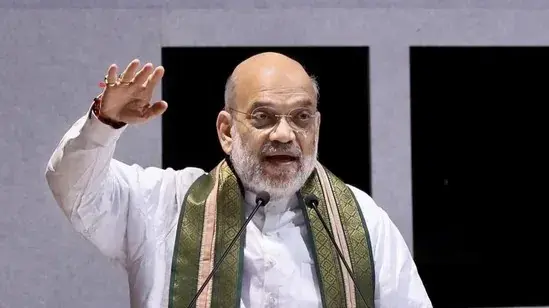
New age security: Home Minister Amit Shah emphasised on the need for linking databases and adopting an AI-driven analytical approach for tackling emerging security challenges, in an event on Friday.
Inaugurating the 58th conference of DGPs and IGPs in Jaipur, the former BJP president also stressed on bringing uniformity in the structures, size and skills of counter-terror mechanisms across the country.
There has been an overall improvement in the security scenario in the country since 2014, especially the reduction of violence in the three critical hotspots -- Jammu and Kashmir, the northeast and Left Wing Extremism-affected areas, he pointed out.
Prime Minister Narendra Modi will interact with the country's top police officers before addressing them at a formal session.
The Home Minister is going to be present throughout the conference spanning several sessions, while the Prime Minister will attend the conference from January 6-7, his office said.
Advertisement
Govt Decisions for Amrit Kaal
Shah highlighted two important decisions taken by the Modi government -- the National Education Policy and the enactment of three criminal justice laws to replace the British-era statutes -- and said the country has entered the "Amrit Kaal".
The new laws were focused on the delivery of justice instead of punishment and their implementation would transform the country's criminal justice system into the most modern and scientific one, he added.
Advertisement
Shah doubled down on training police officers from Station House Officer (SHO) or officer-in-charge of police stations to DGP levels ,and upgrading technology from police stations to police headquarters for the successful implementation of the three new laws.
Why Internal Security
He also highlighted the role of internal security in realising Prime Minister Narendra Modi's vision of India becoming a developed nation by 2047.
The conference has emerged as a 'think tank', Shah said, which facilitates the decision-making and formulation of new security strategies.
The conference is being held in a hybrid mode with DGPs, IGPs and chiefs of Central Police Organisations attending physically in Jaipur. Over 500 police officers of various ranks are participating virtually.
Technology in policing, Left Wing Extremism, prison reforms, activities of pro-Khalistan groups and terror attacks in Jammu and Kashmir are other key issues to be discussed, a Union Home Ministry official said.
What the discussions will look like
The conference will also deliberate on futuristic themes in policing and security like the challenges posed by new technologies such as AI and deepfakes, and ways to deal with them.
It provides an opportunity to identify tangible action points and monitor their progress, which is presented before the prime minister every year.
The conference is the culmination of extensive deliberations involving police and intelligence officers from the district, state and national levels on identified themes, another official said.
Since 2014, the prime minister has taken a keen interest in the conference.
Free-flowing thematic discussions over breakfast, lunch and dinner have also been planned this year.
This will provide an opportunity for senior police officials to share their views and recommendations with the prime minister.
Delhi to Jaipur
Till 2013, the annual meet was held in New Delhi. After the Narendra Modi government assumed office the next year, it was decided to hold the event, organised by the MHA and the Intelligence Bureau, across the country.
The conference was organised in Guwahati in 2014; Dhordo, Rann of Kutch, in 2015; the National Police Academy, Hyderabad, in 2016; the BSF Academy, Tekanpur, in 2017; Kevadiya in 2018; IISER Pune in 2019; Lucknow in 2021; and at the NASC, Delhi, in 2023.
Before 2014, the deliberations largely focused on national security matters. Since then, the conferences have focused on both national security and core policing issues, including prevention and detection of crime, community policing and improving the police's image, another official said.
Earlier, the conference was Delhi-centric with officers coming together only for the meet.
The Discussions
Residing on the same premises over two to three days has served to build a heightened sense of unity among the officers since 2014, the official added.
Direct interaction of the police's top brass with the head of government has resulted in a convergence of views on crucial challenges faced by the country and the emergence of doable recommendations, the official further said.
In the past few years, the topics have been selected after detailed discussions with the highest echelons of the police service.
Once selected, several interactions on presentations are held before committees of DGPs to encourage participation and incorporate ideas from the field and also from younger officers.
As a result, all presentations are now broad-based, content-intensive and carry a set of cogent and actionable recommendations.
Since 2015, detailed follow-up of recommendations of past conferences has become the norm and is the topic of the first business session, attended by the prime minister and the Union home minister, the official said.
(With PTI Inputs)