
Take A Tour Of The First Tiger Reserve In India
The beauty of the park is legendary, and most locals often say it is hard to leave Kanha as the place grows on you.
- Travel News
- 4 min read

;'%3e%3cpath%20d='m8,15.99c4.41,0,7.99-3.58,7.99-7.99S12.41,0,8,0,0,3.59,0,8s3.58,7.99,7.99,7.99Z'%20style='stroke:%23fff;%20stroke-miterlimit:10;%20stroke-width:.02px;'/%3e%3cpath%20d='m3.08,3.37l3.82,5.11-3.84,4.15h.87l3.37-3.64,2.72,3.64h2.94l-4.04-5.39,3.58-3.87h-.86l-3.1,3.35-2.5-3.35h-2.94Zm1.27.64h1.35l5.97,7.99h-1.35l-5.97-7.99Z'%20style='fill:%23fff;'/%3e%3c/g%3e%3c/svg%3e)


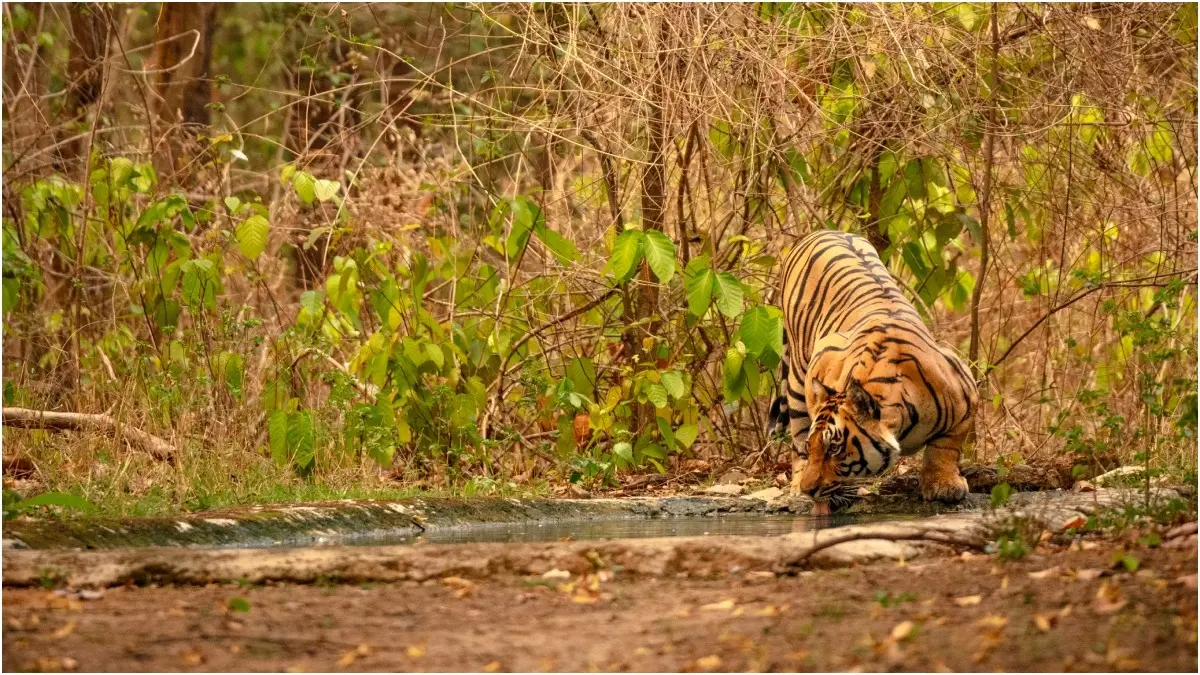
The largest national park in Madhya Pradesh, Kanha is also the setting for Rudyard Kipling's famed ‘The Jungle Book'. Here is a guide to understand the tiger reserve and what it has for tourists.
A unique landscape
Did you know that Kanha National Park is the first tiger reserve in India to introduce an official mascot ‘Bhoorsingh the Barasingha’? Or that the park has worked on a successful conservation programme that ensured that the barasingha (swamp deer) has become its flagship species? Well, chances are you may not know this, but this is exactly where Kanha stands out in more ways than one.
Tree call
Covering a total area of 2,074.31 sq. km that includes the core zone of 940 sq. km, a buffer zone of 1,134.31 sq. km and the Phen Wildlife Sanctuary (satellite core) of 110.74 sq. km, the park is covered with sal trees. This makes the park lush green through the year, and the presence of meadows, tall grass, bamboo forests, Saja, Lendia, Dhwa, Tendu, Palas, Bija, and Mahua trees makes this a unique landscape too.
Advertisement

Mammals and more
The park is home to about 115 tigers; endangered Indian wild dogs, dholes, swamp deer, leopards, spotted deer, sambar deer, gaurs (Indian bison), four-horned antelopes (chousingha), sloth bears, wild boars, Hanuman langurs, and striped hyenas; golden jackals, among many others. It is also a birder’s paradise with over 300 species recorded, including the crested serpent eagle, wood shrike, peacock, paradise flycatcher, grey hornbill, Indian roller, red jungle fowl, and more.
All about the safari
Safaris happen twice every day, in the morning and evening, with a full-day safari option also being available. The core zones are Kanha, Mukki, Sarhi, and Kisli Gates, while the buffer zones include Khatia, Khapa, Sijhora, and Phen. All bookings must be made online on the Madhya Pradesh Forest Department website. Bookings can be made 120 days in advance and are sold out quickly; hence, you must be quick in picking a slot. Alternately, you can also check with the resort or hotel where you will stay to get assistance in the safari booking.
Advertisement
Where to stay?
Kanha has a wide range of properties across budgets, and the best part is many of them also offer experiences that go beyond the safari. Tathastu Resorts Kanha, for instance, offers guided nature walks around the property with the in-house naturalist; that is a great way to understand the local flora and fauna of the region. Local village visits, sunset picnic drives, star gazing, and guided bird watching are also on offer.
Safari Tips
To make your safari experience smooth, do ensure to carry your original ID card (an Aadhar card works best) when you reach the gate. It is ideal to wear the colours of the forest, greens, browns, and khaki hues, so that you blend in with the landscape. Full sleeves are preferable, especially as the sun can be sharp in the summer. A hat, sunscreen, sunglasses, a mask, or a scarf as a dust cover are recommended. Winters are very cold, so do ensure that you wear a thick jacket. As mobile phones are banned, you can carry a camera or a pair of binoculars to enjoy the wildlife.
In conclusion
The beauty of the park is legendary, and most locals often say it is hard to leave Kanha as the place grows on you. Little wonder, then, that the 1980 award-winning film The Land of Tigers for National Geographic was also shot here.
Travel tips
• The closest airport is at Jabalpur about 160 km away.
• Jabalpur (4 hours) and Gondia (3 hours) are the nearest rail heads.
• There are varying kinds of accommodation across all budgets.