
Angela Merkel says G20 Summit's joint declaration in Rome 'good signal' for COP26
During the concluding press conference, Germany's Angela Merkel stated that she was pleased to see a joint declaration that every leader could sign off on.
- World News
- 2 min read

;'%3e%3cpath%20d='m8,15.99c4.41,0,7.99-3.58,7.99-7.99S12.41,0,8,0,0,3.59,0,8s3.58,7.99,7.99,7.99Z'%20style='stroke:%23fff;%20stroke-miterlimit:10;%20stroke-width:.02px;'/%3e%3cpath%20d='m3.08,3.37l3.82,5.11-3.84,4.15h.87l3.37-3.64,2.72,3.64h2.94l-4.04-5.39,3.58-3.87h-.86l-3.1,3.35-2.5-3.35h-2.94Zm1.27.64h1.35l5.97,7.99h-1.35l-5.97-7.99Z'%20style='fill:%23fff;'/%3e%3c/g%3e%3c/svg%3e)


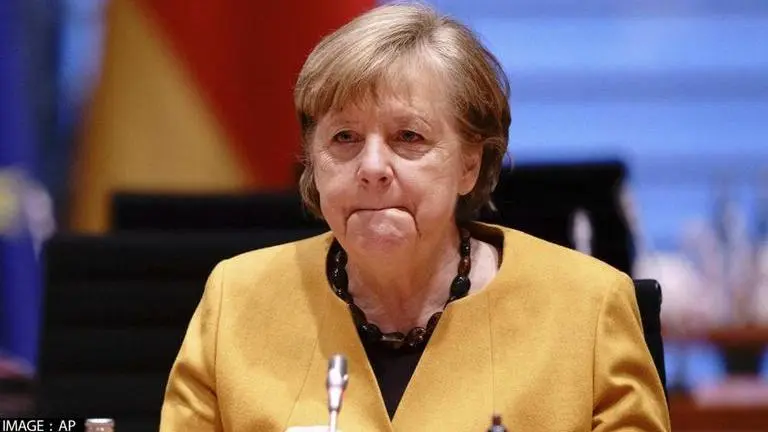
German Chancellor Angela Merkel expressed optimism on G20's position on climate, following the summit in Rome. Angela Merkel, the German Chancellor, said the accord was a 'good signal' for COP26, in Glasgow. During the concluding press conference, Merkel stated that she was pleased to see a joint declaration that every leader could sign off on. On Sunday, leaders of the Group of 20 major countries agreed on a final declaration that encouraged "meaningful and effective" action to curb global warming while angering climate campaigners with few concrete commitments.
In order to achieve the major aims of a G20 Summit, the recently finished conclave in Rome released a Summit declaration in which fellow member nations, including India, 'agree' to pursue specific goals and approaches. However, according to UN experts, even if present national plans are fully executed, the globe will experience global warming of 2.7 degrees Celsius, with disastrous implications. The 'Rome Declaration' was also accepted by G20 leaders and heads of state; the communiqué sent a strong message under the health part, where member nations agreed that COVID vaccination is a global public good.
G20 leaders look forward to meet again in India and Indonesia
Argentina, Australia, Brazil, Canada, China, the European Union, France, Germany, India, Indonesia, Italy, Japan, Mexico, Russia, Saudi Arabia, South Africa, South Korea, Turkey, the United Kingdom, and the United States are all members of the G20. The G20 countries account for over 90% of global GDP, 80% of global trade, and two-thirds of the world's population. Notably, the G-20 leaders' statement added, "We look forward to meeting again in Indonesia in 2022, India in 2023, and Brazil in 2024."
The final G20 statement includes a vow to stop financing overseas coal-fired power production by the end of this year, but there is no timetable for phasing out coal power, merely "as soon as possible." This replaced an earlier draught of the final statement objective of achieving this by the end of the 2030s, demonstrating the strong opposition from several coal-dependent countries. The G20 also set no deadline for phasing out fossil fuel subsidies, instead stating that they will do so "over the medium term." The final statement simply acknowledges that lowering methane emissions is "one of the quickest, most viable, and least expensive methods to minimise climate change."