
Between Trump and Putin, Modi Scripts an Indian Third Way
With Vladimir Putin's India visit, the optics may evoke Cold War camaraderie, but the substance of this visit is brutally contemporary: India is in a great position to have Russia as a hard insurance policy in a world where the China–Pak axis is tightening, & the West has become strategically fickle
- World News
- 3 min read

;'%3e%3cpath%20d='m8,15.99c4.41,0,7.99-3.58,7.99-7.99S12.41,0,8,0,0,3.59,0,8s3.58,7.99,7.99,7.99Z'%20style='stroke:%23fff;%20stroke-miterlimit:10;%20stroke-width:.02px;'/%3e%3cpath%20d='m3.08,3.37l3.82,5.11-3.84,4.15h.87l3.37-3.64,2.72,3.64h2.94l-4.04-5.39,3.58-3.87h-.86l-3.1,3.35-2.5-3.35h-2.94Zm1.27.64h1.35l5.97,7.99h-1.35l-5.97-7.99Z'%20style='fill:%23fff;'/%3e%3c/g%3e%3c/svg%3e)


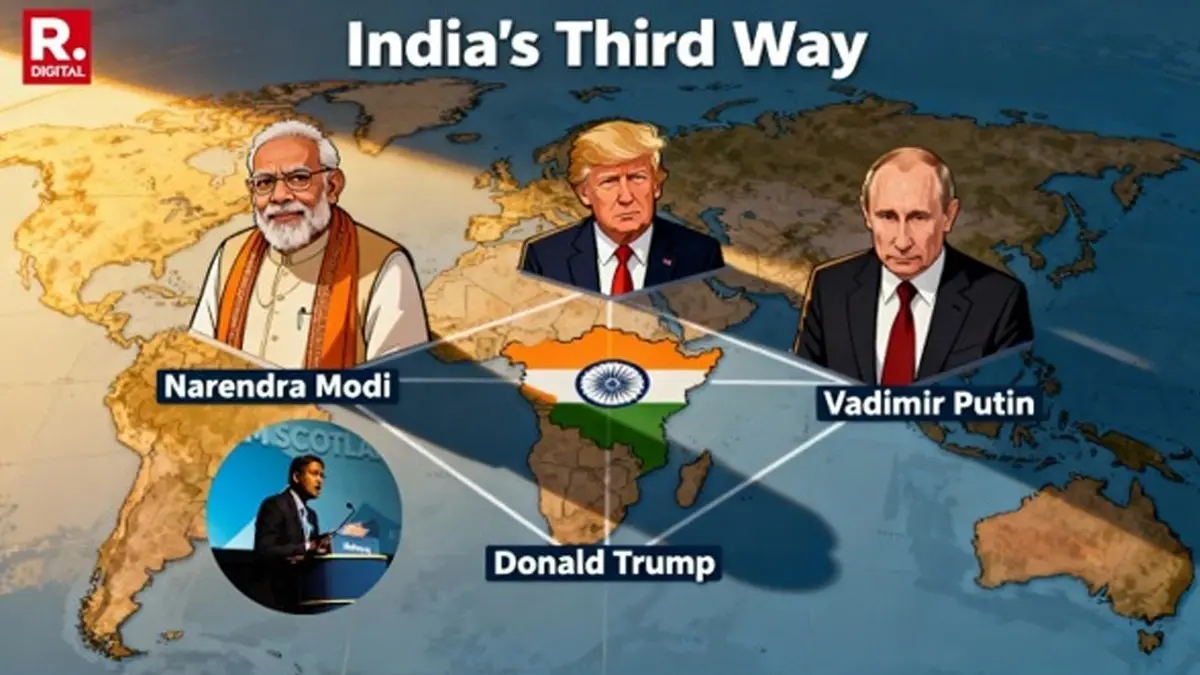
With Vladimir Putin's India visit, the optics may evoke Cold War camaraderie, but the substance of this visit is brutally contemporary: India is in a great position to have Russia as a hard insurance policy in a world where the China–Pakistan axis is tightening, and the West has become strategically fickle. The Modi government’s calculation is not sentimental, it is anchored in oil discounts, defence dependencies and the need for diplomatic options in any future Ukraine peace bargain.
Cost-effective Russian crude has been central to India’s inflation control and growth story since Europe slammed the door on most Russian energy imports. Indian refiners have quietly turned sanctions dislocation into arbitrage, buying cut price Urals, refining it at home and exporting fuels, including to European markets that loudly condemn Moscow but happily buy “Indian” diesel. That trade surplus in energy is what cushions India’s fiscal position at a time of heavy infrastructure spending and politically sensitive fuel prices.
Defence is the second pillar. Aatmanirbhar Bharat and diversification to American and European systems, Indian air defence, armoured formations and major naval platforms still depend on Russian-origin equipment and spares. With a live standoff against China on the LAC and a perpetually unstable Pakistan to the west, Delhi cannot afford gaps in its deterrent while it retools its military-industrial base.
Ensuring timely deliveries of systems like S 400s, keeping joint projects such as BrahMos on track and exploring next-generation co-development are not optional luxuries, they are central to preserving credible deterrence on two nuclear fronts. At the same time, closer defence coordination with Moscow complicates Beijing’s calculus. A Russia that remains economically and politically invested in India is less likely to tilt wholly into China’s camp in South Asia, even if the Moscow–Beijing partnership remains deep.
The third layer is geopolitical leverage. As the Ukraine conflict drags on and sanctions wall off Russia from Europe, Putin needs India to demonstrate he is not a global outcast and to diversify away from over-reliance on China. India, in turn, wants structured mechanisms—currency arrangements, shipping and insurance alternatives, and a broader, more balanced trade basket—to make its Russia exposure more resilient without triggering Western secondary sanctions. With Donald Trump back in the White House wielding tariffs as blunt instruments, New Delhi is signalling that pressure has limits: if Washington and Brussels overreach, India has room to widen its Eurasian and BRICS options.
Advertisement
This does not make India pro-Russia, it makes India relentlessly pro-India. Delhi has little interest in a Russian collapse or a frozen Eurasian war that keeps energy and freight markets permanently distorted. It therefore quietly supports a negotiated peace that restores stability without driving Moscow fully into Beijing’s arms. In that sense, the Modi–Putin summit is best read as an exercise in disciplined hedging. India is not choosing Putin over the West; it is choosing not to be trapped by anyone else’s war.