
'Must Never Acquire Nuclear Weapon': UK, France, Germany and Italy Ready to Lift Iran Sanctions After US-Iran Peace deal
In a joint statement, the leaders of the four European nations, often referred to as the E4, said they were prepared to work alongside the United States, Iran and the International Atomic Energy Agency (IAEA) to ensure that Tehran's nuclear programme remains peaceful.
- World News
- 5 min read

;'%3e%3cpath%20d='m8,15.99c4.41,0,7.99-3.58,7.99-7.99S12.41,0,8,0,0,3.59,0,8s3.58,7.99,7.99,7.99Z'%20style='stroke:%23fff;%20stroke-miterlimit:10;%20stroke-width:.02px;'/%3e%3cpath%20d='m3.08,3.37l3.82,5.11-3.84,4.15h.87l3.37-3.64,2.72,3.64h2.94l-4.04-5.39,3.58-3.87h-.86l-3.1,3.35-2.5-3.35h-2.94Zm1.27.64h1.35l5.97,7.99h-1.35l-5.97-7.99Z'%20style='fill:%23fff;'/%3e%3c/g%3e%3c/svg%3e)


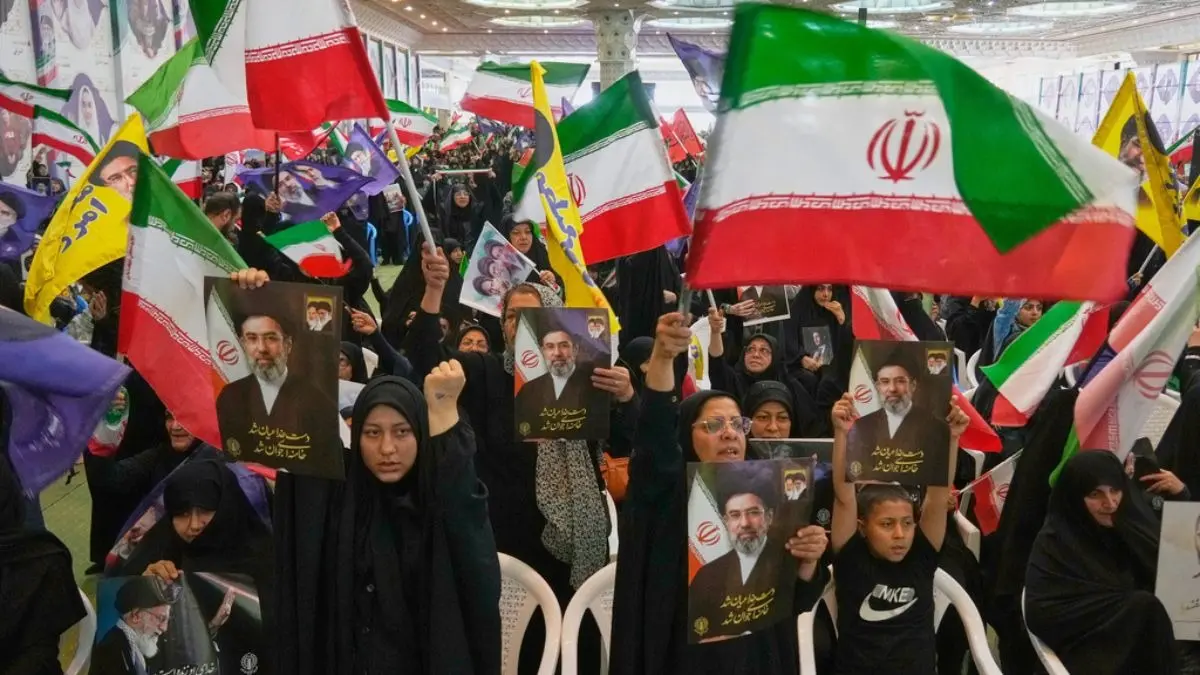
The four major European nations, the United Kingdom, France, Germany and Italy, announced that the countries were prepared to lift sanctions on Iran in response to steps on its nuclear program after the U.S. and Iran reached an agreement to end their war.
In a joint statement issued on Sunday, the leaders of the four European nations, often referred to as the E4, said they were prepared to work alongside the United States, Iran and the International Atomic Energy Agency (IAEA) to ensure that Tehran's nuclear programme remains peaceful.
"Iran must never acquire a nuclear weapon. We stand ready to work with the US, Iran and the IAEA to this end," the leaders said.
‘Let The Oil Flow’: Trump Confirms US-Iran Deal
The announcement comes after the US and Iran reached an agreement aimed at ending more than three months of military confrontation and reopening the strategically crucial Strait of Hormuz.
Advertisement
While the full details of the agreement have not yet been made public, reports suggest the formal signing of the deal is expected to take place in Switzerland later this week.
US President Donald Trump on Sunday confirmed that an agreement had been reached and said he had authorised the end of the US naval blockade of Iranian ports in the Strait of Hormuz.
Advertisement
"Congratulations to all!" Trump wrote on social media.
In a message highlighting the expected economic impact of the deal, he added, "Ships of the World, start your engines. Let the oil flow!"

The reopening of the Strait of Hormuz is expected to ease pressure on global energy markets that have faced uncertainty throughout the conflict.
The agreement is being viewed as one of the most significant diplomatic developments in the Middle East in recent years.
As part of the emerging framework, the United States is expected to ease restrictions on Iran's oil exports and relax certain sanctions that have severely impacted the country's economy.
The move could allow Iran to increase crude oil sales, restore revenue streams and improve economic conditions after years of financial pressure.
The deal came under criticism even in the final hours
The deal likely returns to a status that existed before the war, but with thousands of people dead and Iran wielding a new source of negotiating pressure with its ability to influence transits of the strait. The waterway is crucial to significant shipments of oil, natural gas and related products like fertilizer, and its effective closure rocked the global economy.
Of the stated targets by the U.S. and Israel when they launched the war on Feb. 28 with strikes that killed Iran’s supreme leader, Ayatollah Ali Khamenei, Tehran still has a missile program, support for armed proxies in the region like Hezbollah and a stockpile of highly enriched uranium for its nuclear program.
Khamenei’s son is now the supreme leader, though he has not been seen in public since the war began. His approval was needed for Iran to sign off on the deal.
Iran has wanted a ceasefire deal to include the fighting in Lebanon, where Israel has pushed its invasion deeper than at any point in over a quarter-century as it targets Hezbollah. Tehran also has sought the release of billions of dollars in frozen funds.
The emerging deal had been sharply criticized by Israel’s government and by critics in Trump’s own Republican Party. Some said it did not improve on the terms of the 2015 Iran nuclear deal that Trump withdrew the U.S. from during his first term and still describes as “bad.”
There was also apparent friction inside Iran in the hours before the announcement, as the government earlier Sunday warned that any division at home over the deal weakens its negotiating position. Iranian President Masoud Pezeshkian urged national unity and called it a “disgrace” when someone stands before parliament and calls anyone who negotiates a traitor.
The central question of Iran's nuclear program remains
After the war began, Iran attacked Israel and several Arab Gulf nations with missiles and drones. A ceasefire was reached on April 7. Ten days later, the U.S. military imposed its blockade. A historic face-to-face meeting between Vice President JD Vance and Iranian parliament speaker Mohammad Bagher Qalibaf ended without success.
Throughout negotiations, Trump alternatively threatened to destroy Iranian infrastructure, even its civilization, and praised the relationship with Iran as “more professional” as his administration sought an exit from the war with midterm U.S. elections coming later this year.
Iran’s government, with its own tensions around hard-liners as it scrambled to replace several top officials killed in the war, repeatedly expressed wariness of negotiations after rounds of talks last year and early this year ended with U.S. and Israeli attacks.
Tehran has emphasized that it wanted a deal to focus on ending the war, with discussions put off until later on its nuclear program — the issue at the center of it all.
Iran has 440.9 kilograms (972 pounds) of uranium that is enriched up to 60% purity, a short, technical step from weapons-grade levels of 90%, according to the International Atomic Energy Agency.
Iran has long maintained its nuclear program is peaceful and has not publicly committed to giving up the enriched uranium, which is believed to be buried under three nuclear sites that were badly damaged by U.S. strikes last year.
At times, the U.S. had sought the removal of the enriched uranium from Iran as part of a deal. Russia has offered to take it. At other times, Trump said he wanted the uranium destroyed.