
'Conflict Will Not Be Resolved By Buying or Not Buying Oil': Jaishankar on US Sanctions Bill on Russian Oil
External Affairs Minister S Jaishankar on Thursday said the Russia-Ukraine conflict would not be resolved based on whether countries buy Russian oil, minerals or other commodities, asserting that the dispute can only be settled through dialogue, diplomacy and negotiations.
- World News
- 4 min read

;'%3e%3cpath%20d='m8,15.99c4.41,0,7.99-3.58,7.99-7.99S12.41,0,8,0,0,3.59,0,8s3.58,7.99,7.99,7.99Z'%20style='stroke:%23fff;%20stroke-miterlimit:10;%20stroke-width:.02px;'/%3e%3cpath%20d='m3.08,3.37l3.82,5.11-3.84,4.15h.87l3.37-3.64,2.72,3.64h2.94l-4.04-5.39,3.58-3.87h-.86l-3.1,3.35-2.5-3.35h-2.94Zm1.27.64h1.35l5.97,7.99h-1.35l-5.97-7.99Z'%20style='fill:%23fff;'/%3e%3c/g%3e%3c/svg%3e)


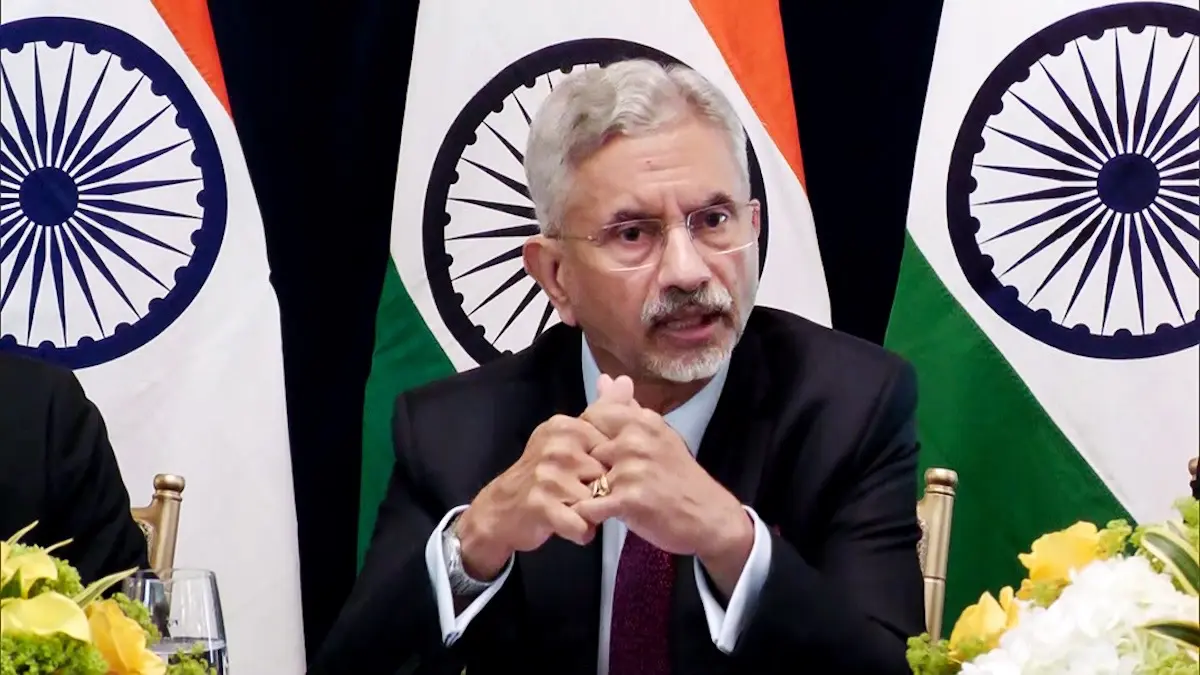
Kyiv, Ukraine: External Affairs Minister S Jaishankar on Thursday said the Russia-Ukraine conflict would not be resolved based on whether countries buy Russian oil, minerals or other commodities, asserting that the dispute can only be settled through dialogue, diplomacy and negotiations.
Responding to a question on whether India would reduce its purchases of Russian oil if the US approves sanctions against countries buying Russian oil, Jaishankar highlighted the challenges of ensuring energy security for India's 1.4 billion people and said both Ukraine's and India's perspectives on the issue should be respected.
"I think it's also important that all of you get the challenges of providing for energy for 1.4 billion people at a time when the world energy situation is very, very difficult. So, I would say, I mean, this is something where clearly the Ukraine side has its perspective, which we respect, and we have ours, which I would expect others to also respect," Jaishankar said while responding to queries after his meeting with Ukrainian Foreign Minister Andrii Sybiha in Kyiv.
"But let me just add this. You know, this conflict, which is today in its fifth year, will not be solved because somebody is buying or not buying oil or alumina or minerals or metals or fertiliser. This conflict will be solved by dialogue, by diplomacy, and by negotiation. And that is why it is something we would encourage," he added.
Advertisement
Last month, the US Senate passed a bipartisan bill that could authorise President Donald Trump to impose tariffs of up to 100 per cent on goods from countries, including India and China, that continue importing Russian oil and gas. The legislation argues that such trade supports Moscow's economy and helps finance its military operations in Ukraine.
The Senate passed the Lindsey O Graham Sanctioning Russia and Iran Act of 2026 by an 86-11 vote. The legislation seeks to increase economic pressure on Russia and Iran and target countries that maintain significant energy trade with Moscow.
Advertisement
Under the bill, the US President would have the discretionary authority to impose tariffs of up to 100 per cent on imports from the five largest buyers of Russian crude oil or natural gas. India remains among the largest buyers of Russian crude, alongside China.
The bill also proposes additional sanctions targeting Russian President Vladimir Putin, senior political and military officials, financial institutions, energy projects and entities linked to Russia's war effort.
US Presidential Counsellor Peter Navarro, meanwhile, said President Trump and Prime Minister Narendra Modi have a "very good working relationship" and would resolve issues related to tariffs linked to Russian oil.
"During the Ukraine-Russia war, 6-8 months ago, I think I wrote an op-ed in the Financial Times, which absolutely factually correctly pointed out that prior to the Russian invasion of Ukraine, India was not involved in the oil trade with Russia, but afterwards it got heavily involved and was selling a lot of refined products on behalf of Russia, which helped feed the war machine. And that issue has been resolved. Maybe I had a little bit to do with that op-ed, but I can tell you, I got actually firebombed by the Indian continent on the internet. All I would say to you is, don't do that," Navarro said in response to an ANI query.
"That's not how we resolve problems here in America. With respect to your question, the President and your Prime Minister have a very good working relationship. They are going to work that out amongst themselves, and it's not for me or any gaggle to get between that," he added.
Commerce Secretary Rajesh Agrawal said India and the US remain committed to advancing their trade deal despite the proposed sanctions legislation.
"This is something of a legislative process of the US which is underway. I don't think we should comment on that. That's their internal process," Agrawal said when asked about the bill and its potential impact on India.
"We are engaged with the US side on the trade deal, and our contacts are regular. And both sides are committed to the deal that we have agreed on. Both sides are completely committed to moving ahead in that spirit," he added.