
Confusion Over Pakistan's Leader: Trump’s Abraham Accords Post Skips PM Shehbaz Sharif for Military Chief Asim Munir
Donald Trump bypasses Pakistan PM Shehbaz Sharif on Truth Social, urging military chief Asim Munir to join the Abraham Accords for regional peace.
- World News
- 4 min read

;'%3e%3cpath%20d='m8,15.99c4.41,0,7.99-3.58,7.99-7.99S12.41,0,8,0,0,3.59,0,8s3.58,7.99,7.99,7.99Z'%20style='stroke:%23fff;%20stroke-miterlimit:10;%20stroke-width:.02px;'/%3e%3cpath%20d='m3.08,3.37l3.82,5.11-3.84,4.15h.87l3.37-3.64,2.72,3.64h2.94l-4.04-5.39,3.58-3.87h-.86l-3.1,3.35-2.5-3.35h-2.94Zm1.27.64h1.35l5.97,7.99h-1.35l-5.97-7.99Z'%20style='fill:%23fff;'/%3e%3c/g%3e%3c/svg%3e)


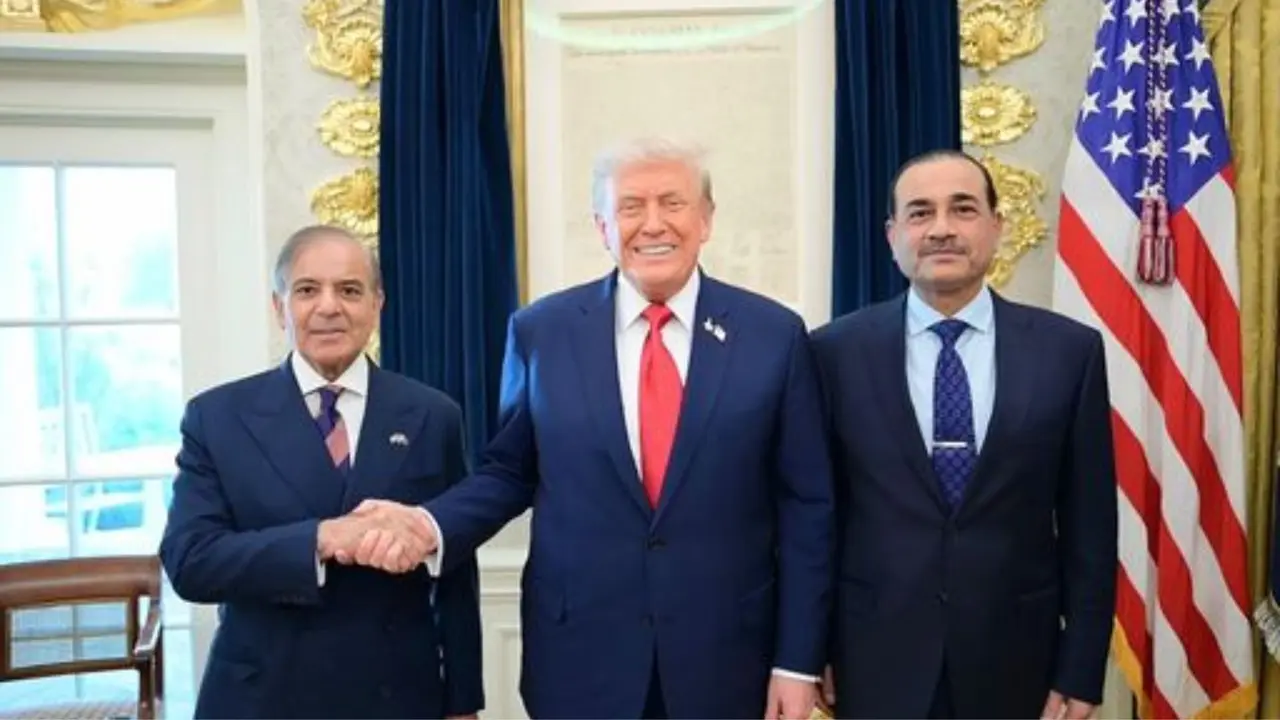
US President Donald Trump on Monday urged several Muslim-majority nations to sign on to the Abraham Accords. The move is part of a larger push to establish a wider regional peace agreement that involves Iran. However, while listing the world leaders he had been in communication with, Trump bypassed Prime Minister Shehbaz Sharif in his social media post, naming Pakistan’s military chief, General Syed Asim Munir, instead.
Trump Identifies Asim Munir in Regional Peace Push
Writing on his platform, Truth Social, Trump stated that nations such as Saudi Arabia, Qatar, Pakistan, Egypt, and Türkiye ought to formalize ties with Israel through the Abraham Accords framework, which was first launched during his initial presidency.
In the post, Trump properly referenced Saudi Crown Prince Mohammed bin Salman, UAE President Mohammed bin Zayed, and Turkish President Recep Tayyip Erdoğan by their official titles. Yet, when addressing Pakistan, he identified the country's representative as "Field Marshal Syed Asim Munir Ahmed Shah".
Leaving out Prime Minister Shehbaz Sharif quickly turned heads. While Munir does not hold an elected political office, he is widely viewed as the most powerful individual in Pakistan. Historically, the Pakistani military has maintained a dominant grip on the nation's political landscape and its foreign policy decisions.
Advertisement
The Growing Spotlight on Trump-Munir Relations
This is not the first time Trump has spotlighted the military leader. During public remarks last year, Trump openly praised Syed Asim Munir, calling the Pakistani army chief a “very great guy” while discussing diplomatic talks involving Islamabad.
According to analysts, Munir has successfully secured direct access to Trump and his core circle. This comes at a critical juncture as Pakistan works to repair its relationship with Washington, which suffered years of strain following the American military withdrawal from Afghanistan.
Advertisement
Furthermore, Munir has turned into a vital player in regional diplomacy concerning Iran. Sharing a lengthy border with Iran, Pakistan remains highly wary that continued regional instability could spark internal sectarian conflict, trigger fuel shortages, and pile more pressure onto its fragile domestic economy.
Islamabad Faces Fresh Pressure Over Israel Ties
Trump’s public call for Pakistan to enter the Abraham Accords lands on highly sensitive political ground. Islamabad has long maintained a firm stance against recognizing Israel, conditioning any diplomatic ties on the creation of a sovereign Palestinian state.
At the same time, Pakistan relies heavily on its deep economic, political, and military alliances with Gulf nations—many of which have moved closer to Israel through Washington's diplomatic channels. Analysts note that this dynamic has left Islamabad navigating a precarious diplomatic tightrope ever since the accords debuted in 2020.
While the UAE and Bahrain chose to normalize relations with Israel, Pakistan kept its distance, fearing severe domestic political backlash and remaining committed to its historical defense of the Palestinian cause.
What Exactly Are the Abraham Accords?
Brokered by the United States, the Abraham Accords are a series of joint agreements aimed at normalising diplomatic relations between Israel and Arab countries. The foundational treaties were signed on September 15, 2020, by Israel, the UAE, and Bahrain.
The diplomatic framework later grew to encompass Morocco and Sudan. Kazakhstan also officially joined the bloc in 2025, though it had already kept up bilateral relations with Israel since the 1990s.
Taking its name from the shared Abrahamic heritage linking Judaism, Islam, and Christianity, the accord stands as one of the biggest diplomatic shifts in Arab-Israeli history since Israel signed peace treaties with Egypt in 1979 and Jordan in 1994.
Rather than tying the recognition of Israel directly to a resolution for Palestine, the signatory countries chose to prioritize trade, economic investment, defense partnerships, and shared strategic defenses—particularly regarding mutual tensions with Iran.
Pakistan Holds Firm on Its Diplomatic Position
Despite the renewed pressure, Pakistan has consistently reiterated that it will not recognize Israel until an independent Palestinian state is established based on the pre-1967 borders, with East Jerusalem as its capital. Addressing rumors on the matter, Pakistan Foreign Minister Ishaq Dar firmly dismissed any talk of Islamabad joining the Abraham Accords. He stated that Pakistan was not prepared to recognise Israel until a two-state solution to the Palestine issue was accepted and added that there had been no change in the country’s official policy on Palestine.