
Nepal Flash Floods: Over 400 Dead, 1,400 Missing After Glacier Collapse; Massive Cross-Border Rescue Operations Underway
The report said the figures were compiled based on details received from the District Administration Office and District and National Emergency Operation Centres and cover the emergency created by the Bhote Koshi flood in Rasuwa and the major search and rescue operations.
- World News
- 7 min read

;'%3e%3cpath%20d='m8,15.99c4.41,0,7.99-3.58,7.99-7.99S12.41,0,8,0,0,3.59,0,8s3.58,7.99,7.99,7.99Z'%20style='stroke:%23fff;%20stroke-miterlimit:10;%20stroke-width:.02px;'/%3e%3cpath%20d='m3.08,3.37l3.82,5.11-3.84,4.15h.87l3.37-3.64,2.72,3.64h2.94l-4.04-5.39,3.58-3.87h-.86l-3.1,3.35-2.5-3.35h-2.94Zm1.27.64h1.35l5.97,7.99h-1.35l-5.97-7.99Z'%20style='fill:%23fff;'/%3e%3c/g%3e%3c/svg%3e)


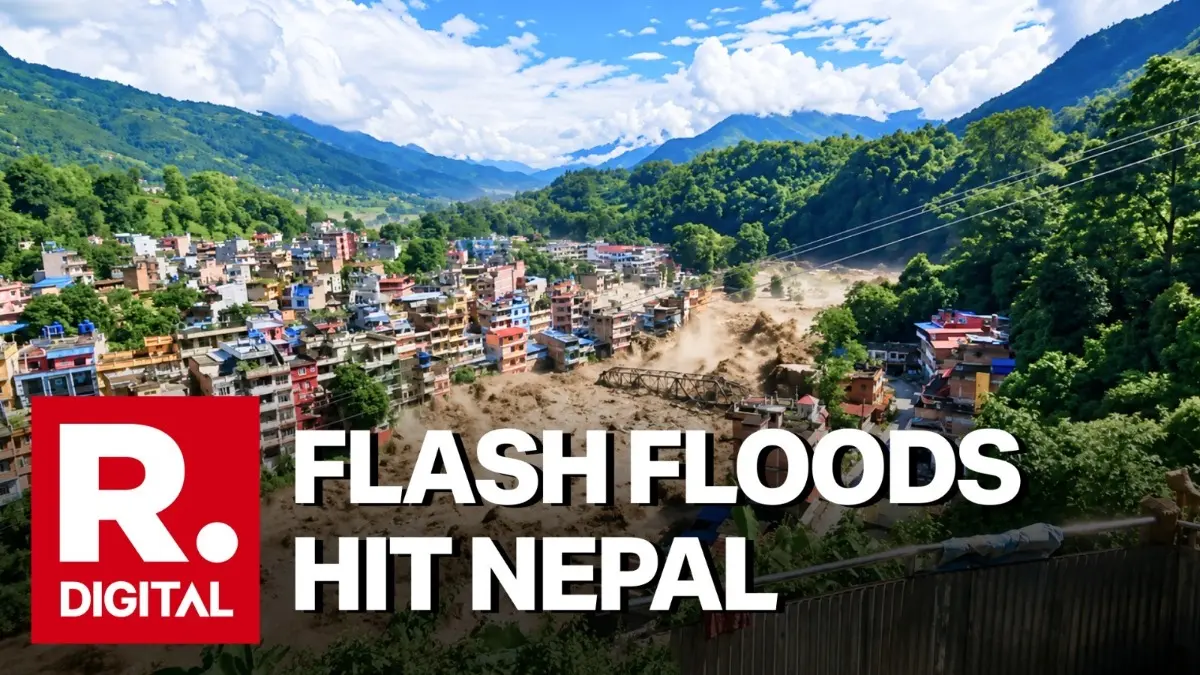
Kathmandu: A devastating glacier collapse near the Nepal-Tibet border has triggered one of the most destructive flash floods in the Himalayan region's recent history.
Raging torrents of ice, mud, and heavy rock surged down the Lhende Khola river basin and through the Bhotekoshi-Trishuli river corridor, leaving at least 390 people dead and more than 1,400 missing across Nepal and China's Tibet Autonomous Region.
As search-and-rescue teams fight treacherous conditions, deep mud, and collapsed infrastructure, the Indian Ministry of External Affairs (MEA) confirmed that 84 Indian nationals have been successfully rescued.
However, anxiety mounts as nearly 290 Indian citizens remain uncontactable in affected mountain districts.
Advertisement
The Nepal Police on Friday said that the authorities involved in rescue operations have recovered 475 bodies, raising the death toll from the devastating Bhotekoshi flood, which occurred on Wednesday, The Kathmandu Post reported.
The Nepal Tourism Board said on Thursday night that 667 tourists and travellers, including 127 Nepali residents, were still missing in areas affected by the floods.
Advertisement
Earlier on Friday morning, Nepal Police said that 1,545 people were injured and rescued. Meanwhile, police have issued a fresh alert for floods in the Himalayan country, evacuating people from Trishuli.
A police official told ANI that all forms of work, including the rebuilding of the roads in the region, have halted.
Nepal Police officer P Chaudhary said, "The water level is about to rise, so everyone is being stopped. The vehicles that were engaged in the operation are all returning. They are all coming back. Everyone is being evacuated from there and is being taken to a safe location. All the work has stopped. Even worse flooding is yet to come; that is why everyone is being put on alert."
Earlier today, an earthquake of magnitude 5.1 hit Sichuan in China, prompting a flood alert in Nepal. People in the Trishuli area of Nepal were evacuated again as a heavy flow of water from above has threatened to raise the river's water level, Nepal Police stated.
1. Rescue Operations and the Status of Indian Nationals
Emergency crews, military units, and international response teams are conducting non-stop search operations across high-altitude border passes and downstream river basins.
The affected transit route, a major corridor for international trekkers and pilgrims travelling to Mount Kailash in Tibet, was heavily populated when the flash flood struck.
According to official updates from New Delhi, the 84 Indian nationals rescued so far fall into two primary groups:
Trishuli-I Hydropower Project Workers: 63 Indian workers stationed at the Trishuli-I hydroelectric facility in Rasuwa district were trapped when raging waters submerged the complex. Nepalese Army personnel and rescue squads successfully evacuated all 63 individuals through tactical air flights and ground extractions.
Kailash Mansarovar Pilgrims: 21 pilgrims from Tamil Nadu, who were stranded at high-altitude border checkpoints during their pilgrimage, were safely rescued and are being assisted with return travel to India.
Despite these rescues, roughly 290 Indian nationals remain out of contact. Many were part of organised pilgrimage tours or independent trekking groups in rugged sectors such as Rasuwa, Darchen, and Gyirong.
In response, India dispatched two Indian Air Force (IAF) C-130J transport aircraft delivering 47.5 tonnes of Humanitarian Assistance and Disaster Relief (HADR) materials to Kathmandu, including temporary shelters, blankets, hygiene kits, solar lighting, and essential medicines. Emergency helplines have been set up by Indian diplomatic missions in Kathmandu and Beijing to assist searching families.
2. Anatomy of the Disaster: How the Glacier Sheared Off
Satellite imagery and hydrological evaluations indicate that the event was not caused by standard monsoon cloudbursts, but rather by a massive structural failure of a high-altitude glacier.
Nearly two-thirds of a high-altitude glacier on the Nepalese side of the border sheared away from the bedrock, plunging approximately 1.2 kilometres into the Lhende Khola river catchment:
Kinetic Impact: The kinetic force of the falling ice mass registered a seismic signal equivalent to a magnitude 5.2 event.
Debris Bulking: As millions of tons of ice smashed into the riverbed, it pulverised rock and mixed with glacial sediment, instantly forming a high-density, cement-like slurry that hydrologists described as "liquid concrete".
The Surge Wave: The massive debris flow temporarily dammed the narrow river gorge before bursting downstream with violent force.
Barely seven minutes passed between the initial seismic signal and the moment a multi-story wave of debris hit the border outpost at Rasuwagadhi.
Security footage captured residents and border personnel running moments before immigration offices, military posts, and concrete bridges were swept away.
3. Trajectory of Destruction: From High Peaks to Southern Plains
The destructive wave funnelled through the narrow Trishuli gorge, causing widespread damage to civil infrastructure.
Over a dozen hydroelectric facilities along the river system suffered severe damage or total flooding, knocking out major power lines. Crucial highway segments connecting Kathmandu to Lhasa were completely severed.
The downstream path of the flood created a trail of devastation across multiple administrative zones:
Rasuwa and Nuwakot: As the immediate point of impact, settlements, police barracks, and customs hubs were buried under deep silt and mud.
Chitwan and Nawalparasi: As the Trishuli River flattened out into the southern plains, floodwaters deposited thousands of tons of sediment along with victims carried down from the mountains.
In Chitwan district alone, emergency personnel recovered 132 bodies from riverbanks located nearly 150 to 200 kilometres downstream from the epicentre.
Cross-Border Impact in India: The sheer power of the water carried debris across the international border into India. Authorities in Uttar Pradesh’s Maharajganj district recovered three bodies from the Gandak river system believed to have been swept down from Nepal.
4. On-the-Ground Response and Secondary Flood Risks
Nepal's Prime Minister announced that state machinery is operating at full capacity to manage the crisis. More than 13,200 personnel from the Nepal Police, Nepal Army, and Armed Police Force (APF) have been deployed across the eight affected districts.
Aerial search-and-rescue flights using military and chartered private helicopters have conducted dozens of sorties, airlifting stranded tourists, pregnant women, children, and critically injured victims to medical facilities in Kathmandu.
Relief camps set up by the Nepal Red Cross and international aid agencies are providing food, clean drinking water, and basic medical care to thousands of displaced residents.
However, search efforts remain under constant threat from secondary environmental hazards:
Rising Risk of Barrier Lake Breaches: Geological teams have warned that massive landslides triggered by the collapse have partially blocked segments of the Bhotekoshi River, creating artificial debris-blocked lakes.
If these unstable sediment dams breach under rising water levels, a secondary surge could cascade downstream, endangering search operations and additional settlements in both Nepal and northern India.
5. Most Affected Districts
Rasuwa, Nuwakot, Dhading, Chitwan, Nawalparasi East, Gorkha
While emergency responders continue searching under challenging high-altitude conditions, climate and geological experts note that rising global temperatures are making glacial instability and sudden catastrophic structural failures an escalating threat across the Himalayan belt.
Emergency operations face significant danger from landslide-triggered sediment dams along the Bhotekoshi River.
Geologists warn that if these unstable artificial lakes burst, rising water levels could trigger a secondary surge that could cascade downstream, threatening rescue workers and settlements across northern Nepal and low-lying border areas in northern India.