
'Don't Think Iran Has Ever Faced President Like Trump': US Secretary of State Marco Rubio
US Secretary of State Marco Rubio praised President Trump's direct strategy towards Iran, noting a significant shift from past approaches that allowed Tehran to evade accountability. Rubio claimed that US military actions have greatly diminished Iran's defensive capabilities, stripping it of its protective "conventional shield."
- World News
- 3 min read

;'%3e%3cpath%20d='m8,15.99c4.41,0,7.99-3.58,7.99-7.99S12.41,0,8,0,0,3.59,0,8s3.58,7.99,7.99,7.99Z'%20style='stroke:%23fff;%20stroke-miterlimit:10;%20stroke-width:.02px;'/%3e%3cpath%20d='m3.08,3.37l3.82,5.11-3.84,4.15h.87l3.37-3.64,2.72,3.64h2.94l-4.04-5.39,3.58-3.87h-.86l-3.1,3.35-2.5-3.35h-2.94Zm1.27.64h1.35l5.97,7.99h-1.35l-5.97-7.99Z'%20style='fill:%23fff;'/%3e%3c/g%3e%3c/svg%3e)


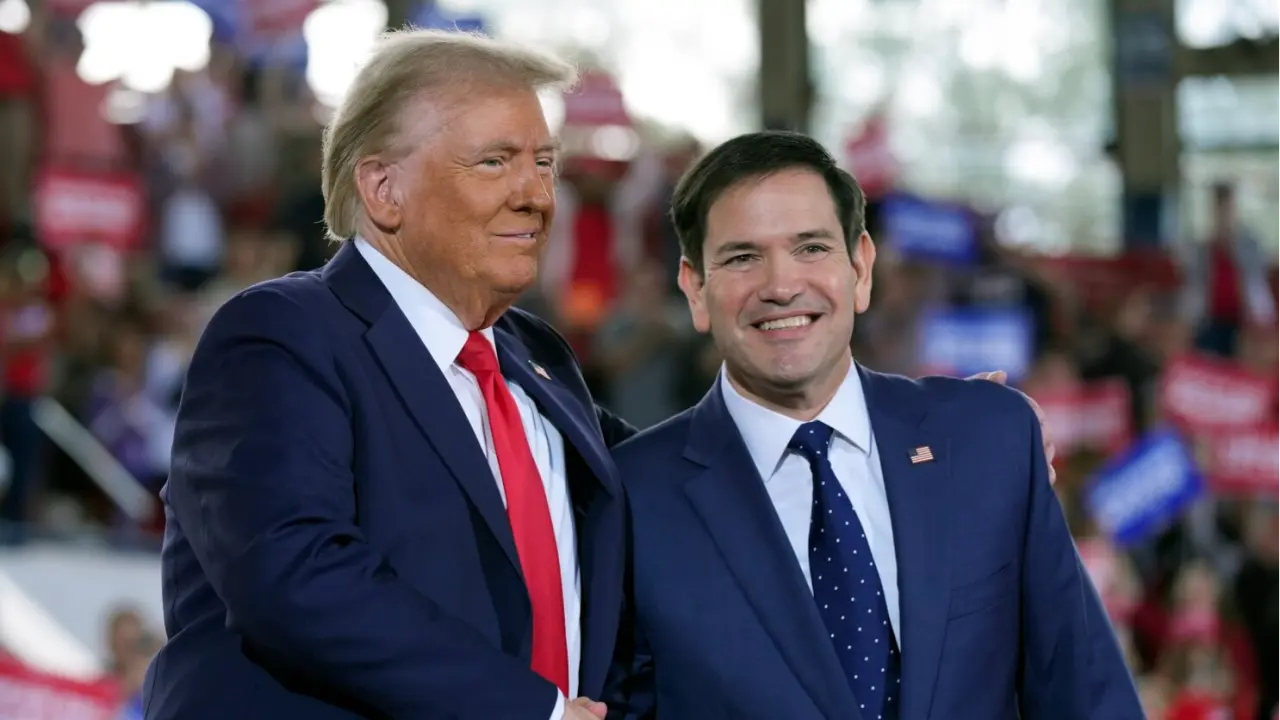
Washington: US Secretary of State Marco Rubio on Saturday (local time) praised President Donald Trump's decisive strategy against Tehran, stating that the Iranian regime has never encountered an American leader who acts with such directness.
Speaking in an interview with Fox News, Rubio reflected on Washington's approach to the Islamic Republic and highlighted a sharp shift from past precedent, asserting that Tehran can no longer rely on usual tactics to evade consequences.
"I don't think the Iranian regime has ever faced a President like Trump, which is somebody that actually takes action," Rubio said. "They got used to, for 20-30 years -- not just the U.S., but the broader world -- allowing them to get away with things like lying, breaking deals."
Detailing the impact of recent military actions, Rubio stated that US strikes have "severely degraded" Iran's defensive capabilities, claiming that the regime has lost the conventional shield it once relied on for protection.
Advertisement
"They still have missiles and they still have drones, and they can still do damage," Rubio acknowledged. He emphasised, however, that Iran no longer possesses the "conventional shield that they were going to hide behind."
He asserted this as the reason why Iran now appears eager to negotiate deals regarding denuclearisation and the Strait of Hormuz, emphasising that Washington is dealing from a position of absolute strength.
Advertisement
"And that's changed the whole dynamic. It's the only reason why they are now willing and in some cases, seem eager, to do a deal on denuclearisation, to do a deal on the straits. Because we are now approaching them from a position of strength, not from a position of weakness," he added.
Addressing Tehran's foreign policy goals and long-standing efforts to project power across the Middle East, the Secretary of State emphasised that Washington must significantly raise the stakes to curb the regime's regional influence.
"They want to export their revolution," Rubio added. "That does have to change -- and the only way you're going to change that is if you make the price of it too high for them to be able to pay."
Hours after Rubio's remarks, US President Donald Trump announced the cancellation of a planned attack on Iran, subject to being able to rapidly make a deal with the Persian Gulf country, while noting that Israel has joined him in this commitment.
Trump said there have been urgent appeals from Middle Eastern Countries to hold off any attack as "perimeters of a deal have been agreed to".
He asserted this would include immediate and total opening of the Hormuz Strait and an end to Iran's nuclear threat.
While the cancellation of the strike signals a temporary reprieve from total escalation, Trump emphasised that the pause is entirely conditional on Iran's readiness to " rapidly make a deal."