
Emerging and Middle Powers Seek Greater Relevance Amid US-China Rivalry: Jaishankar at Munich Security Conference
Jaishankar described the international landscape as defined by 2 major shifts: a deliberate repositioning of the US, which has chosen a more solitary posture, & the rise of China, whose economic weight, accounting for roughly one-third of global manufacturing, is translating into political influence
- World News
- 5 min read

;'%3e%3cpath%20d='m8,15.99c4.41,0,7.99-3.58,7.99-7.99S12.41,0,8,0,0,3.59,0,8s3.58,7.99,7.99,7.99Z'%20style='stroke:%23fff;%20stroke-miterlimit:10;%20stroke-width:.02px;'/%3e%3cpath%20d='m3.08,3.37l3.82,5.11-3.84,4.15h.87l3.37-3.64,2.72,3.64h2.94l-4.04-5.39,3.58-3.87h-.86l-3.1,3.35-2.5-3.35h-2.94Zm1.27.64h1.35l5.97,7.99h-1.35l-5.97-7.99Z'%20style='fill:%23fff;'/%3e%3c/g%3e%3c/svg%3e)


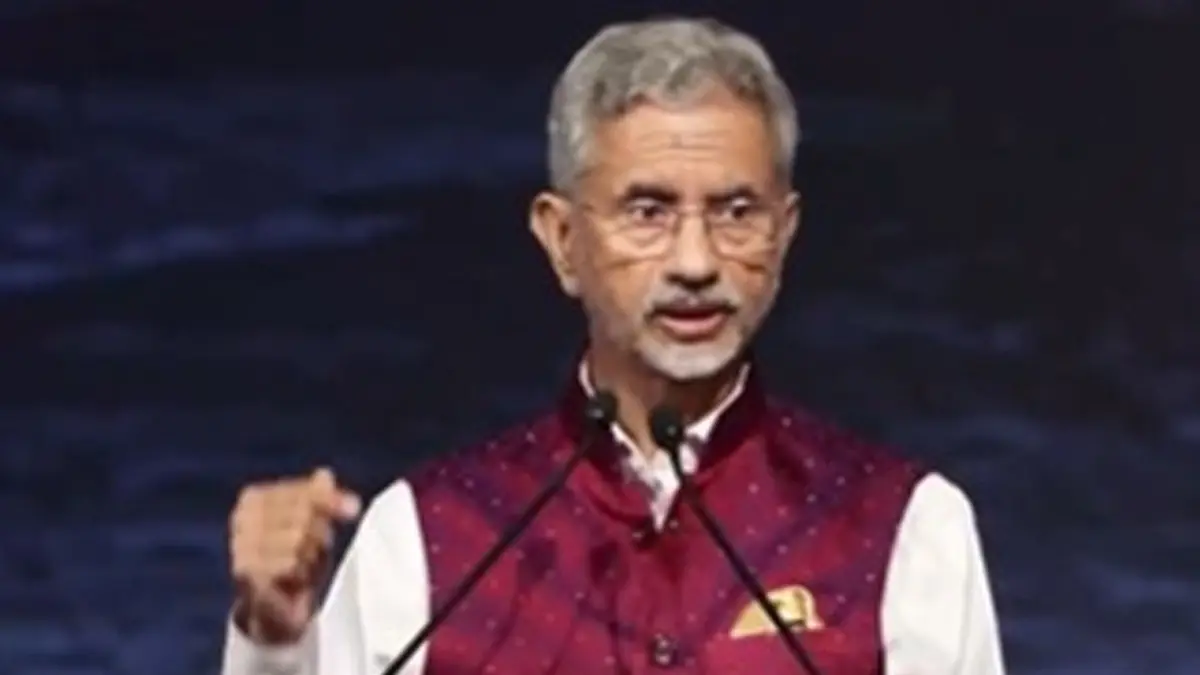
Munich: External Affairs Minister S. Jaishankar has underlined that emerging and middle powers -- whether from the Global South or the Global North -- are united by a shared desire to become more relevant and exercise greater influence in a rapidly changing world order.
Speaking at the 62nd Munich Security Conference, Jaishankar said the term “emerging powers” covers two distinct categories. Some countries, like India, are rising after centuries of colonisation as their economies grow. Others are emerging from the relative comfort of long-standing alliance structures.
“Both are emerging in different ways, and what is common between them is the desire to be more relevant, to make a greater impact, and that really is a point of convergence,” he stated.
He cautioned against rigid definitions of “middle powers,” arguing that relevance today often rests on specialised strengths rather than overall economic size. Countries outside the G20 can still punch above their weight in specific domains -- the Netherlands in semiconductors or the UAE in broader influence, for example. Both emerging and middle powers, he said, should be viewed through a flexible and expansive lens.
Advertisement
Jaishankar described the current international landscape as defined by two major shifts: a deliberate repositioning of the United States, which has chosen a more solitary posture, and the rise of China, whose economic weight -- accounting for roughly one-third of global manufacturing -- is translating into political influence. The sharp competition between the two has led to the weaponisation of every form of leverage, even as deep interdependence continues.
In this environment, he observed, the player with greater command over key factors and stronger determination gains the upper hand. Most emerging and middle powers are responding by prioritising diversification, de-risking and the building of resilient supply chains. They are forging agenda-based partnerships rather than seeking complete identity of views.
Advertisement
“If you have enough touch points, that is good enough for countries to work together,” he said. A new architecture is gradually taking shape through this process of hedging and cooperation.
Examples cited by the minister include the Quad, the India-Middle East-Europe Economic Corridor, the International North-South Transport Corridor, BRICS, the International Solar Alliance and the Coalition for Disaster Resilient Infrastructure. Such platforms allow countries to pool strength where interests align while maintaining pragmatic engagement with both the US and China.
The result, Jaishankar argued, is an acceleration of multipolarity and the rise of “multi-alignment” as the practical third way. Countries increasingly maintain relationships that are not always easy to harmonise, advancing their interests by hedging. This trend is already placing pressure on traditional multilateralism, particularly the gridlocked United Nations, and is encouraging the formation of smaller, issue-based groups.
The minister outlined a concrete agenda for cooperation among emerging and middle powers: contributing to international peace and security, expanding investment and trade, strengthening supply-chain resilience (including in critical areas such as pharmaceuticals and advanced manufacturing), promoting connectivity, advancing climate action and sustainability, modernising defence cooperation, and collaborating in space.
“There is today a substantial agenda for emerging and middle powers to cooperate,” Jaishankar said.
“The world is changing, its agenda is changing, the landscape is changing, the architecture is changing,” he added.