
EU Leaders Agree to Provide 90 Billion Euros to Ukraine Over the Next Two Years
EU leaders have agreed to provide 90 billion Euros of support for Ukraine's defense against Russia for 2026-2027, opting to borrow from capital markets instead of using frozen Russian assets. While Hungary, Slovakia, and the Czech Republic won't contribute, a separate loan for Ukraine from Russian assets is still under discussion, to be repaid after receiving reparations from Moscow.
- World News
- 4 min read

;'%3e%3cpath%20d='m8,15.99c4.41,0,7.99-3.58,7.99-7.99S12.41,0,8,0,0,3.59,0,8s3.58,7.99,7.99,7.99Z'%20style='stroke:%23fff;%20stroke-miterlimit:10;%20stroke-width:.02px;'/%3e%3cpath%20d='m3.08,3.37l3.82,5.11-3.84,4.15h.87l3.37-3.64,2.72,3.64h2.94l-4.04-5.39,3.58-3.87h-.86l-3.1,3.35-2.5-3.35h-2.94Zm1.27.64h1.35l5.97,7.99h-1.35l-5.97-7.99Z'%20style='fill:%23fff;'/%3e%3c/g%3e%3c/svg%3e)


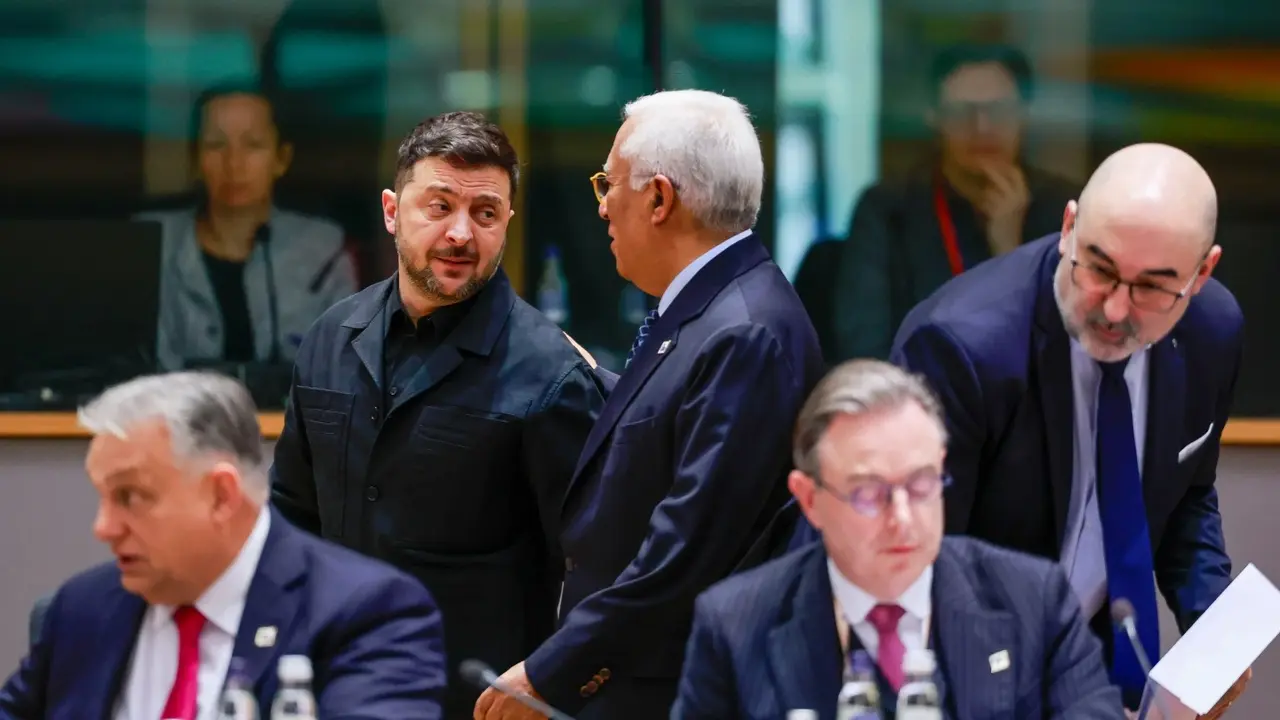
Brussels: European Union leaders decided on Friday to borrow cash to fund Ukraine's defence against Russia rather than use frozen Russian assets, diplomats said. "We have a deal. Decision to provide 90 billion euros of support to Ukraine for 2026-27 approved," EU summit chairman Antonio Costa posted on social media in the early hours of Friday morning after hours of talks.
Costa did not specify the source of the funding but a draft text of the summit's conclusions, seen by Reuters, said it would come from borrowing on capital markets, secured against the EU budget. The deal will not affect the financial obligations of Hungary, Slovakia and the Czech Republic, which did not want to contribute to the financing of Ukraine, the text said.
At the same time, EU governments and the European Parliament would continue working on setting up a loan for Ukraine that would be based on the frozen Russian central bank assets, it said.
The loan to Ukraine based on the joint borrowing would only be repaid by Ukraine once it receives war reparations from Moscow. Until then, the Russian assets would remain immobilised and the EU reserved the right to use them to repay the loan, according to the text.
Advertisement
"It’s good in the sense that Ukraine will secure funding for 2 years," one EU diplomat said. The move follows hours of discussions among leaders on the technical details of a loan based on the frozen Russian assets, which turned out to be too complex or politically demanding to sort out at this stage, diplomats said.
"We have gone from saving Ukraine, to saving face, at least that of those who have been pushing for the use of the frozen assets," a second EU diplomat said.
Advertisement
The main difficulty in the use of the Russian money was providing Belgium, where 185 billion of the total 210 billion euros of Russian assets in Europe are held, with sufficient guarantees against financial and legal risks from potential Russian retaliation for the release of the money to Ukraine.
Hungary Scores A Win
The EU sees Russia's war as a threat to its own security and wants to keep Ukraine financed and fighting.
With public finances across the EU already strained by high debt levels, the European Commission had proposed using frozen Russian central bank assets to secure a huge loan of 90 billion euros to Kyiv, with joint borrowing against the EU budget as a second option.
The joint borrowing was difficult because it requires unanimity. Moscow-friendly Hungary had said it would oppose it, just as it opposed the use of Russian assets.
But Hungarian Prime Minister Viktor Orban appeared to have agreed not to block the borrowing as long as his country, Slovakia and the Czech Republic were excluded from the guarantees for the debt.
"Orban got what he wanted: no reparation loan. And EU action without participation of Hungary, Czech Republic and Slovakia," a third EU diplomat said.
'Can't Afford to Fail'
Several EU leaders arriving at the summit said it was imperative they find a solution to keep Ukraine financed and fighting for the next two years. They were also keen to show European countries' strength and resolve after U.S. President Donald Trump last week called them "weak".
"We just can't afford to fail," EU foreign policy chief Kaja Kallas said.
Ukrainian President Volodymyr Zelenskiy, who took part in the summit, urged the bloc to agree to use the Russian assets to provide the funds he said would allow Ukraine to keep fighting.
"The decision now on the table – the decision to fully use Russian assets to defend against Russian aggression – is one of the clearest and most morally justified decisions that could ever be made," he said.
Belgium Wanted More Guarantees on Risk Sharing
Belgian Prime Minister Bart De Wever told his country's parliament early on Thursday that he had not yet seen guarantees that answered his concerns on legal and liquidity risks for Belgium to agree to the use of the Russian assets.
Russia's central bank has said the EU plans to use its assets are illegal. It filed a lawsuit in Moscow this week seeking $230 billion in damages from clearing house Euroclear.
The stakes for finding money for Kyiv are high because without the EU's financial help Ukraine will run out of money in the second quarter of next year and most likely lose the war to Russia, which the EU fears would bring closer the threat of Russian aggression against the bloc.
Additional reporting by Andrew Gray, Yuliia Dysa, Inti Landauro, Olena Harmash, Julia Payne, John Irish, Bart Meijer, Benoit Van Overstraeten, Andreas Rinke, Alan Charlish, Krisztina Than. Writing by Jan Strupczewski and Ingrid Melander. Editing by Richard Lough, Alex Richardson, Mark Potter and Nick Zieminski.