
From Vision To Reality: Quad Foreign Ministers Deepen Economic And Maritime Security Deals For Free And Open Indo-Pacific
Hosted by India's External Affairs Minister Dr S. Jaishankar, the high-profile gathering also features Australian Foreign Minister Penny Wong and Japanese Foreign Minister Toshimitsu Motegi. The summit builds directly on the framework established during the grouping's last gathering in Washington, D.C., in July 2025, marking the third time the leaders have met in the last 18 months.
- World News
- 10 min read

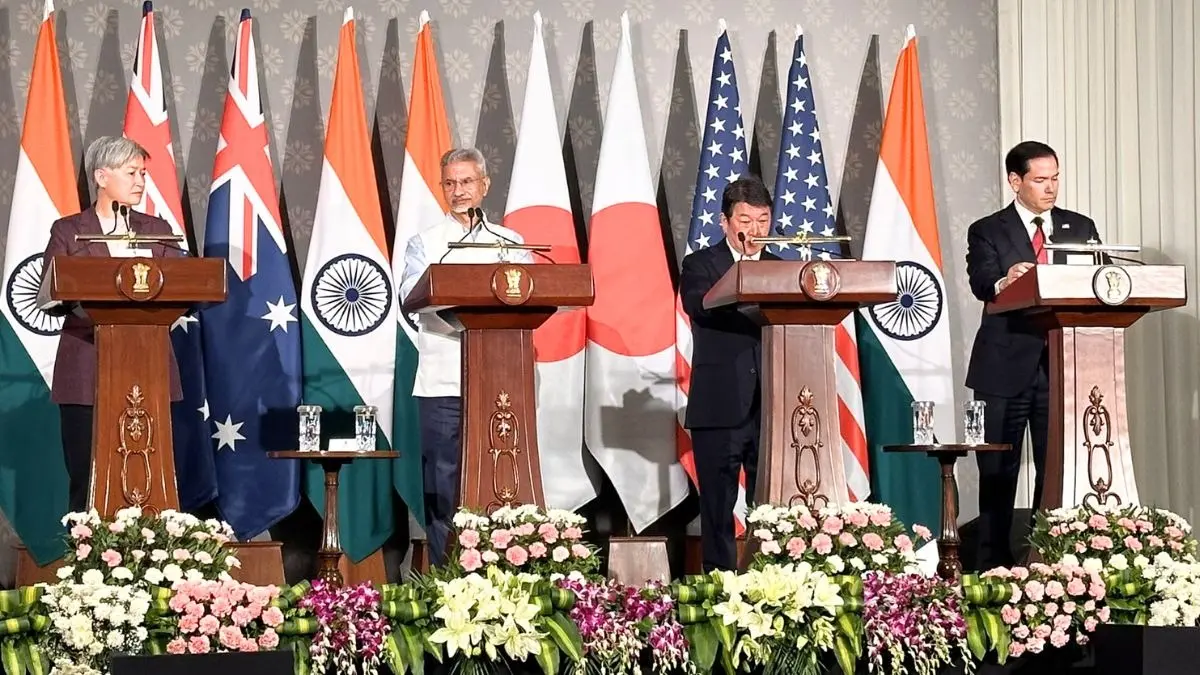
New Delhi: US Secretary of State Marco Rubio arrived in the national capital on Tuesday, accompanied by US Ambassador to India Sergio Gor, to participate in the Quad Foreign Ministers' Meeting. Representatives from India, Australia, Japan, and the United States kicked off the summit at Hyderabad House with a traditional family photograph, signalling a united front among the maritime democracies.
Hosted by India's External Affairs Minister Dr S. Jaishankar, the high-profile gathering also features Australian Foreign Minister Penny Wong and Japanese Foreign Minister Toshimitsu Motegi. The summit builds directly on the framework established during the grouping's last gathering in Washington, D.C., in July 2025, marking the third time the leaders have met in the last 18 months.
India Calls for Deepening Collaborations
In his opening remarks, Jaishankar underlined the strength of the partnership, noting how the leaders are meeting for the third time in 18 months. "At the global level we have to address issues like supply chain resilience, connectivity chokepoints, manufacturing and resource concentration and gaps in critical infrastructure", he said and underlined that each of these avenues offers for deeper collaborations, stronger growth and realising the promise of technologies,", he said.
He called for enhancing strategic confidence, ensuring maritime security, promoting economic choices, and fostering a deeper collaborative ethos by promoting trusted and transparent partnerships to address the concerns of the Indo-Pacific. Over the past several months, partner countries have advanced collaboration across key priorities, including maritime security, critical technologies, economic resilience, and HADR. Jaishankar noted encouraging progress on many initiatives.
Advertisement
"As maritime democracies, pluralistic societies and market economies, we share the responsibility towards a free and open Indo-Pacific. The region must remain a driver for global growth and stability", he said. Earlier on Monday, Motegi and Jaishankar held bilateral-level delegation talks here in the national capital.
Japan and India Target Economic Security
Japanese Foreign Minister Toshimitsu Motegi highlighted how the Quad serves as an important platform towards advancing cooperation in the Indo-Pacific region and expressed optimism that the discussions at the Foreign Ministers' Meet would deepen collaboration between the partner countries.
Advertisement
A statement by Japan's Ministry of Foreign Affairs highlighted that Motegi explained Japan's updated "Free and Open Indo-Pacific (FOIP)" and stated that, to realise FOIP, Japan and India must serve as the driving force, and expressed his expectation for close Japan-India coordination, including through the Quad framework.
Motegi made the remarks here in the national capital while speaking at the Quad Foreign Ministers Meet and said, “This Quad meeting signifies the firm message to the world that Quad will strongly promote cooperation to realise free and open Indo-Pacific.” He underlined how the Indo-Pacific nations must enhance their resilience and economic security and said, "The Indo-Pacific nations should strengthen resilience and the necessary capacity to determine their own future, including economic security. Today, I hope for frank discussions, including accelerating the Quad collaboration."
The statement highlighted that the Ministers agreed that, based on the "Japan-India Joint Vision for the Next Decade" launched during Prime Minister Modi's visit to Japan last August, they would accelerate cooperation between the public and private sectors, particularly in the field of economic security, including strengthening supply chain resilience for critical materials, as well as to promote economic growth in both countries through investment and innovation.
Australia Stresses Sovereign Freedom of Choice
Australian Foreign Minister Penny Wong on Tuesday emphasised the importance of safeguarding sovereign choice and maintaining a free and open Indo-Pacific, while reaffirming Australia's commitment to deeper Quad cooperation. Addressing the Quad Foreign Ministers' meeting in New Delhi, Wong praised India's role in the region and highlighted the strategic significance of the gathering.
Ahead of her visit, Australian Foreign Minister Penny Wong hailed the Quad as a vital partnership for shaping a peaceful, stable and prosperous future for the Indo-Pacific region in a statement shared in advance. She added, "While in India, I will hold the 17th Australia-India Foreign Ministers' Framework Dialogue with my counterpart, Minister for External Affairs Dr S. Jaishankar. Australia and India's partnership has never been more consequential."
"Looking ahead, the Indo-Pacific is going to become more and more important with the passage of time. It will even become a big energy lifeline," he said. The External Affairs Minister stated that there is potential for growth between India and the US across areas such as energy and trade, adding, "The work on Quad goes on, and two days from now you will see us on the podium talking about the Quad. I can assure you we will have a good, strong story to tell."
"We meet in the world's largest democracy and a power that is so important in the shaping of the Indo-Pacific and the world," Wong said during her opening remarks. Referring to an earlier 2025 Quad discussion in Washington, Wong recalled Jaishankar's remarks on strategic autonomy and sovereign decision-making.
"I want to start by reflecting on a point that Minister Jaishankar made at one of our earlier Quads in Washington and spoke about choices and about doing what we can together to ensure that the Indo-Pacific and the countries within it have the freedom of choice on their security and on asserting their sovereign interests," she stated.
"This is central to how Australia approaches our engagement in the Quad," Wong added. The Australian Foreign Minister stressed that while the four Quad nations have different histories and perspectives, they remain closely aligned in their broader regional goals. "We are four sovereign nations, have our own histories and interests, but there is great alignment between our interests," Wong said.
"We all share a vision for the Indo-Pacific, a region that is free and open," she added. Wong also underlined the practical outcomes achieved through Quad cooperation, particularly in areas of humanitarian response, infrastructure, maritime security, and supply chains. "Each of us brings our unique perspective, experiences and strengths together as we work to achieve such a region," she said.
"As the Quad, we have delivered concrete results when we responded to natural disasters," Wong noted. "We have also cooperated on critical infrastructure, undersea cables, maritime security and critical minerals," she added. Highlighting the grouping's future direction, Wong said all four nations remain committed to strengthening the Quad and ensuring it delivers tangible results for the region. "We all want the Quad to be as strong and as effective as we can make it be, focused on delivering, and we are determined to continue its momentum," she said.
"This is the future we want for our region, a peaceful, stable, prosperous region, and today we continue the work to build that," Wong said. Ahead of her visit, Australian Foreign Minister Penny Wong hailed Quad as a vital partnership for shaping a peaceful, stable and prosperous future for the Indo-Pacific region in a statement shared ahead of the visit.
She added, “While in India, I will hold the 17th Australia-India Foreign Ministers' Framework Dialogue with my counterpart, Minister for External Affairs Dr S. Jaishankar. Australia and India's partnership has never been more consequential.” US Secretary of State Marco Rubio on Tuesday said the Quad grouping is evolving from a discussion platform into an action-oriented strategic partnership, emphasising cooperation on security, energy, humanitarian response, and supply chains.
US Signals Shift from Talk to Action
Speaking at Hyderabad House in New Delhi, Rubio thanked External Affairs Minister S. Jaishankar and the Indian government for hosting the gathering, describing the meeting as taking place at “an important time.” "Over the last three days, not just I want to thank Minister Jaishankar and the Indian government for hosting us here, not just in the bilateral visit over the last three days, but for hosting this important gathering here again today," Rubio said during his opening remarks. The US Secretary of State noted that his first meeting after being sworn into office was with the Quad, saying it reflected Washington's commitment to the grouping.
"It was our goal as I began as Secretary of State, and as has been pointed out earlier, my first meeting as a Secretary of State was the Quad, literally within minutes of being sworn in. And I thought that demonstrated our commitment to this process," Rubio said.
Rubio stressed that the Quad's collective objective over the past year has been to move beyond dialogue and toward practical cooperation. "But our goal collectively over the last year has been to turn this from a forum in which we meet and talk about problems to one where we actually do something about it," he stated.
"I think we can report to our peoples respectively that we are beginning to do that pretty aggressively and pretty impressively in many areas of cooperation," he added.
According to Rubio, recent global developments have made the Quad's agenda even more significant and relevant. "And it's also interesting that the areas that we are working together on have become even more relevant and more important because of recent events around the world," he said.
The US Secretary of State highlighted the unique strengths that each Quad member nation brings to the partnership. "The most interesting thing about the Quad is not simply that it is a gathering of four strategic allies in which we come together to sort of compare notes about areas of common interest," Rubio said.
"Each of these four nations represented here today bring unique capabilities that collectively we can bring to bear on some of the most significant problems facing the world, whether it's a humanitarian response, whether it's the security of energy, whether it's the freedom of navigation, whether it's the need to diversify our supplies of not just energy but critical minerals and supply chains," he added.
Rubio also underscored the continuing coordination among member nations outside formal meetings, saying officials remain engaged year-round to operationalise Quad initiatives. "A lot of work happens after our meetings. Our staff go back, they coordinate year-round constantly," Rubio said.
"We have people at the State Department that are specifically assigned to this relationship and to this forum and to turning it into action," he added. Rubio also expressed confidence that the Quad would continue building momentum as a “gathering of strategic allies.” Discussions are expected to focus heavily on: Free and Open Indo-Pacific, reaffirming commitment to maritime security, freedom of navigation, and a rules-based order, evaluating progress on critical technology, climate resilience, and infrastructure delivery and exchanging perspectives on emerging security challenges in the region and broader international developments.
The summit builds directly on the framework established during their last gathering in Washington, D.C., on July 1, 2025. Discussions are expected to focus heavily on: Free and Open Indo-Pacific, reaffirming commitment to maritime security, freedom of navigation, and a rules-based order, evaluating progress on critical technology, climate resilience, and infrastructure delivery and exchanging perspectives on emerging security challenges in the region and broader international developments. (With ANI Inputs)