
Half of Afghanistan's vulnerable population 'in dire need' of humanitarian aid: UN
UN highlighted the plight of Afghanistan's displaced families to neighbouring areas due to heavy fighting in Nahr-e-Saraj District Administrative Centre (DAC).
- World News
- 3 min read

;'%3e%3cpath%20d='m8,15.99c4.41,0,7.99-3.58,7.99-7.99S12.41,0,8,0,0,3.59,0,8s3.58,7.99,7.99,7.99Z'%20style='stroke:%23fff;%20stroke-miterlimit:10;%20stroke-width:.02px;'/%3e%3cpath%20d='m3.08,3.37l3.82,5.11-3.84,4.15h.87l3.37-3.64,2.72,3.64h2.94l-4.04-5.39,3.58-3.87h-.86l-3.1,3.35-2.5-3.35h-2.94Zm1.27.64h1.35l5.97,7.99h-1.35l-5.97-7.99Z'%20style='fill:%23fff;'/%3e%3c/g%3e%3c/svg%3e)


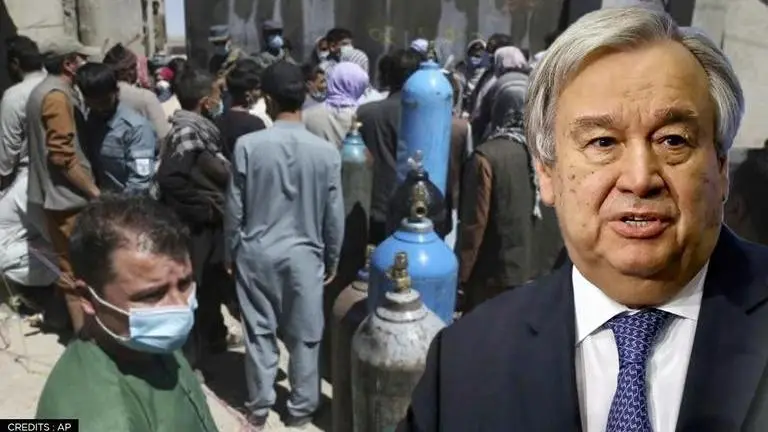
Highlighting the “sufferings" of the vulnerable Afghani population, mostly women and children, due to insurgency across several fronts on borders of Afghanistan, the UN on Monday stated that half of the Afghan population was now in dire need of humanitarian aid. This included a third of children that are facing malnutrition driven by food shortages due to the COVID-19 pandemic and the country’s military and political turmoil, alike.
A report published by the Asia Pacific Regional Humanitarian wing of the UN highlighted the plight of the displaced families to neighbouring areas due to heavy fighting in areas of Nahr-e-Saraj District Administrative Centre (DAC) in Hilmand province. UN stated that this wave of the internally displaced population was in need of international financial assistance for survival.
Following yesterday event with @KhalidPayenda ANDMA Gvt #Afghanistan I am with @unafghanistan @OCHAAfg team meeting with IDPs in Shark-e-Sabz, Herat to address the challenges of war, drought and COVID-19 #stayanddeliver pic.twitter.com/No8E25XD6R
— Dr. Ramiz Alakbarov (@RamizAlakbarov) July 12, 2021
Afghanistan's refugees and repatriation ministry had confirmed the vulnerable Afghani population’s fleeing the territory in a statement last week, stating, “Escalation of violence by the Taliban terrorist group in the country and the spread of the third wave of COVID-19 have caused a great deal of economic and social unrest, creating concerns and challenges for the people.” It further appealed to the European governments and host countries to refrain from forcibly deporting Afghan refugees back in the war-torn region for at least the next three months.
According to the United Nations refugee agency data, the world’s second-largest registered refugee population, an estimated 2.5 million came from Afghanistan, with the vast majority taking refuge in neighbouring Pakistan, Europe or Iran.
Advertisement
People of #Afghanistan are suffering from escalating conflict, #COVID19 and drought. @unafghanistan proud to work with @KhalidPayenda ANDMA and #Stayanddeliver partners @OCHAAfg to deliver urgently needed #humanitarianassistance https://t.co/t5utkIOqpg
— Dr. Ramiz Alakbarov (@RamizAlakbarov) July 11, 2021
Today, the Gov’t launched the Joint Humanitarian Appeal with the UN to prevent a humanitarian crisis in Afg caused by escalated war&drought.18.4m Afghans need humanitarian assistance in2021. The appeal is to humanity to show that we can save people from hunger by working together pic.twitter.com/ypGucS0CA9
— Khalid Payenda (@KhalidPayenda) July 11, 2021
Kabul’s state news agency Khaama Press on Monday quoted the UN general secretary’s deputy special representative in Afghanistan, Ramiz Alkabrove, as saying that approximately 18.4 million people in Afghanistan were in need of urgent humanitarian assistance. To address this humanitarian crisis, the Afghan government launched a Joint Humanitarian Appeal with UNAMA to prevent a humanitarian crisis that worsened in recent weeks due to pandemic, drought, and Taliban- Afghan government conflict.
“The appeal is to humanity to show that we can save people from hunger by working together,” the Acting Minister for finance for the Islamic Republic of Afghanistan wrote on Twitter as he announced the USD 250 million scheme for relief.
'Food, water, NFIs, shelter urgent needs,' says UN OCHA
Afghanistan’s deputy special representative, Ramiz Alakbarov, meanwhile expressed concerns about the Afghani children suffering from acute malnutrition as well as condemned the humanitarian aid envoys being attacked and killed as he reiterated that the neutral workers should not be subjected to attacks by armed groups. On June 17 armed conflict started between the Afghan National Security Forces (ANSF) and a Non-State Armed Group (NSAG) in Afghanistan’s Nahr-e-Saraj district of Helmand Province. The fight spread across many regions including Ab Pashak, Band-e-Barq, Parchaw, Old Prison, Deh Adam Khan and Musaqalah Adda areas.
Advertisement
In Herat today with Humanitarian Coordinador @RamizAlakbarov meeting with partners, listening to displaced communities and exchanging with UN teams #stayanddeliver a lot of work still needed to scale up principled humanitarian response. pic.twitter.com/g3dG44U6K9
— Isabelle Moussard Carlsen (@IMoussardC) July 12, 2021
The conflict led to the humanitarian impact as it triggered the flight of local residents with local authorities estimating that 4,200 people have been displaced from Nahr-e-Saraj DAC alone to nearby villages within the Nahr-e-Saraj district. Many of these displaced people and affected families took shelter with host families and relatives, or have been staying in open. UN OCHA stated in a report, that “food, water, NFIs, shelter and wash assistance are the most urgent needs for vulnerable groups.”