
‘How Did They’: Trump Responds to Iran Threat as Missiles, Drones Rock West Asia War Zone
The US-Israel-Iran conflict intensifies with missile and drone strikes across the region, while Trump downplays Iran’s threats against American companies. Oil markets and diplomacy remain volatile amid escalating tensions.
- World News
- 4 min read

;'%3e%3cpath%20d='m8,15.99c4.41,0,7.99-3.58,7.99-7.99S12.41,0,8,0,0,3.59,0,8s3.58,7.99,7.99,7.99Z'%20style='stroke:%23fff;%20stroke-miterlimit:10;%20stroke-width:.02px;'/%3e%3cpath%20d='m3.08,3.37l3.82,5.11-3.84,4.15h.87l3.37-3.64,2.72,3.64h2.94l-4.04-5.39,3.58-3.87h-.86l-3.1,3.35-2.5-3.35h-2.94Zm1.27.64h1.35l5.97,7.99h-1.35l-5.97-7.99Z'%20style='fill:%23fff;'/%3e%3c/g%3e%3c/svg%3e)


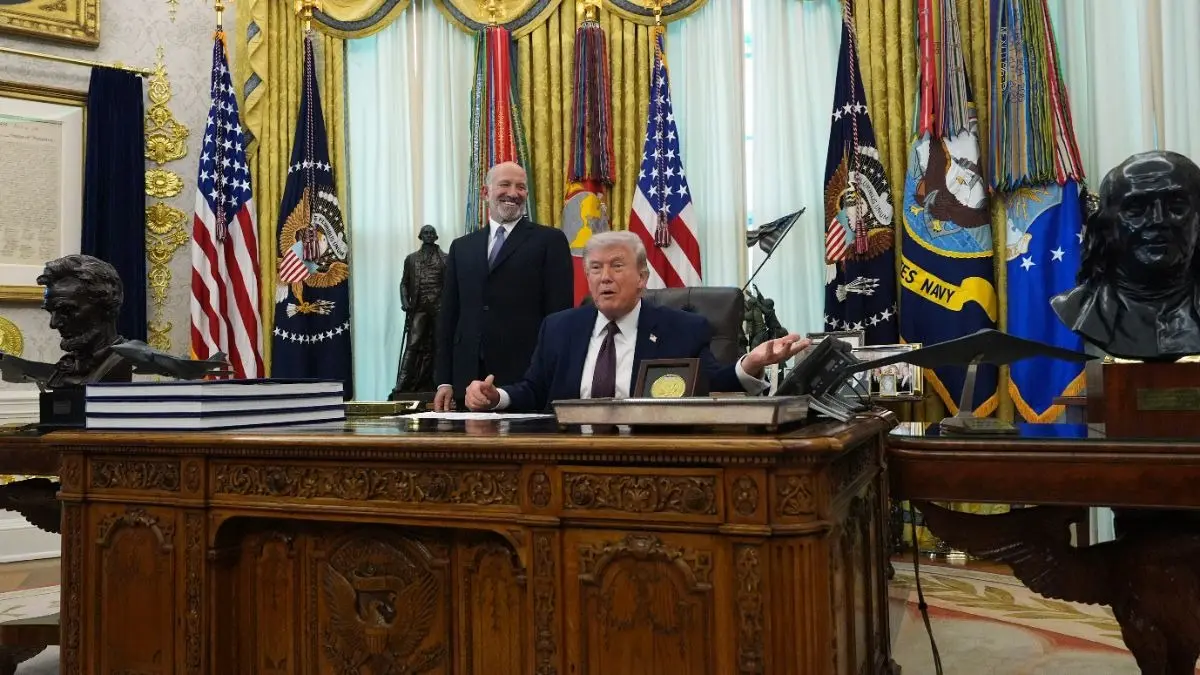
As the US-Israel-Iran conflict enters a critical phase, Donald Trump has downplayed Iran’s reported threats against American companies operating in West Asia, even as fresh missile and drone attacks continue across the region.
Speaking to reporters, Trump questioned the seriousness of Tehran’s warning. “What did they threaten them with?… Are they going to blow them up?… They’re not going to hit them,” he said, adding that Iran would not escalate to nuclear action and claiming, “Most of those people are dead already.”
His remarks come at a time when the ground reality appears far more volatile.
Missiles Strike Israel, Gulf Infrastructure Hit
In the past 24 hours alone, multiple attacks have been reported across the region. Missile impacts were recorded in central Israel, including Tel Aviv, following launches attributed to Iran’s Islamic Revolutionary Guard Corps (IRGC).
Advertisement
Further south, Qatar confirmed that three cruise missiles were fired toward its territory, with one striking an oil tanker. While the crew was safely evacuated, the incident has raised concerns over the vulnerability of energy routes.
Kuwait, meanwhile, faced another drone strike that ignited a fire at an airport fuel facility just days after a previous blaze had been brought under control. Saudi Arabia also reported intercepting drones, underscoring the widening geographical spread of the conflict.
Advertisement
Civilian Impact and Expanding Conflict Zones
The war is increasingly affecting civilians. In the UAE, one person was killed after debris from an intercepted missile fell on a farm. In Iran, an airstrike reportedly hit a Shia mosque in Zanjan, causing casualties and structural damage.
Yemen’s Houthi group has also stepped up involvement, claiming joint missile launches with Iran and Hezbollah targeting Israel marking a further expansion of the conflict beyond direct state actors.
Explosions have been heard in Tehran, with air defence systems activated. One reported strike may have hit the compound of the former US embassy, highlighting how symbolic and strategic targets are being drawn into the conflict.
Internal Strain in Iran, Escalation by Israel
There are also signs of internal pressure within Iran. Reports suggest growing tensions between the elected government and the IRGC, which is believed to be consolidating control during the war.
At the same time, Israel has intensified its operations, announcing the killing of a senior Quds Force engineering official linked to underground military infrastructure in the region.
Oil Markets React, Diplomacy Struggles
Despite the escalation, oil prices have shown volatility rather than a sustained spike. Brent crude briefly fell below $100 per barrel, driven by market hopes that the conflict could de-escalate after Trump indicated a possible US exit within “two to three weeks.”
However, risks remain high, especially around the Strait of Hormuz- a key global oil route-with regional players signalling readiness to act if shipping lanes are threatened.
On the diplomatic front, China and Pakistan have proposed a peace plan calling for ceasefire and negotiations, while Qatar has offered to mediate. But divisions persist among Western allies over the ongoing military strategy.
Words vs Ground Reality
Trump’s comments suggest confidence that Iran will not directly target US-linked interests in a major way. But the steady pace of missile launches, drone strikes, and expanding battle zones paints a different picture-one of a conflict that remains active, unpredictable, and still escalating.
With thousands of US troops deployed and fresh incidents reported almost hourly, the situation on the ground continues to evolve rapidly.
For now, while leaders talk of timelines and restraint, the war itself shows little sign of slowing down.