
In a world's first, doctors discover live worm in 64-year-old Australian woman's brain
A neurosurgeon pulled an 8cm-long parasitic roundworm from her patient in Australia, marking the first such discovery in the world.
- World News
- 3 min read

;'%3e%3cpath%20d='m8,15.99c4.41,0,7.99-3.58,7.99-7.99S12.41,0,8,0,0,3.59,0,8s3.58,7.99,7.99,7.99Z'%20style='stroke:%23fff;%20stroke-miterlimit:10;%20stroke-width:.02px;'/%3e%3cpath%20d='m3.08,3.37l3.82,5.11-3.84,4.15h.87l3.37-3.64,2.72,3.64h2.94l-4.04-5.39,3.58-3.87h-.86l-3.1,3.35-2.5-3.35h-2.94Zm1.27.64h1.35l5.97,7.99h-1.35l-5.97-7.99Z'%20style='fill:%23fff;'/%3e%3c/g%3e%3c/svg%3e)


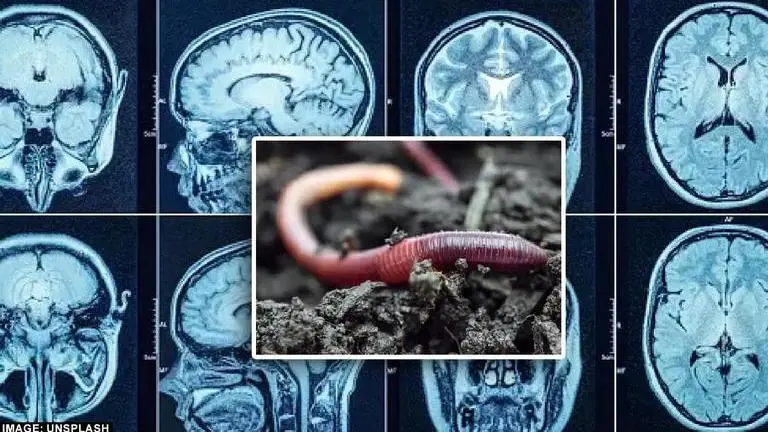
A startling discovery has shaken the medical community as an extraordinary case unfolds in the Australian capital of Canberra. In a scene reminiscent of a sci-fi thriller, a neurosurgeon extracted an 8cm-long parasitic roundworm, which was not only alive but wriggling, from a patient's brain. The astonishing event was reported by The Guardian and has left medical experts baffled.
The account begins with Dr. Sanjaya Senanayake, an infectious diseases physician at Canberra Hospital, receiving an urgent call from neurosurgeon Dr. Hari Priya Bandi. Dr. Bandi had made the shocking find while treating a 64-year-old woman from south-eastern New South Wales.
The patient, initially admitted to a local hospital in late January 2021 with abdominal pain, diarrhea, and fever, experienced progressively worsening symptoms. Her medical journey eventually led to Canberra Hospital, where an MRI scan of her brain revealed abnormalities requiring surgery, reported The Guardian.
Dr. Senanayake shared, "But the neurosurgeon certainly didn’t go in there thinking they would find a wriggling worm." He described the discovery as a "once-in-a-career finding," catching the entire medical team off guard.
Advertisement
Could not find the parasite in any medical textbooks
The incident prompted a swift collaboration among medical professionals to identify the type of roundworm and determine appropriate treatment. Despite searching medical textbooks, the experts struggled to pinpoint the specific parasite. Assistance was sought from external specialists, leading the team to a CSIRO scientist experienced in parasites.
The scientist confirmed the worm to be Ophidascaris robertsi, a roundworm typically found in pythons. This marked the first known case of the parasite being found in humans, making it an unprecedented discovery.
Advertisement
“Canberra is a small place, so we sent the worm, which was still alive, straight to the laboratory of a CSIRO scientist who is very experienced with parasites,” Senanayake said. “He just looked at it and said, ‘Oh my goodness, this is Ophidascaris robertsi’.”
The patient's proximity to a lake inhabited by carpet pythons is believed to be a significant factor. Although she had no direct contact with snakes, she often collected native grasses, including warrigal greens, from the area for cooking. Experts hypothesise that a python might have shed the parasite through its feces onto the grass. It's likely the patient was infected by direct contact with the grass or through consuming the greens.
“That poor patient, she was so courageous and wonderful,” Senanayake said. “You don’t want to be the first patient in the world with a roundworm found in pythons and we really take our hats off to her. She’s been wonderful.”
Due to the lack of prior cases, careful consideration was given to treatment options to prevent adverse reactions as larvae died off. The patient's recovery is progressing well, and ongoing monitoring is being conducted, reported The Guardian.
The case underscores the potential risks of diseases transmitted from animals to humans, known as zoonotic diseases. Dr. Senanayake stated, "Of the emerging infections globally, about 75% are zoonotic, meaning there has been transmission from the animal world to the human world. This includes coronaviruses."
While Ophidascaris infection does not spread among people, experts warn of the need for caution as humans and animals increasingly share habitats, leading to increased opportunities for cross-species transmission. This discovery serves as a reminder of the intricate interconnectedness between humans, animals, and the environment.