
International pressure mounts against Sudan coup
The coup threatens to halt Sudan's fitful transition to democracy, which began after the 2019 ouster of longtime ruler Omar al-Bashir in a popular uprising.
- World News
- 4 min read

;'%3e%3cpath%20d='m8,15.99c4.41,0,7.99-3.58,7.99-7.99S12.41,0,8,0,0,3.59,0,8s3.58,7.99,7.99,7.99Z'%20style='stroke:%23fff;%20stroke-miterlimit:10;%20stroke-width:.02px;'/%3e%3cpath%20d='m3.08,3.37l3.82,5.11-3.84,4.15h.87l3.37-3.64,2.72,3.64h2.94l-4.04-5.39,3.58-3.87h-.86l-3.1,3.35-2.5-3.35h-2.94Zm1.27.64h1.35l5.97,7.99h-1.35l-5.97-7.99Z'%20style='fill:%23fff;'/%3e%3c/g%3e%3c/svg%3e)


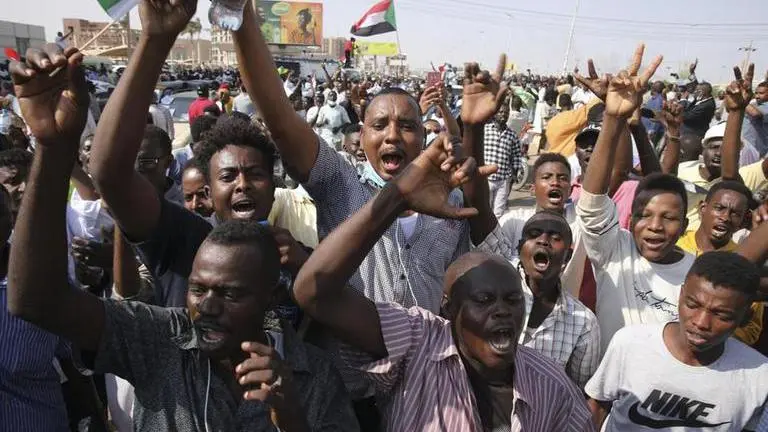
International pressure mounted on the military in Sudan on Wednesday, a day after it ousted the transitional government in the northeastern African nation.
The coup threatens to halt Sudan's fitful transition to democracy, which began after the 2019 ouster of longtime ruler Omar al-Bashir in a popular uprising.
Members of the United Nations Security Council on Wednesday denounced the coup, warning that it threatens to destabilize one of Africa's unstable region.
Prime Minister Abdalla Hamdok's now-deposed government had embarked on a series of reforms meant to transform the country's economy and have the nation rejoin the international community after over two decades of isolation under al-Bashir.
Advertisement
Brian Flynn is Ireland's Deputy Permanent Representative to the U.N.
"The actions of the military represent a betrayal of the revolution, the transition and the legitimate requests of the Sudanese people for peace, justice and economic development."
Advertisement
The coup came after weeks of mounting tensions between military and civilian leaders over the course and pace of Sudan's moves toward democracy.
"The United States has condemned the military takeover of the transitional government in Sudan. This contravenes the constitutional declaration and the democratic aspirations of the Sudanese people and is utterly unacceptable. As we have said repeatedly, any changes to the transitional government by force in Khartoum puts at risk U.S. assistance," Richard M. Mills Jr., U.S. Deputy Representative to the U.N., said at the Security Council meeting.
The African Union suspended Sudan — an expected move typically taken in the wake of coups.
The AU Peace and Security Council said via Twitter on Wednesday that the suspension would remain in place "until the effective restoration of the civilian-led Transitional Authority," as the deposed government is known.
The AU plans to send a mission to Sudan to hold talks with rival parties.
Diplomats at the U.N. Security Council lauded the move.
Trine Heimerback is Norway's Deputy Permanent Representative to the U.N.
"We feel it appropriate, as others also in this meeting, to state again that we are deeply alarmed by the current situation in Sudan, where the gains made in the transition are now at serious risk. We condemn the ongoing military coup and we call for the immediate release of all those who have been detained," Heimerback said at the Security Council meeting.
Relatives and activists say Sudanese security forces have detained three prominent pro-democracy figures overnight.
The arrests come as internal and international pressure mounts on the country's military following its coup and protests denouncing the takeover continued Wednesday.
Many businesses have shut in response to calls for strikes.
Groups of protesters set up barricades of stones on main roads throughout the day.
Security forces waded in, chasing demonstrators and dismantling the barricades.
Andre Lipand, Estonia's Deputy Permanent Representative to the U.N, addressed the situation in Sudan in his speech at the U.N. Security Council
"Estonia strongly condemns the military coup of 25th October in Sudan. It is a great setback for the Sudanese people who have worked so hard towards democratic transition, but it also has potential destabilizing effects on the wider region. We call on Sudan's military authorities to refrain from violence and immediately ... immediately return to the road map for transition to civilian rule, as laid out in the constitutional document and the Juba Peace Agreement" between the government and an alliance of rebel groups.
The coup occurred weeks ahead of a scheduled rotation of the leadership on the ruling sovereign council from the military to civilians, according to the constitutional declaration that established the joint government in August 2019.
Parfait Onanga-Anyanga is the U.N. special envoy for the Horn of Africa.
He told the Security Council that the military takeover subsequent violent suppression of pro-democracy activists could have effects far beyond Sudanese borders.
"The tragic event unfolding in Sudan following the unconstitutional change of government reflects the shaky transitions that many countries in the region are going through. It would be, therefore, critical to urgently restore the constitutional order in Sudan, consistent with the constitutional declaration, as well as the Juba Peace Agreement," Onanga-Anyanga said.
IMAGE: AP