
'Iran Opposes Such Terrorist Schemes': ‘Epstein Network’ Plotting 9/11-Style Attack To Blame Tehran, Claims Security Chief Larijani
Ali Larijani claimed that remnants of the late Jeffrey Epstein’s network are orchestrating a "false flag" terrorist operation designed to mirror the September 11 attacks and shift the blame onto Tehran.
- World News
- 4 min read

;'%3e%3cpath%20d='m8,15.99c4.41,0,7.99-3.58,7.99-7.99S12.41,0,8,0,0,3.59,0,8s3.58,7.99,7.99,7.99Z'%20style='stroke:%23fff;%20stroke-miterlimit:10;%20stroke-width:.02px;'/%3e%3cpath%20d='m3.08,3.37l3.82,5.11-3.84,4.15h.87l3.37-3.64,2.72,3.64h2.94l-4.04-5.39,3.58-3.87h-.86l-3.1,3.35-2.5-3.35h-2.94Zm1.27.64h1.35l5.97,7.99h-1.35l-5.97-7.99Z'%20style='fill:%23fff;'/%3e%3c/g%3e%3c/svg%3e)


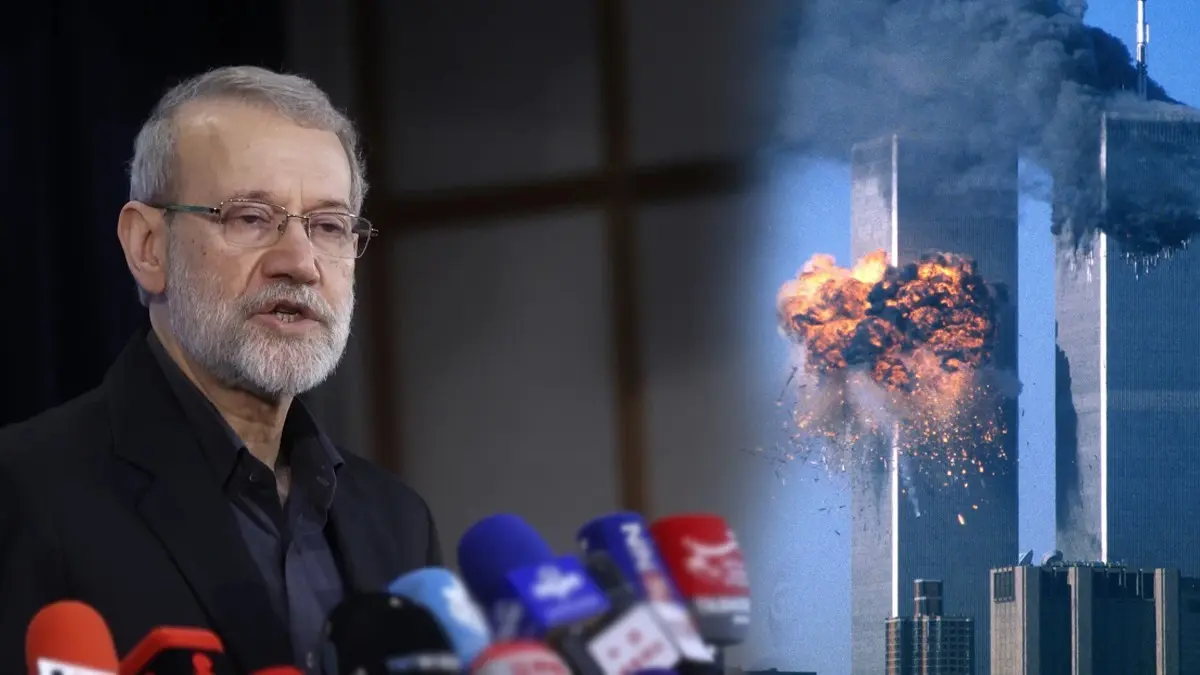
New Delhi: Amid the rapidly intensifying conflict in the Middle East, a senior Iranian security official- Ali Larijani- has alleged a conspiracy involving US lobbyists linked to the late financier Jeffrey Epstein.
Larijani claims this group is planning a 9/11-style attack intended to frame Tehran and provoke further conflict.
In a post on X, Ali Larijani, secretary of the Supreme National Security Council of Iran, said, "I’ve heard that the remaining members of Epstein’s network have devised a conspiracy to create an incident similar to 9/11 and blame Iran for it."
"Iran fundamentally opposes such terrorist schemes and has no war with the American people," Ali Larijani added.
Advertisement
Larijani asserted that Iran is currently acting in self-defense against what he characterized as unprovoked aggression from the United States and Israel.
He emphasized that Tehran will maintain its resistance, vowing to persevere in its military efforts to 'punish the aggressors' and ensure they are 'taught a lesson' for their actions.
Advertisement
The 9/11 Attacks
The September 11, 2001, attacks stand as one of the deadliest terrorist events in history, claiming nearly 3,000 lives. The coordinated assault involved 19 Al-Qaeda hijackers seizing four commercial aircraft.
Two were flown into the World Trade Center’s Twin Towers in New York, causing both to collapse, while a third struck the Pentagon. The fourth plane crashed in a Pennsylvania field after passengers fought back, thwarting an intended strike likely aimed at the U.S. Capitol.
Heightened tensions
The comments surface at a period of peak regional instability, as the confrontation between Iran and its opponents reaches a critical boiling point. This escalation is defined by a volatile mix of direct military threats and an increasingly aggressive war of words from both sides.
A war’s mounting toll
Since the war started, Iranian strikes have killed at least a dozen civilians in Gulf countries, most of them migrant workers.
In Iran, the International Committee for the Red Cross said more than 1,300 people have been killed so far.
Iran’s Health Ministry says 223 women and 202 children are among those killed, according to Mizan, the judiciary’s official news agency.
In Israel, 12 people have been killed by Iranian missile fire and more have been injured, including three on Sunday. At least 13 members of the U.S. military have also been killed since the war began; six of them died in a plane crash in Iraq last week.
Meanwhile, at least 820 people have been killed in Lebanon, according to its Health Ministry, and 850,000 have been displaced since Iran-backed Hezbollah started hitting Israel and Israel responded with strikes and sent additional troops into southern Lebanon.
Who Is Ali Larijani?
Born in Najaf, Iraq, in 1958 to a leading Iranian clerical family, veteran Iranian politician Ali Larijani re-emerged last year as one of the most powerful figures in the security hierarchy.
He has been managing a broad portfolio from nuclear negotiations to Tehran’s regional ties to its violent suppression of internal unrest.
Appointed in August as Secretary of the Supreme National Security Council (SNSC), Larijani has held senior jobs throughout a career marked by loyalty to Khamenei and a reputation for pragmatic relations with the system's often-rival factions.
In his early life, Larijani moved to Iran as a child and went on to earn a philosophy PhD.
Several of his brothers have also held senior establishment jobs including in the judiciary and foreign ministry.
One of Larijani's daughters was dismissed in January from a medical teaching position at the U.S. Emory University following protests by Iranian-American activists angered by his role in the suppression of that month's demonstrations.
His status as a trusted Khamenei strategist was underscored last month by a trip to mediator Oman to prepare for indirect nuclear talks with the U.S., as Washington built up its military forces in the Middle East to try to force concessions from Iran ahead of the strikes.