
Iran, Russia Condemn Attack On Venezuela, Spain Offers Mediation
On Saturday, January 3, 2026, the international community was jolted by a dramatic military escalation as U.S. President Donald Trump announced that the United States had conducted "large-scale strikes" against Venezuela.
- World News
- 7 min read

;'%3e%3cpath%20d='m8,15.99c4.41,0,7.99-3.58,7.99-7.99S12.41,0,8,0,0,3.59,0,8s3.58,7.99,7.99,7.99Z'%20style='stroke:%23fff;%20stroke-miterlimit:10;%20stroke-width:.02px;'/%3e%3cpath%20d='m3.08,3.37l3.82,5.11-3.84,4.15h.87l3.37-3.64,2.72,3.64h2.94l-4.04-5.39,3.58-3.87h-.86l-3.1,3.35-2.5-3.35h-2.94Zm1.27.64h1.35l5.97,7.99h-1.35l-5.97-7.99Z'%20style='fill:%23fff;'/%3e%3c/g%3e%3c/svg%3e)


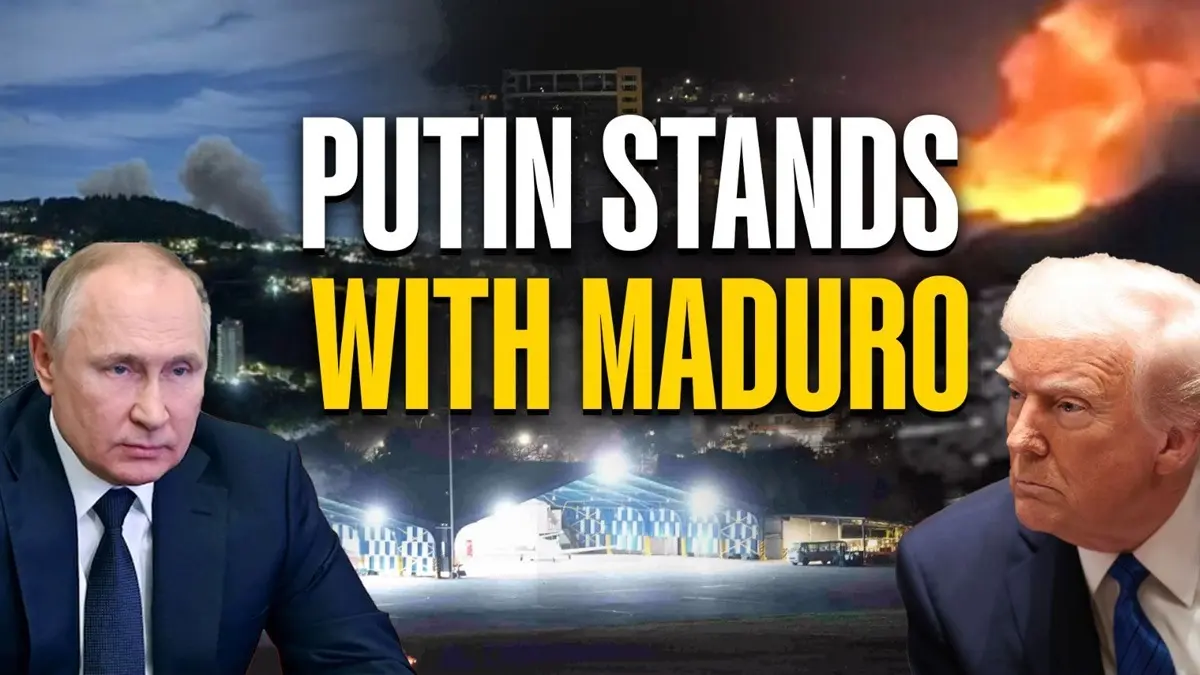
Caracas: US President Donald Trump announced that the United States had conducted "large-scale strikes" against Venezuela on Saturday, claiming that President Nicolás Maduro and his wife, Cilia Flores, had been "captured and flown out of the country.
The operation, which reportedly involved Delta Force units and airstrikes on key military installations in Caracas, including the Fuerte Tiuna complex and La Carlota airbase, has triggered a wave of diplomatic activity and movements across the globe.
The international community is reacting with a mixture of sharp condemnation and urgent calls for restraint after a dramatic escalation in South America.
‘Act of aggression’: Russia, Iran condemn attack
The Russian Foreign Ministry issued a statement, characterising the strikes as an "act of armed aggression" driven by "ideological hostility" rather than diplomacy.
Advertisement
President Vladimir Putin reaffirmed Moscow’s solidarity with the Venezuelan people, asserting that Venezuela must be guaranteed the right to determine its destiny without "destructive military intervention" from the outside.
"Now it is important to prevent further escalation and to focus on finding a way out of the situation through dialogue," the Ministry stated, emphasising that Latin America must remain a 'zone of peace'.
Advertisement
The Russian government stated it is "extremely alarmed" by reports suggesting that Venezuelan President Nicolás Maduro and his wife have been "forcibly removed from the country."
The Russian Foreign Ministry has issued an urgent call for "immediate clarification" regarding the current situation and the whereabouts of the Venezuelan leader. Officials warned that such actions, if confirmed, would represent an "unacceptable infringement on the sovereignty of an independent state.
Iran condemned the “U.S. military aggression” against Venezuela, with officials in Tehran labelling the attack a "clear violation of the fundamental principles of the United Nations Charter". Iran, a close ally of the Maduro administration, warned that such unilateral actions disrupt global security norms.
Colombia Deploys Forces Along Border
Colombian President Gustavo Petro urged an emergency meeting of the National Security Council, ordering the deployment of security forces along the 1,300-mile border.
While Petro rejected the "aggression against Venezuela's sovereignty", his primary concern remains the potential for a massive humanitarian spillover. Colombia has activated emergency response plans to manage an anticipated "mass influx of refugees" fleeing the chaos in Caracas.
Spain offers Peaceful Negotiations
The Spanish Foreign Ministry has offered to serve as a negotiator, urging a return to international law and a “peaceful, negotiated solution”. The Spanish Foreign Ministry has urged restraint and de-escalation after the attack in Venezuela.
Maintaining its refusal to recognise the July 28, 2024, election results, Spain offered to facilitate a peaceful, negotiated settlement and reaffirmed its commitment to supporting a democratic resolution for the nation.
Europe Calls for Diplomacy
Kaja Kallas, the EU High Representative for Foreign Affairs and Security Policy, confirmed she has spoken with U.S. Secretary of State Marco Rubio and the EU Ambassador in Caracas to discuss the unfolding situation in Venezuela.
She reiterated the European Union’s long-standing position that Nicolás Maduro lacks democratic legitimacy, while emphasising the EU's continued support for a peaceful political transition.
Kallas stressed that the principles of international law and the UN Charter must be respected under all circumstances, specifically calling for restraint from all involved parties.
She highlighted that the primary priority for the European Union at this time is ensuring the safety and security of EU citizens currently in Venezuela.
Italy And Germany
Foreign Minister Antonio Tajani confirmed that Rome is "closely monitoring" the situation, specifically focused on the safety of the large Italian community living in Venezuela. Prime Minister Giorgia Meloni is constantly being informed.
The German Foreign Ministry remains in constant contact with its embassy in Caracas. However, the city remains in a state of high tension, with reports of power outages and smoke rising from military sites. The crisis team is expected to meet later today.

According to reports, the whereabouts of Nicolás Maduro remain unconfirmed, though Venezuelan Vice President Delcy Rodríguez has demanded "proof of life".
While some regional allies, such as Argentina’s Javier Milei, have praised the move, the prevailing sentiment among world leaders is a desperate plea for de-escalation.
Cuba and Argentina
Cuba, a supporter of the Maduro government and a longtime adversary of the United States, called for the international community to respond to what President Miguel Diaz-Canel Bermudez called "the criminal attack." "Our zone of peace is being brutally assaulted," he said on X.
President Javier Milei of Argentina praised the claim by his close ally, Trump, that Maduro had been captured with a political slogan he often deploys to celebrate right-wing advances: “Long live freedom, dammit!”
Bolivia and Chile
Former Bolivian president Evo Morales, a close Caracas ally, said on X that he "forcefully rejected" the US "bombardment."
Chilean President Gabriel Boric called for a peaceful resolution and condemned the military action in Venezuela, adding that the crisis must be resolved through dialogue and multilateralism.
In a post on X, he said, "As the Government of Chile, we express our concern and condemnation of the military actions by the United States taking place in Venezuela, and we call for seeking a peaceful solution to the serious crisis affecting the country. Chile reaffirms its commitment to basic principles of International Law, such as the prohibition of the use of force, non-intervention, the peaceful settlement of international disputes, and the territorial integrity of States.
The Venezuelan crisis must be resolved through dialogue and the support of multilateralism, and not through violence or foreign interference."
Brewing Tensions
The U.S. military had been attacking boats in the Caribbean Sea and the eastern Pacific Ocean since early September. As of Friday, the number of known boat strikes is 35, and the number of people killed is at least 115, according to numbers announced by the Trump administration.
They followed a major buildup of American forces in the waters off South America, including the arrival in November of the nation’s most advanced aircraft carrier, which added thousands more troops to what was already the largest military presence in the region in generations.
On Friday, Venezuela said it was open to negotiating an agreement with the U.S. to combat drug trafficking.
Maduro also said in a pre-recorded interview aired Thursday that the U.S. wants to force a government change in Venezuela and gain access to its vast oil reserves through the pressure campaign.
Meanwhile, Iranian state television reported on the explosions in Caracas on Saturday, showing images of the Venezuelan capital. Iran has been close to Venezuela for years, in part due to their shared enmity of the U.S.