
Iran’s Araghchi Says Tehran to Respond to Us Peace Plan Within Days as Pentagon Prepares Fresh Strikes
Iranian Foreign Minister Abbas Araghchi says Tehran will respond within days to a US peace proposal as negotiations continue through mediators. The remarks come as reports say the Pentagon has prepared military options for possible renewed strikes on Iran, with regional tensions remaining high.
- World News
- 5 min read

;'%3e%3cpath%20d='m8,15.99c4.41,0,7.99-3.58,7.99-7.99S12.41,0,8,0,0,3.59,0,8s3.58,7.99,7.99,7.99Z'%20style='stroke:%23fff;%20stroke-miterlimit:10;%20stroke-width:.02px;'/%3e%3cpath%20d='m3.08,3.37l3.82,5.11-3.84,4.15h.87l3.37-3.64,2.72,3.64h2.94l-4.04-5.39,3.58-3.87h-.86l-3.1,3.35-2.5-3.35h-2.94Zm1.27.64h1.35l5.97,7.99h-1.35l-5.97-7.99Z'%20style='fill:%23fff;'/%3e%3c/g%3e%3c/svg%3e)


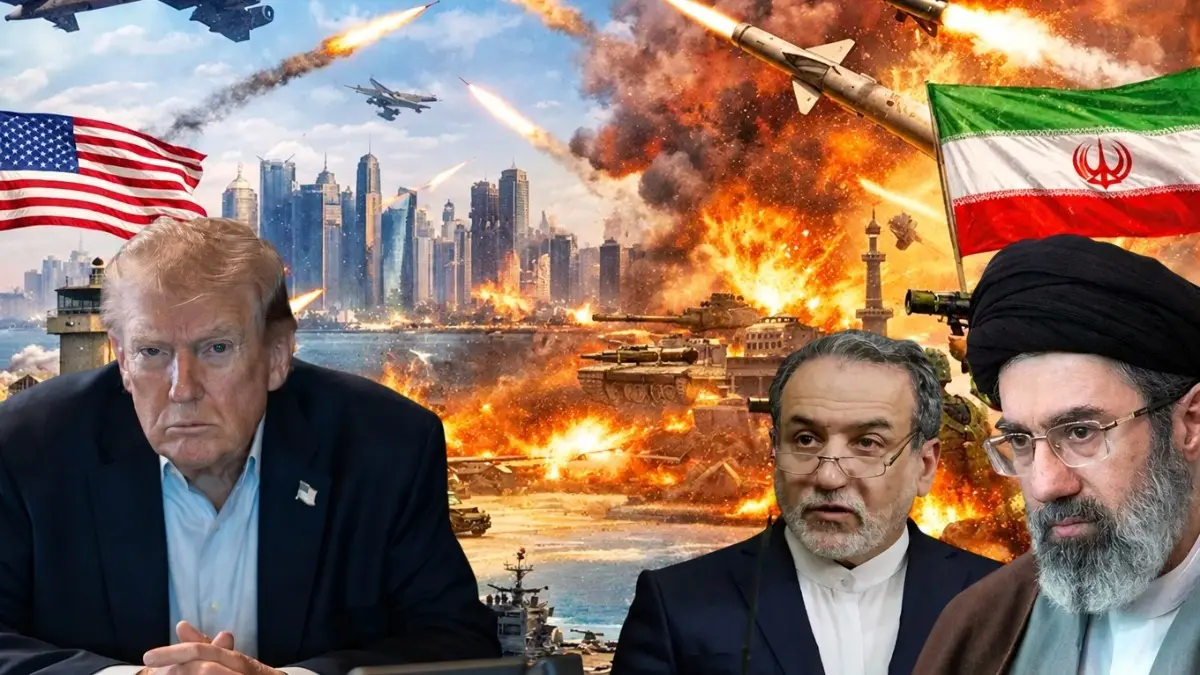
Tehran: Iranian Foreign Minister Seyyed Abbas Araghchi on Thursday said that Tehran will respond to a US peace proposal on the West Asia conflict “within the next few days” amid reports suggesting that Washington is preparing for military options for a possible resumption of major combat operations against the Islamic Republic.
Speaking after attending an event here, Araghchi said negotiations between Tehran and Washington remain ongoing, with messages continuing to be exchanged through mediators.
“The negotiation process is still ongoing and messages are being exchanged through mediators,” Araghchi said, as quoted by Iranian state media, Islamic Republic of Iran Broadcasting (IRIB).
He stated that Tehran had already presented its proposal, referring to the “Seven-Day Plan”, last month and had received Washington's views on it.
Advertisement
“We presented our plan, which we had presented under the title "Seven-Day Plan," and we also heard the American side's views on it,” Araghchi said.
“We are currently reviewing the views of the Americans and I think we will provide our response within the next few days,” he added.
Advertisement
His remarks came hours after an Axios report stating that US President Donald Trump has not made a final decision on resuming major combat operations against the Islamic Republic; however, the Pentagon has been instructed to prepare for possible fresh strikes.
According to Axios, citing US officials, the Pentagon instructed US Central Command (US CENTCOM) several days ago to conclude preparations for resuming major combat operations in Iran. The directive did not set a specific date for launching strikes.
US and Israeli officials told Axios that renewed combat operations could take place before the US midterm elections, scheduled to be held on November 3, and possibly ahead of Israeli elections, which are expected a week earlier.
If major combat operations resume, they are expected to include extensive strikes on Iranian energy, infrastructure and nuclear targets, Axios reported, citing sources.
“The Department's job is to develop and present military options to the President,” a Pentagon official told Axios.
A White House official said Trump has all options available at any time.
“The U.S. is in a very strong position with control of the Strait of Hormuz and the Iranian economy collapsing. Iran has been decimated, and things will go one of two ways: the easy way or the hard way,” the official told Axios.
“President Trump holds all the cards and will do whatever is best for the United States,” the official added.
Last month, during the 81st United Nations General Assembly (UNGA), Araghchi presented a proposal for reopening the Strait of Hormuz under a seven-day plan.
Araghchi had said the timeline for the proposed plan would begin once the United States accepted it.
According to Al Jazeera, he said Washington would need to take certain actions under the plan, which could be completed within four to five days.
“If they accept this plan tomorrow, the seven days will start from tomorrow,” Araghchi said.
He said the required steps were already part of a memorandum of understanding and would not be difficult to implement. If the US fulfilled the conditions, he said, the Strait of Hormuz could be reopened on the sixth day, followed by renewed talks between Tehran and Washington on the seventh day.
However, Trump had earlier rejected the proposed, as reported by the Wall Street Journal.
According to Axios, negotiations between the US and Iran have made no progress, while Qatari mediators are still waiting for an Iranian response to a US counterproposal that included demands for nuclear concessions.
“The discussion about possible resumption of major combat operations in Iran has increased. The chances of it happening before the elections is not high but we don't rule it out.
After the midterms the chances of it happening increase significantly,” a second Israeli official told Axios.
Axios also reported that Trump's national security team met at Camp David on Friday for several hours to discuss the war and other issues. An Israeli official said part of the meeting focused on a possible resumption of major combat operations in Iran.
US Secretary of State Marco Rubio said after the meeting that it focused on “long-term” foreign policy planning.
Trump on Wednesday spoke with Israeli Prime Minister Benjamin Netanyahu, marking their second call in a few days after they had barely spoken for several weeks.
A US official said Trump and Netanyahu spoke about “remembrance and respect for the victims of the October 7 massacre.”
The call came after Netanyahu held a meeting with his national security team on Iran, according to the first Israeli official cited by Axios. Netanyahu also spoke with Rubio on Monday.
If major combat operations resume, they are likely to involve the US and Israel working in tandem, with the Israeli military participating, according to the report.
The two Israeli officials said the Iranian regime is desperate and paranoid, which could lead Tehran to strike first. They said Iran has suffered two surprise attacks and does not want to experience a third.
A renewed war could also affect Israeli elections, as Iran would likely fire hundreds of ballistic missiles at Israel in retaliation, Axios reported.
Trump had, earlier, told aides he expected to resume bombing Iran after the November midterm elections.
This followed Trump's open threat of annihilating Iran during his speech to the UNGA.